Scripting in Sphinx config
 Sergey Nikolaev··Updated
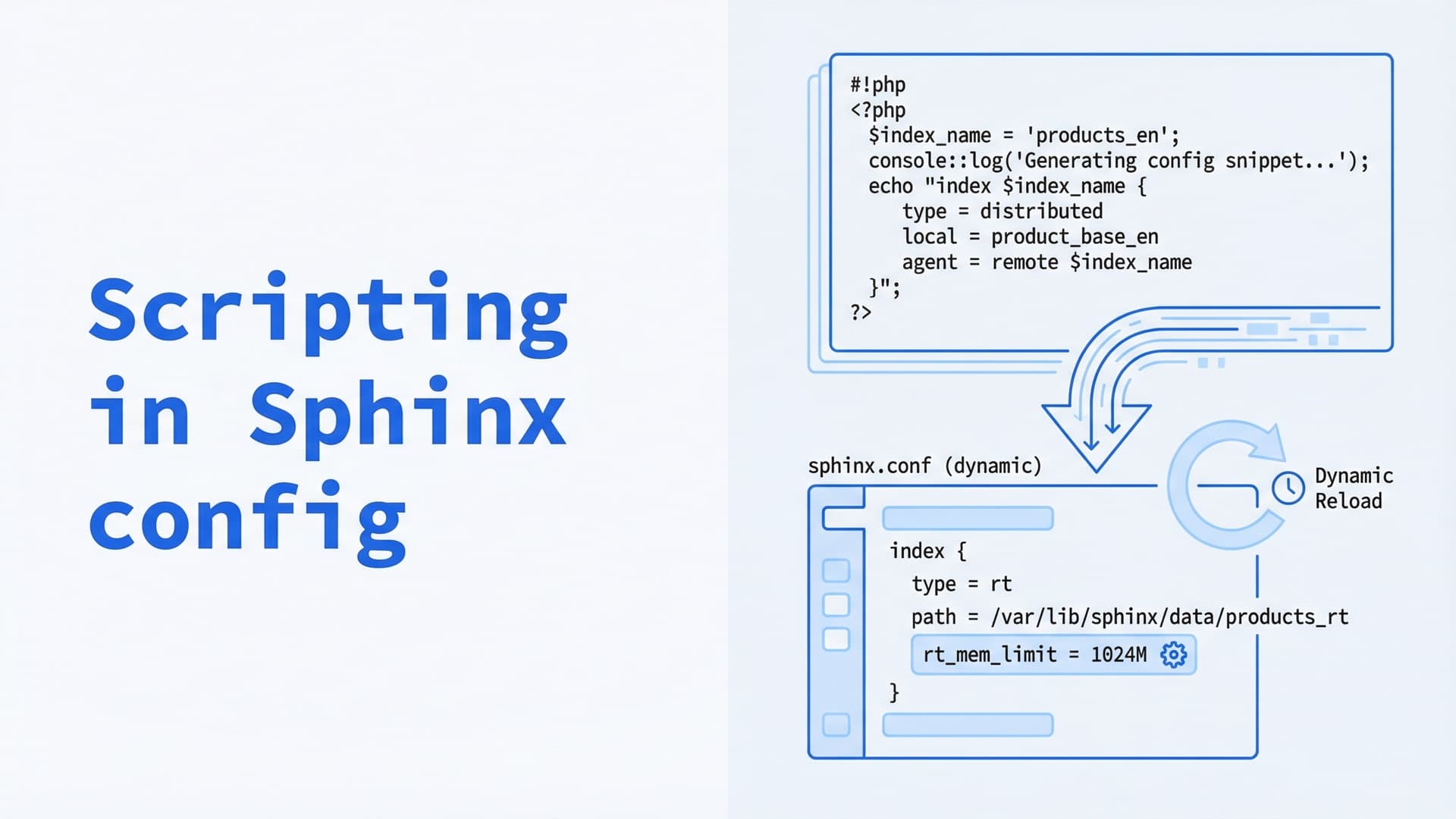
Did you know that Sphinx config enables you to use shebang syntax? Here is an example of how useful it can be in some cases: imagine you have 3 tables with identical structure that you would like to index into 3 indexes one per table. You can just make a php script which would do this and use it as a Sphinx config instead of describing each source/index separately:
#!/usr/bin/php
<?php

$source = "source [TABLE]_src {
    type      = mysql
    sql_host    = localhost
    sql_user    = user
    sql_pass    = password
    sql_db      = db
    sql_port    = 3306

    sql_query = SELECT [TABLE].id, title, body FROM [TABLE] WHERE [TABLE].id >=\$start and [TABLE].ID <=\$end
    sql_query_range = SELECT MIN(id), MAX(id) FROM [TABLE]
    sql_range_step = 1000
}
";

$index = "index [TABLE]_idx {
    source      = [TABLE]_src
    path      = /path/to/indexes/idx_[TABLE]
}
";

$tables = array('Cats', 'Dogs', 'Mouses');

foreach ($tables as $table) {
	echo str_replace('[TABLE]', $table, $source)."\n";
        echo str_replace('[TABLE]', $table, $index)."\n";
}
?>

searchd {
    listen          = localhost:9306:mysql41
    pid_file        = /path/to/pid_file.pid
}
Now you can use this file just like a normal sphinx config:
snikolaev@a5530:~$ searchd -c sphinx.conf
Sphinx 1.11-id64-dev (r2500)
Copyright (c) 2001-2010, Andrew Aksyonoff
Copyright (c) 2008-2010, Sphinx Technologies Inc (http://sphinxsearch.com)

using config file 'sphinx.conf'...
Need help with search infrastructure? See how Ivinco's development team can help →
Frequently Asked Questions
How does shebang scripting work in Sphinx configuration?
Sphinx config files support shebang syntax (#!/usr/bin/php or any interpreter). When Sphinx reads a config starting with a shebang, it executes the script and uses its stdout as the actual configuration. This lets you generate source and index definitions dynamically — useful when you have dozens of identically structured tables that each need their own index.
When should you use dynamic Sphinx config generation?
Use scripted configs when you have multiple tables with identical structure that each need separate indexes, or when your index list changes based on external data (new tenants, new data sources). For static setups with a few indexes, a plain config file is simpler and easier to debug.
Can you use any scripting language for Sphinx config generation?
Yes — any language with a shebang-compatible interpreter works: PHP, Python, Bash, Perl, Ruby. The script just needs to output valid Sphinx config text to stdout. The searchd section can sit outside the script block as plain text.
Related Reading
Related posts
Sphinx in Action: Fuzzy matching and 2nd pass query
This is a post from a series of posts called "Sphinx in Action".

Sphinx in Action: Top related queries
This is a post from a series of posts called "Sphinx in Action".

Sphinx in Action: Autocomplete
This is a post from a series of posts called "Sphinx in Action".