 Back
Back
Eugene Levitin
April 7, 2026 ・ Agentic Commerce
Who Captures the Value When AI Shops for You?
We're building UCP integrations for WooCommerce at Ivinco. Every merchant conversation lands on the same question: "If AI agents are sending me traffic, who am I paying for it?"
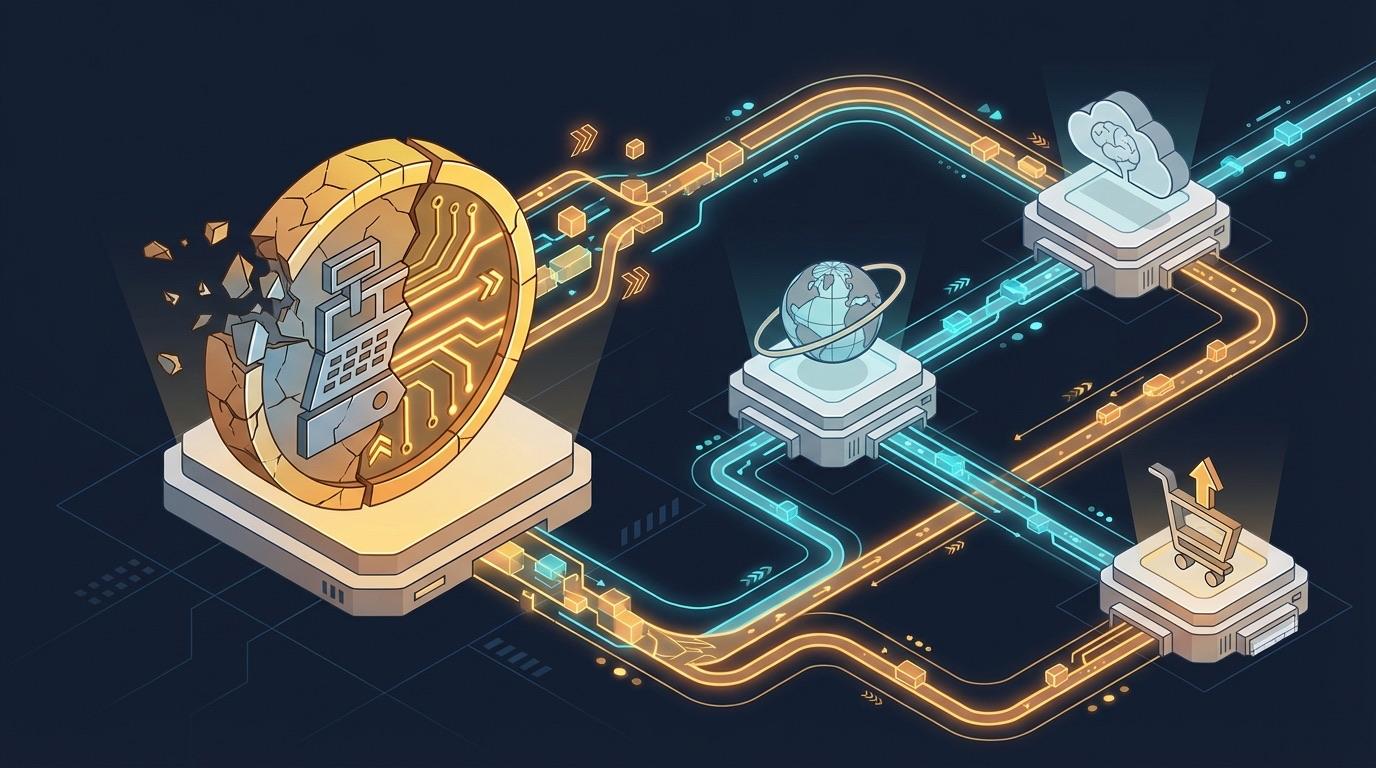
In January, the answer was clear — OpenAI charged a 4% fee on every ChatGPT checkout. By March, they killed it. The entire Instant Checkout model lasted about six weeks.
That speed tells you something. The last post showed that demand is building — 44% of consumers are comfortable, 94% who try it are satisfied. But nobody has figured out how to monetize the middle. I spent a week tracing where the distribution tax actually lands when AI agents mediate the sale.
The Fee That Lasted Six Weeks
On January 26, 2026, OpenAI launched Instant Checkout inside ChatGPT. The Information reported a 4% fee on every completed sale. A Shopify spokesperson confirmed it.
On a $100 order, that meant roughly $4 to OpenAI, $3.20 to Stripe, $2 to Shopify. A total effective take rate of 9.2%. OpenAI followed it two weeks later with advertising inside ChatGPT at $60 CPM and a $200,000 minimum spend. Two monetization layers on the same shopping interaction, introduced within fourteen days.
By March 9, OpenAI pulled the plug. Instant Checkout was dead. CNBC reported that despite millions of merchants on partner platforms, only about a dozen were actually using it. Walmart found conversion rates 3x lower than its own website. Tax regulations and fraud prevention created compliance obstacles OpenAI hadn't anticipated. The company admitted the feature "did not offer the level of flexibility that we aspire to provide."
The replacement: product discovery stays in ChatGPT, but checkout redirects to the merchant's own site. No transaction fee. OpenAI went from charging 4% to charging nothing — in six weeks.
What the Market Said
Before Instant Checkout died, Marketplace Pulse analyzed the take rates across platforms. Amazon: 25-30% (referral fees plus the advertising you basically have to buy). TikTok Shop: around 8%. Etsy: 6.5%. ChatGPT at 4% looked cheap.
But Google's UCP — live since February 2026 with Etsy, Wayfair, Shopify, and Target — charges nothing. Microsoft's Copilot Checkout, launched January 2026: also zero. When two of the three major AI shopping platforms charge no transaction fees, the third can't hold at 4%. The market corrected in six weeks.
This wasn't just a pricing failure. Google and Microsoft already run ad businesses generating tens of billions — commerce checkout is a feature that keeps users inside their ecosystems. OpenAI had neither the ad revenue to subsidize free checkout nor the merchant adoption to justify the fee. Sacra's analysis estimates OpenAI projected $1 billion in 2026 from monetizing free users through ads and checkout fees. The checkout half of that equation is now gone.
What Happens to $50 Billion in Advertising?
Amazon made roughly $50 billion in advertising revenue in 2025 — up 18% year-over-year. Almost all of it comes from merchants paying to show up in search results on Amazon's own platform. Sponsored product listings. Headline search ads. The tax you pay to be visible where people are already shopping.
Now imagine an AI agent shopping for your customer. The agent doesn't see banner ads. It doesn't care about sponsored placement. It parses product data — specs, reviews, price, availability, return policies — and picks the best match.
Bain's February 2026 analysis estimates that 60-65% of searches are now "zero-click" — users get answers from AI summaries and never visit the retailer's site. SparkToro's tracking shows that figure rose from 58.5% to 65% in twelve months. If agent-mediated shopping follows the same pattern, merchants won't need to buy ads to be discovered. They'll need structured data.
Amazon's response has been telling. They've blocked all OpenAI crawlers from accessing their site. Six hundred million product listings, invisible to ChatGPT. They built Rufus — their own AI shopping agent — as a closed loop inside the Amazon ecosystem. According to company reports, Rufus reaches 250-300 million users with 60% higher conversion rates than standard search. Amazon doesn't need open protocols. It IS the protocol.
This matters directly for the work we're doing at Ivinco. We're building UCP integrations for WooCommerce — the platform Amazon's walled garden leaves behind. If structured data is the new ad spend, the stores that expose their product feeds to AI agents gain a distribution channel that costs zero in fees. The stores that don't stay invisible.
Kearney's retail disruption report warned of 500 basis points of EBIT erosion for retailers who aren't ready for this shift. That's five percentage points of operating margin. For a retailer running at 10% EBIT, that's half their profit.
Ads Aren't Dying — They're Moving Inside the Conversation
When I started mapping this out for our UCP work, I assumed the pitch would be straightforward: AI agents skip ads, so your structured data matters more than your ad budget. I pulled Criteo's data, Microsoft's shopping metrics, and OpenAI's own announcements into the same spreadsheet. The "agents kill ads" narrative fell apart within an hour. Advertising isn't shrinking — the surface is migrating from search results into AI conversations.
Criteo launched what they call an "Agentic Commerce Recommendation Service" in February 2026. They built an MCP integration that makes merchant inventory directly accessible to AI shopping assistants. In January testing, they reported 60% improvement in recommendation relevancy compared to product-description-only approaches. Their scale: 720 million daily shoppers, $1 trillion in annual transactions, 4.5 billion product SKUs. This isn't a startup experiment — this is ad tech infrastructure rebuilding itself for a world where the customer is an algorithm.
The conversion data makes the case sharper. Shopping journeys through Microsoft's Copilot are 33% shorter than traditional search and 194% more likely to result in a purchase. An ad surface where users convert at nearly 3x the rate of traditional search isn't less valuable. It's more valuable.
Which makes OpenAI's position harder to square. They publicly stated that "ads do not influence the answers ChatGPT gives you" — then launched ads inside ChatGPT on February 9, 2026. For now, only in the free tier. But consumers aren't buying the separation. More on that in a moment.
Merit-Based Shopping vs. the Money
Shopify's CEO Tobi Lutke called this "merit-based shopping" — the idea that AI agents will recommend products based on quality and fit rather than ad spend. The best product wins, regardless of marketing budget.
The death of Instant Checkout should reinforce that vision. No transaction fees means no pay-to-play at the checkout layer. But OpenAI kept the other monetization layer — ads inside ChatGPT at $60 CPM, launched February 9. With checkout revenue gone, advertising is now OpenAI's only commerce monetization path.
If the discovery layer is funded by advertising, how is it merit-based? PartnerCentric's survey found that 78% of consumers already believe AI recommendations are influenced by advertisers. OpenAI says ads don't affect answers. But the economic incentive — and consumer perception — pull in one direction.
The way I see it: the checkout layer is free. The discovery layer won't be. Google did it with search ads. Amazon did it with sponsored listings. The pattern repeats — whoever controls the point of discovery extracts value from the point of sale. The checkout fee was one extraction mechanism. It failed in six weeks. Advertising is the other. It's working.
Where the Value Lands
Here's the short answer to that merchant question. Today, no AI platform charges you a transaction fee. OpenAI tried and failed. Google and Microsoft never started. The checkout layer is free.
But the discovery layer isn't. Criteo's MCP integration is the clearest signal — ad tech is already rebuilding for agent-mediated commerce. The dollars are moving from search ads to in-conversation recommendations, and they're moving now, not waiting. Amazon's decision to block crawlers and build Rufus internally makes more strategic sense to me every week — when you control $10 trillion in GMV, you don't join open protocols.
The discovery layer moved from search bars to AI agents. The extraction followed. Same game, new plumbing.
Every analyst report, every platform announcement frames agentic commerce as a consumer story. But $15 trillion in annual B2B procurement runs on purchase orders, vendor catalogs, and compliance rules. Nobody on that side of the economy needs to "enjoy shopping." That's where I want to look next.
This is post 10 of 12 in "The Agentic Commerce Investigation." Next: B2B Is the Real Agentic Commerce Story.
Last updated: April 7, 2026 By Eugene Levitin, CEO at Ivinco
Frequently Asked Questions
What happened to ChatGPT's 4% Instant Checkout fee?
OpenAI launched Instant Checkout with a 4% merchant fee on January 26, 2026. By March 9, they killed it. Only about a dozen merchants were using it, Walmart reported 3x lower conversion rates than its own site, and compliance issues proved unworkable. OpenAI now redirects shoppers to merchant websites for checkout with no transaction fee.
Do any AI platforms charge merchants for checkout?
No. As of April 2026, all three major AI shopping platforms — ChatGPT, Google (UCP), and Microsoft (Copilot Checkout) — charge zero transaction fees for AI-mediated purchases. Google and Microsoft never charged; OpenAI tried and retreated after six weeks.
Will AI agents replace advertising in ecommerce?
Not exactly. AI agents bypass traditional ad placements like sponsored search results, but advertising is moving inside AI conversations. Criteo launched an agentic commerce recommendation service, and OpenAI sells ads inside ChatGPT at $60 CPM. The ad budget is being redirected from search results to conversational surfaces, not eliminated.
How do Amazon seller fees compare to AI shopping platforms?
On $1 million in sales, an Amazon seller pays approximately $250,000-$300,000 in combined referral fees and advertising costs (25-30% effective take rate). AI shopping platforms currently charge no transaction fees, though merchants may face future advertising costs to influence AI recommendations.
Does advertising influence ChatGPT product recommendations?
OpenAI states that "ads do not influence the answers ChatGPT gives you." However, with Instant Checkout dead, advertising is OpenAI's only commerce revenue stream, and PartnerCentric's survey found that 78% of consumers already believe AI recommendations are influenced by advertisers.
- Agentic Commerce
- AI
- Ecommerce
- Advertising
- Revenue Models

CEO, Ivinco
Building Ivinco since 2009 — a Kubernetes consulting firm with 20+ senior engineers managing 1,350+ servers worldwide. Currently exploring how AI agents are reshaping e-commerce infrastructure.
 Tweet
Tweet Share
Share Share
Share