 Back
Back
Eugene Levitin
March 28, 2026 ・ Agentic Commerce
The Trust-Action Gap: Why 'Comfortable' Doesn't Mean 'Buying'
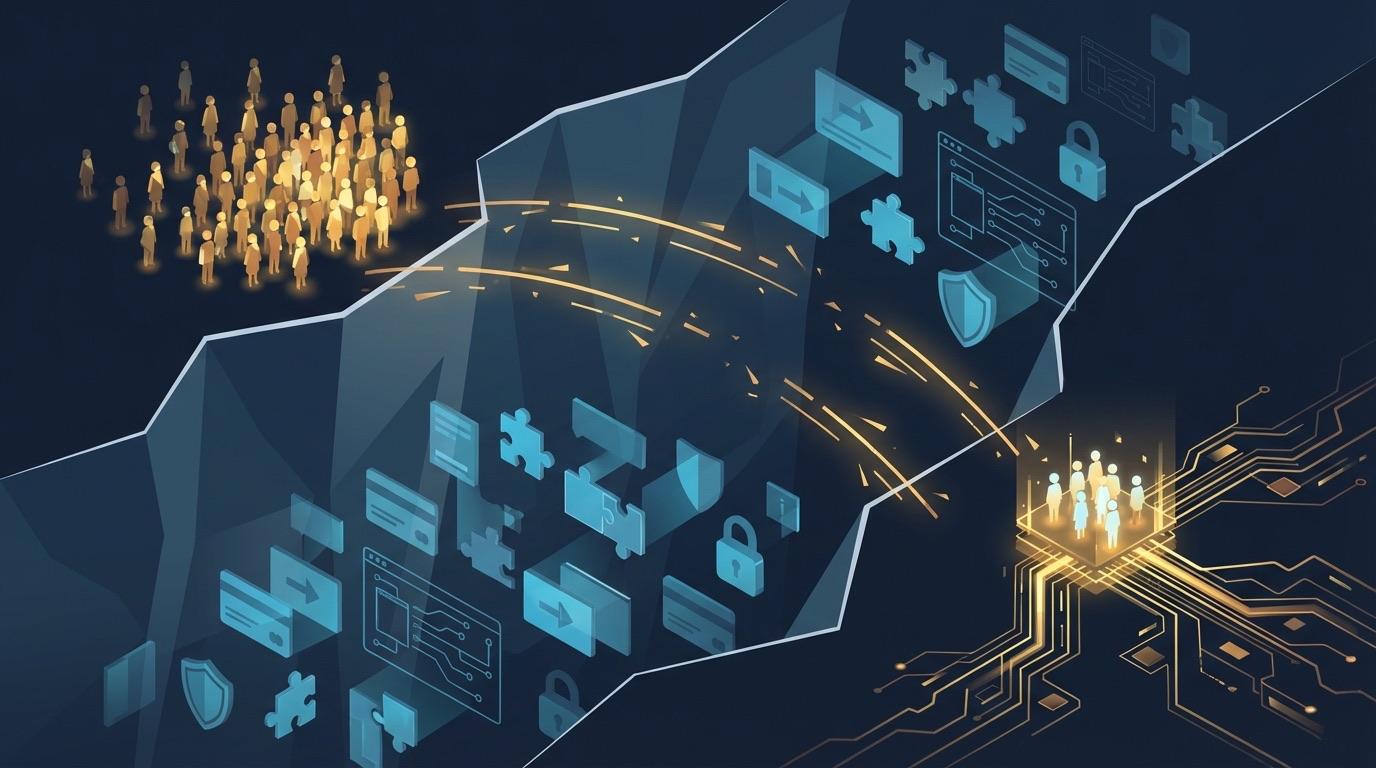
In the last post, I mapped out which product categories consumers will delegate to AI agents and which ones they won't. The data was fairly clean — groceries and reorders go to agents, fashion and luxury stay human, electronics sit in between. But one number kept bothering me after I finished writing.
Forty-four percent of Americans say they'd let AI browse for them. Only 8% have actually let AI complete a purchase.
That's roughly a 5-to-1 ratio between "I'm comfortable with this" and "I've actually done it." I've been staring at agentic commerce data for months now, and I still can't figure out whether this gap means the market is early or the market is stuck.
TL;DR: The trust-action gap in AI shopping is the difference between 30-44% who say they're comfortable and the 8-13% who've actually bought. But the barrier isn't what you'd think. It's not trust — 94% of people who try AI-assisted purchasing are satisfied. It's activation energy: the friction of the first purchase. And the underrated force that will close this gap isn't better AI — it's decision fatigue. When you're drowning in 35,000 daily decisions and abandoning 70% of your carts, the question isn't whether you trust the agent. It's whether you're tired enough to let it help.
The Numbers That Don't Add Up
Here's the gap, laid out across multiple surveys so you can see it's not just one outlier data point.
Worldpay's 2025 report found that 44% of Americans would allow AI to browse for them — rising to 59% among 18-34 year-olds. But only 20% feel "very comfortable" with AI completing a purchase on their behalf, and just 6% would grant complete autonomous control.
PartnerCentric's survey tells a similar story: 49% of consumers tried AI shopping tools in 2025, but only 13% let AI handle the actual checkout. Salsify's 2026 research found that just 14% trust AI recommendations alone — 27% trust them but verify with other sources first.
I've been testing agentic commerce tools for this entire series. I've used ChatGPT to find products, Perplexity to compare specs, Gemini to check prices. And even after all that testing, I've completed exactly one AI-assisted purchase — the toddler pajamas I wrote about in Post 1. I keep stopping at the same point: the moment the AI says "ready to buy?" and I think, "let me just go check the actual store first." I'm part of the gap.
The Obvious Explanation Is Wrong
The default story is straightforward: people don't trust AI to buy things for them. And yes, the concern data supports that narrative if you squint at it. According to PartnerCentric, the numbers look damning — 76% concerned about data use, 60% won't trust chatbots with payment info, 78% worried about scams.
But here's what kept nagging at me. If trust were the real barrier, the 13% who do try it should be unhappy. They took the risk, got burned, confirmed everyone's fears. That's what a trust problem looks like.
They're not. They're absurdly high.
According to the same PartnerCentric survey, 94% of consumers who've made AI-assisted purchases are satisfied with the results. Not "somewhat satisfied." Satisfied. Adobe's holiday shopping data showed that AI-assisted purchases had a 1.2% lower return rate year-over-year, and 68% of consumers said they were less likely to return items found through AI recommendations. Only 12% of AI shoppers reported any purchase regret.
So the pattern is: 8-13% try it, and 94% of that group are satisfied. The overwhelming majority never try — but the ones who do aren't getting burned. Something other than trust is keeping the rest on the sideline.
The Real Barrier: Activation Energy
Think about what has to happen for someone to make their first AI-assisted purchase.
You have to type a shopping query into ChatGPT or Perplexity instead of going to Amazon or Google like you've done thousands of times. Then evaluate product recommendations without the familiar review format. Enter payment information into a new interface. And do all of this for the first time, alone, with nobody showing you it works.
I noticed this in my own testing. It's not that I distrusted the results — I wrote about how ChatGPT's product matching actually works well. The friction was more mundane. I'd find a product, think "that looks right," and then reflexively open a new tab to check the store directly. Habit, not distrust.
I think there's a useful analogy to mobile payments. When Apple Pay launched, surveys showed high "comfort" with the concept. Adoption was slow for years. Not because people didn't trust Apple with their credit card — they already did. The barrier was the same kind of activation energy: you had to set it up, you had to remember to use it at checkout, you had to trust that the tap would work in front of the cashier. Once people used it three or four times, it became default behavior. The 94% satisfaction rate in AI shopping suggests we're looking at the same pattern.
Wildfire's survey found that 75% of consumers would trust AI shopping more if paired with cashback or bonus incentives. That's telling — people aren't asking for better security or more transparency. They're asking for a reason to bother trying. The 94% satisfaction rate suggests the product sells itself after the first use. The hard part is that first use.
Decision Fatigue: The Demand Nobody's Measuring
Here's the part of this story I'm most interested in — the demand side. In the first eight posts of this series, I've mostly written about supply: protocols, platform integrations, merchant readiness. But what's actually going to push those 44% of comfortable-but-passive consumers to make their first purchase?
I keep coming back to exhaustion.
According to research cited by Cornell and CNBC, the average American makes roughly 35,000 decisions per day — 226 of them about food alone. The Journal of Consumer Psychology found that conversion peaks when shoppers see 4-6 options and drops sharply after 7-9 comparisons, as cognitive fatigue sets in.
The evidence of this fatigue is already visible in shopping behavior. Baymard Institute's meta-analysis puts the average cart abandonment rate at 69.57% — nearly seven out of ten shopping sessions end with someone giving up. Salsify's research found that 89-96% of consumers spend at least 10 minutes researching purchases, with 20-32% spending hours or even days.
And then there's the classic jam study by Iyengar and Lepper: when shoppers were offered 6 jam options, 30% purchased. When offered 24 options, only 3% did. More choice didn't help — it paralyzed.
Here's my read on how these pieces connect. I haven't seen a single agentic commerce forecast — not Morgan Stanley's, not McKinsey's, not Worldpay's — that factors in decision fatigue as an adoption driver. They model trust curves and protocol adoption rates. But 69.57% of shopping sessions already end in abandonment. Consumers aren't finishing purchases with the tools they have now. The question they're answering when they say they're "comfortable" with AI shopping isn't "do I trust this?" It's closer to "am I tired enough to try something different?" — and the cart abandonment data says a lot of them already are.
The First-Purchase Flywheel
If this is really an activation energy problem, then everything depends on the first purchase. What happens after that?
According to PartnerCentric, people who've tried AI shopping report time savings as the top benefit — 34% call it the primary value. They save an average of 6.2 hours per purchase cycle (PartnerCentric measures this from first search to completed checkout). And 67% say they found deals they wouldn't have discovered through their usual shopping methods.
That's a strong retention signal. But where does the first purchase actually happen? Bain's research found that consumers trust retailers' on-site AI agents 3x more than third-party agents like ChatGPT or Perplexity. If I had to bet, I'd say the first AI-assisted purchase for most consumers won't happen in a chatbot — it'll happen inside an Amazon or Target checkout flow that quietly introduces AI product matching. The retailer already has the payment info, the account, the return policy trust. The activation energy is lowest there.
But here's what makes me less certain about that prediction. Forrester found 54% of consumers aren't comfortable sharing personal information with generative AI — even on sites they already use. And PartnerCentric found that 78% believe AI recommendations are influenced by advertisers. Only 2% have actually been scammed through AI shopping, but the perception gap between "2% scammed" and "78% worried about scams" is enormous.
I keep going back and forth on this. The 94% satisfaction rate says the product works. The 3x retailer trust advantage says the distribution channel exists. But the perception gap — 78% suspicious of advertiser influence — means even the right channel might not be enough. Maybe the first purchases won't come from the cautious 44% at all. Maybe they'll come from the exhausted 70% who are abandoning carts anyway and have nothing left to lose.
What This Means for the Series
Nine posts into this investigation, and the picture keeps getting messier. I started by testing which stores AI recommends, expecting to find a simple platform winner. Instead I found an infrastructure gap, a country that leapfrogged everyone, a walled garden that doesn't need open protocols, courts making rules faster than the industry, protocols fighting each other, and consumers who are simultaneously the biggest users and biggest skeptics of AI shopping.
Now I'm looking at a 94% satisfaction rate hidden behind a 5-to-1 comfort-to-action gap, and I honestly don't know if that means this market is 18 months away or 5 years away. The satisfaction data says it works. The activation energy data says almost nobody will find out on their own.
There's one piece I haven't touched yet, and it might be the most important: when people do start crossing this gap — and the satisfaction numbers say they eventually will — who actually makes money? Right now, Amazon's ad business pulls in $50 billion a year because shoppers browse and click. If AI agents skip the browsing and go straight to the best match, that $50 billion is up for grabs. I don't know who captures it. That's what I want to figure out next.
Frequently Asked Questions
What is the trust-action gap in AI shopping?
The trust-action gap describes the difference between the 30-44% of consumers who say they're comfortable with AI-assisted shopping and the 8-13% who have actually completed an AI-assisted purchase. According to Worldpay and PartnerCentric surveys from 2025, this 3-5x gap suggests that stated comfort doesn't translate into purchasing behavior — the barrier is activation energy, not trust.
Why are so few consumers buying through AI if they say they trust it?
The primary barrier is activation energy — the friction of a first-time behavior change — not distrust. According to PartnerCentric, 94% of consumers who make AI-assisted purchases are satisfied with the results, and Adobe reports that AI-assisted purchases have 1.2% lower return rates. The pattern resembles early mobile payment adoption: high stated comfort, slow initial uptake, rapid acceleration once the first experience succeeds.
What is driving demand for AI shopping agents?
Decision fatigue is the underrated demand driver. Research from Cornell shows Americans make approximately 35,000 decisions daily, while Baymard Institute reports a 69.57% cart abandonment rate. The Journal of Consumer Psychology found that shoppers experience cognitive fatigue after comparing 7-9 options. AI agents reduce this decision load — PartnerCentric data shows AI shoppers save an average of 6.2 hours per shopping cycle.
How can merchants help customers make their first AI purchase?
Bain's 2026 research found consumers trust retailers' on-site AI agents 3x more than third-party agents like ChatGPT or Perplexity. The most effective strategy is embedding AI assistance inside existing checkout flows where customers already have accounts and stored payment information. Wildfire's data shows that 75% of consumers would trust AI shopping more when paired with cashback or bonus incentives.
Do consumers regret AI-assisted purchases?
Only 12% of AI shoppers report any purchase regret, according to PartnerCentric. Adobe's holiday shopping data found that 68% of consumers are less likely to return items discovered through AI recommendations, with AI-assisted returns dropping 1.2% year-over-year. The high satisfaction and low regret rates suggest that the barrier to AI commerce is getting consumers to try it — not convincing them to keep using it.
- Agentic Commerce
- AI
- Ecommerce
- Consumer Behavior
- Trust

CEO, Ivinco
Building Ivinco since 2009 — a Kubernetes consulting firm with 20+ senior engineers managing 1,350+ servers worldwide. Currently exploring how AI agents are reshaping e-commerce infrastructure.
 Tweet
Tweet Share
Share Share
Share