 Back
Back
Eugene Levitin
March 24, 2026 ・ Agentic Commerce
The Protocol Wars: UCP vs. ACP vs. MCP in Agentic Commerce
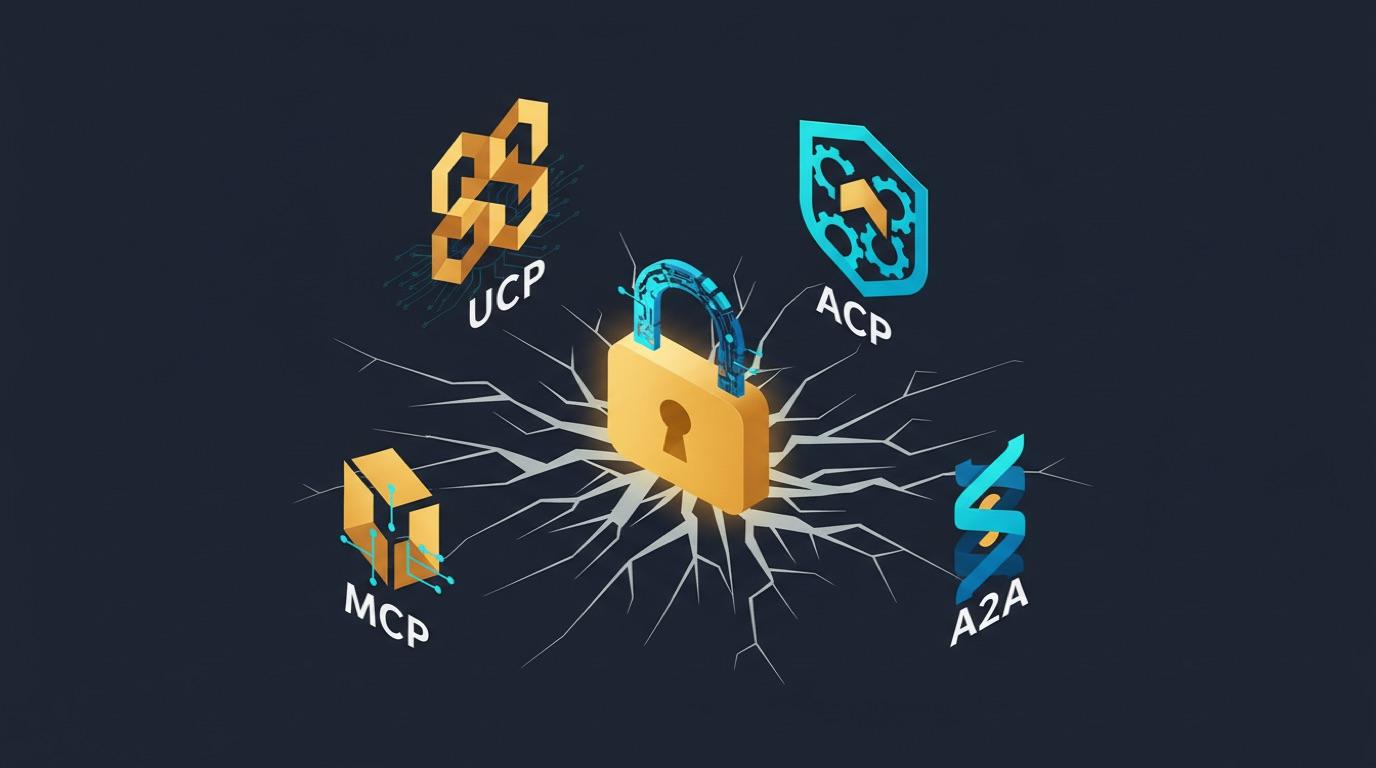
Everyone keeps asking which protocol will win. UCP? ACP? MCP? I spent three weeks mapping the competing standards, reading IETF drafts, and tracking what actually shipped. The answer I landed on surprised me: the protocol question is a sideshow. The real war is happening underneath it.
TL;DR: Four protocols — UCP (Google/Shopify), ACP (OpenAI/Stripe), MCP (Anthropic), and A2A (Google) — compete to become the HTTP of AI shopping. But OpenAI just killed its flagship checkout implementation after Walmart revealed 3x worse conversion rates. Meanwhile, Visa, Mastercard, and Cloudflare are quietly building the trust infrastructure that will matter more than any protocol: cryptographic identity, behavioral certification, and verifiable intent. We're in the pre-SSL era of agent commerce, and the padlock icon hasn't been invented yet.
Since I started investigating how AI agents actually shop, one thing has become clear: the technical plumbing between agents and stores is the bottleneck. AI commerce traffic is up 805%, but conversion from AI surfaces is 86% worse than affiliates, according to MetaRouter (2026). The protocols are supposed to fix that. Here's what I found when I dug into whether they actually can.
What Are the Four Competing Protocols?
Four distinct protocols have emerged to connect AI agents with commerce, each backed by different tech giants and solving different parts of the problem. According to Stripe's NRF 2026 report, roughly 75% of retail technology leaders are already implementing or planning agentic commerce integration — but there's no agreement on which standard to use.
Let me try to untangle what each one is actually for.
UCP — Universal Commerce Protocol (Google + Shopify)
UCP handles the full shopping journey — browsing, cart, checkout, fulfillment tracking. Google and Shopify lead it. As of March 19, 2026, Google expanded UCP with three new capabilities: Cart (multi-item baskets per store), Catalog (real-time product data including variants and inventory), and Identity Linking (loyalty programs travel with the shopper across AI surfaces).
The coalition is big: 20-plus partners including Stripe, Visa, Mastercard, Amazon, Target, Best Buy, Walmart, and Macy's. When Walmart integrated into Google Gemini via UCP in January, consumers could browse inventory and complete purchases without leaving the AI interface.
UCP's pitch is interoperability. One integration, every AI surface. Shopify calls this "merit-based shopping" — agents recommend based on product quality, not ad spend.
ACP — Agentic Commerce Protocol (OpenAI + Stripe)
ACP is narrower. It focuses on the transaction layer — the payment moment. OpenAI and Stripe built it as an open-source (Apache 2.0) standard with a key innovation: Shared Payment Tokens that let agents complete purchases without seeing full card numbers.
The flagship implementation was ChatGPT Instant Checkout — buy from Etsy and eventually 1 million-plus Shopify merchants inside the chat window. OpenAI charged a 4% fee on each transaction.
I'll come back to what happened to that flagship in a moment.
MCP — Model Context Protocol (Anthropic)
MCP isn't a commerce protocol at all. It's Anthropic's general-purpose standard for connecting AI models to external data sources — databases, APIs, file systems. Shopify uses MCP to connect its product catalog to Claude and other AI assistants.
Think of MCP as the data pipe. It can feed product information to an agent, but it doesn't handle carts, payments, or fulfillment. It's the ingredient list, not the recipe.
A2A — Agent-to-Agent Protocol (Google)
A2A handles communication between agents. When your personal shopping agent needs to negotiate with a store's inventory agent, A2A manages that conversation. Nobody's really talking about A2A yet in the commerce context — there are no production deployments I could find. But if B2B agentic commerce takes off the way Gartner expects (90% of B2B buying AI-mediated by 2028), agent-to-agent coordination becomes the whole game.
Which Protocol Is Winning? The One That Just Failed.
Here's where the narrative I expected fell apart. I assumed I'd be writing about protocol adoption curves and technical trade-offs. Instead, the biggest story of March 2026 dropped while I was mid-research.
On March 20, CNBC reported that Walmart disclosed ChatGPT Instant Checkout — ACP's showcase implementation — converted at 3x worse than walmart.com. Three times worse. Walmart pulled the plug and is now embedding its own Sparky AI assistant inside ChatGPT instead. Internal data shows Sparky-in-ChatGPT converts at roughly 70% of website rates — still worse, but a massive improvement over the generic checkout.
OpenAI's response was essentially to retreat. The "buy it in ChatGPT" model is dead. The new approach: retailers build dedicated apps inside ChatGPT that route users back to the retailer's own checkout. Etsy is building one. Walmart already has Sparky.
This matters beyond OpenAI. It's the same pattern we've seen three times now. Facebook launched Facebook Shops in 2020, pushed in-app checkout hard for two years, then quietly pivoted back to sending users to merchant websites by 2023. Google Shopping Actions launched in 2018 with a universal cart across Google surfaces — Google shut it down in 2023 and moved to a redirect model. Now OpenAI.
Three platforms, three attempts to own checkout, three retreats. I'm starting to think this isn't a technical problem. It's a structural one.
I went back through my notes from Post 2 on the infrastructure gap. The 86% worse conversion from AI surfaces — that MetaRouter stat — suddenly makes more sense. It's not just bad infrastructure. Checkout inside someone else's interface keeps failing because the trust, the brand, the purchase context — it all belongs to the merchant. You can pipe product data through any protocol. But the moment of "yes, I'll pay" — that's earned, not transferred.
The War Nobody's Talking About: Identity and Trust
So if the protocol wars are partly settling themselves — UCP expanding, ACP's showcase dead, MCP staying in its lane — what's the actual fight? I kept pulling at this thread and ended up somewhere I didn't expect: a layer underneath the protocols that nobody in the commerce press seems to be covering.
The SSL Moment for AI Agents
In the 1990s, anyone could put up a website and claim to be a legitimate store. There was no way to verify identity. SSL certificates fixed that — a cryptographic proof verified by a trusted third party. The padlock icon became a trust signal billions of people understand.
AI agents are in that same pre-SSL moment right now. When Perplexity's Comet browser tried to shop on Amazon — the case I covered in Post 5 — Amazon had no standardized way to verify who or what was accessing its platform. The court had to step in because the technology hadn't.
What surprised me is how fast the fix is emerging.
Agent Identity: Who Is This Agent?
Visa launched its Transaction Authentication Protocol (TAP) — open-source on GitHub, using Ed25519 cryptographic key pairs. Agents get signed certificates that platforms verify at the edge. It's digital identity for AI agents in commerce.
Cloudflare released Web Bot Auth — a 7-step edge-level verification process where agents present credentials before reaching the origin server. An IETF draft proposes Agent Name Service (ANS) — like DNS but for agents, where shopping-agent.perplexity.ai resolves to a verifiable identity with capability declarations.
And then there's World AgentKit. On March 17, Sam Altman's World project launched a tool that uses iris-scan biometrics and zero-knowledge proofs to verify there's a real human behind every AI shopping agent. It integrates with Coinbase's x402 payment protocol for autonomous agent transactions with verified human backing.
According to HID Global (2026), 15% of organizations are already deploying certificates and credentials for AI agents. For context, their 2025 survey didn't even include AI agents as a category.
Behavioral Trust — The Part That Keeps Bugging Me
Knowing who an agent is doesn't tell you whether it'll behave. And this is the gap I keep coming back to. Two competing standards are trying to fill it.
The Agent Certification Framework (ACF) — built by Josh Baker, who commented on my LinkedIn post about the Perplexity ruling — runs 30 behavioral tests across four suites: commitment boundaries, consistency, hallucination detection, and adversarial resistance. Agents that pass get cryptographic certificates and appear in a public registry.
AIUC-1 is the heavier-weight alternative — think "SOC 2 for AI agents." Over 2,000 evaluations, backed by Stanford, MIT, and MITRE. On March 9, 2026 — the same day as the Perplexity injunction — UiPath became the first platform certified under AIUC-1. That timing wasn't coincidental. The market is moving from "let courts decide" to "let certification decide."
The Cloud Security Alliance has its own Agentic Trust Framework. AWS, Google, and JPMorgan formed the A2AS consortium for runtime security between agents. I count at least six separate initiatives that didn't exist 12 months ago — fragmented, yes, but that's what early infrastructure build-outs look like. HTTP had competing implementations too before the standards settled.
Authorization Records: What Is This Agent Allowed to Do?
The third gap — and the one the Perplexity case exposed most directly — is proving what a user actually authorized.
Mastercard launched Verifiable Intent with Google on March 5, 2026. It creates cryptographic proof that a user authorized a specific transaction through a specific AI agent. Baker's comment on my Post 5 nailed it: "If Comet had operated under a certification standard that required proving platform-level authorization before executing a transaction, this ruling might have looked very different."
NIST launched its AI Agent Standards Initiative in February 2026 — early stage, but it signals the federal government sees this coming. Know Your Agent (KYA) frameworks, analogous to KYC in banking, are emerging from multiple groups independently.
Three Camps, Not Four Protocols
I kept trying to organize four protocols into a coherent picture and it never worked. The mental model that finally clicked has three camps, not four protocols. The protocols are just weapons each camp picked up.
Amazon and eBay are the walled garden. Block external agents, build internal ones, own every layer. Amazon's Rufus has 250-300 million users and a reported $10 billion revenue run rate (2025). Two days after the Perplexity injunction, Amazon expanded Buy for Me to 400,000-plus merchants and 100 million products. They don't need open protocols. They already are the protocol.
Then there's the open coalition — Google, Shopify, Visa, Mastercard — building interoperable standards so every store is accessible to every agent. UCP is the backbone. Shopify just flipped a switch that activated Agentic Storefronts by default for all stores. Every Shopify merchant now appears in ChatGPT, Gemini, and Copilot whether they know it or not. That's a fundamentally different philosophy from Amazon's walls.
And OpenAI? They're regrouping. The 4% fee model didn't survive contact with actual conversion data. The pivot — retailer apps inside ChatGPT — is an admission that AI platforms are discovery layers, not transaction layers. Gartner predicts 40% of agentic AI projects will be canceled by end of 2027. I'd bet that number is low for commerce specifically.
What I Still Can't Figure Out
Here's where I'm stuck. The protocol you support probably matters less than your data readiness. Shopify merchants are already on UCP by default. WooCommerce and Magento merchants — the ones I flagged in Post 1 as invisible to AI agents — still need to act. But the act isn't "pick a protocol." It's "make your product data machine-readable."
I've been helping merchants assess their AI readiness through Ivinco. Last month I ran audits on 12 mid-market WooCommerce stores. Eight of them had product schema markup so incomplete that no AI agent could extract basic pricing or availability. The four that showed up in AI recommendations weren't the ones with the biggest ad budgets — they were the ones where a developer had properly implemented structured data. A $2M/year DTC brand was invisible to ChatGPT. A $400K Shopify store selling the same category showed up on the first query.
But here's the question I keep circling: the platforms are fighting, the protocols are splitting, the courts are ruling. What do actual consumers want? Do they even care about AI shopping, or is this an industry building infrastructure for a demand that doesn't exist yet?
That's what I'm digging into next — starting with a paradox. GenZ uses AI for shopping more than any other generation. They also trust it the least.
FAQ
Which agentic commerce protocol is winning in 2026?
Google's Universal Commerce Protocol (UCP) has the broadest coalition — 20-plus partners including Shopify, Stripe, Visa, Mastercard, Amazon, Target, and Best Buy. OpenAI's ACP lost its flagship implementation when Walmart revealed ChatGPT checkout converted 3x worse than its own website. Anthropic's MCP serves as a data layer, not a full commerce standard.
What happened to ChatGPT Instant Checkout?
OpenAI killed Instant Checkout in March 2026 after Walmart disclosed 3x worse conversion rates compared to walmart.com. The replacement model: retailers build dedicated apps inside ChatGPT that route users back to the retailer's own checkout. This effectively concedes that AI platforms are discovery layers, not transaction layers.
What is UCP (Universal Commerce Protocol)?
UCP is Google and Shopify's open standard for AI-powered shopping. It handles the full commerce journey — browsing, cart management, checkout, and fulfillment tracking. As of March 2026, UCP supports Cart (multi-item baskets), Catalog (real-time product data), and Identity Linking (loyalty programs across AI surfaces), with 20-plus retail and payment partners.
How do AI agents prove their identity to merchants?
Several competing systems are emerging: Visa's Transaction Authentication Protocol uses Ed25519 cryptographic key pairs. Cloudflare's Web Bot Auth provides 7-step edge-level verification. The IETF is drafting Agent Name Service (ANS) — like DNS for agents. World AgentKit uses iris-scan biometrics to verify a real human backs each agent.
Should merchants pick a specific AI commerce protocol?
Protocol choice matters less than data readiness. Shopify merchants are already on UCP by default. For other platforms, the priority is making product data machine-readable — structured markup, clean product feeds, explicit pricing and availability, and return policies in formats agents can parse. The protocols will come to you; the data readiness won't happen automatically.
- Agentic Commerce
- AI
- Ecommerce
- Protocols

CEO, Ivinco
Building Ivinco since 2009 — a Kubernetes consulting firm with 20+ senior engineers managing 1,350+ servers worldwide. Currently exploring how AI agents are reshaping e-commerce infrastructure.
 Tweet
Tweet Share
Share Share
Share