Why Half of All Outsourcing Relationships Fail (And It's Not Geography)
We run staff augmentation engagements — placing senior engineers into client teams, managing the handoff, watching what happens after month three. The pattern that keeps repeating: a buyer calls after a failed engagement, quotes the same stat, and blames geography. 50% of outsourcing relationships fail within five years. Another 20-25% collapse within the first two years. Vendors cite it to explain why their approach is different. Buyers cite it to justify their skepticism. Both use it wrong.
The stat traces back to the Dun & Bradstreet Barometer of Global Outsourcing. But what neither side mentions is what D&B actually measured. The failures weren't clustered around offshore teams, or cheap rates, or language barriers. They were clustered around governance — the structures (or absence of structures) that determine who manages what, who reviews whose work, and who makes decisions when requirements change.
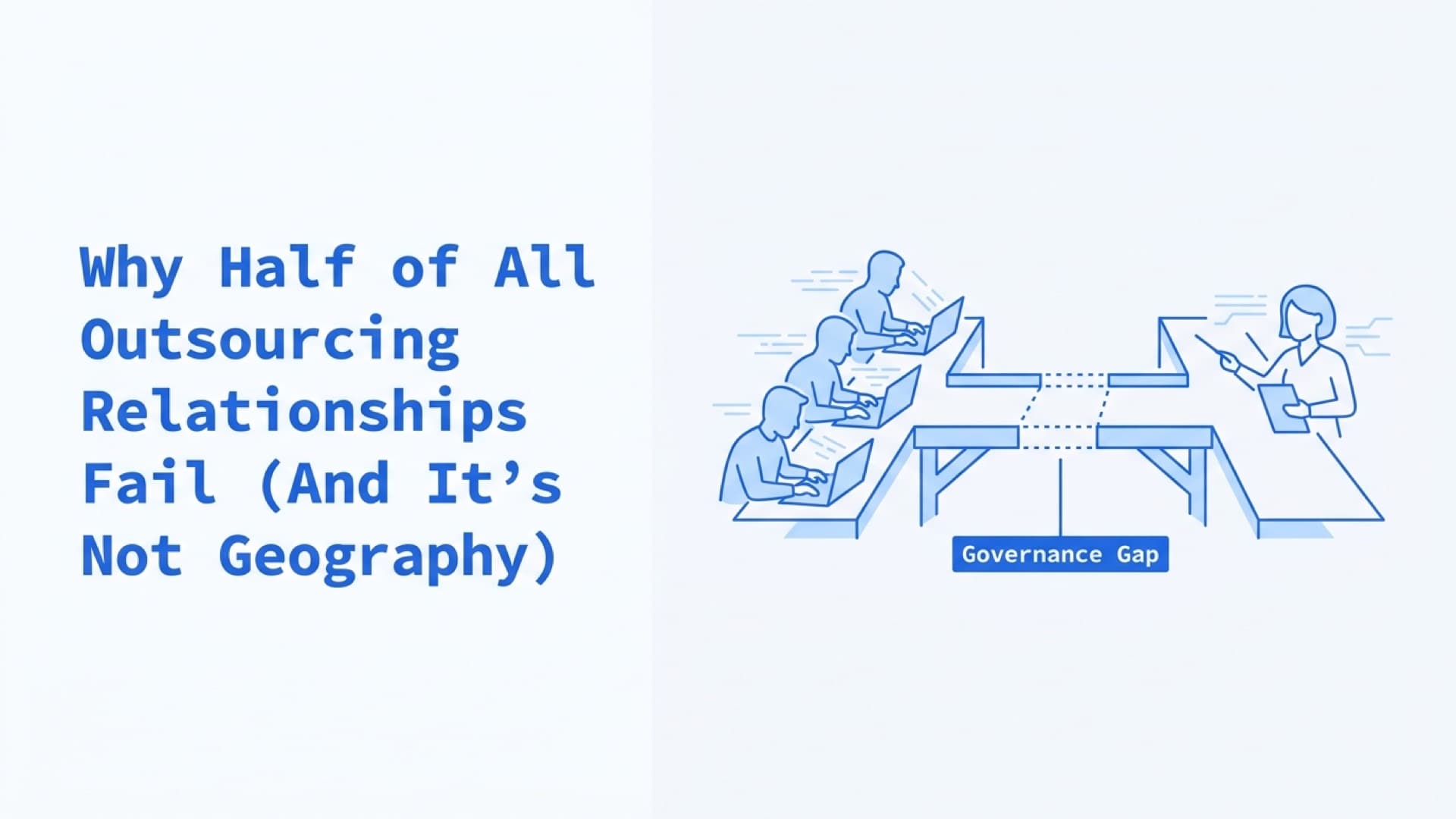
There is a name for this structural mismatch: the Governance Gap — the distance between the engineering capacity you purchased and the engineering leadership required to use it. Most outsourcing failures live inside that gap.
The Governance Gap in Practice
A VP of Engineering at a Series B SaaS company needs to ship faster. The team is six engineers, the backlog is three sprints deep, and hiring domestically will take four months minimum. So they sign a staff augmentation contract for three additional developers, usually senior, usually remote. This is a composite, but the shape of it recurs across virtually every staff augmentation failure post-mortem.
The first month looks fine. The augmented engineers ship tickets, attend standups, push code. By month three, something shifts. Pull request quality starts sliding. Architectural decisions happen without context. The tech lead — who was already managing six people — is now reviewing code from nine, three of whom are new to the codebase and working in a different time zone.
By month six, the VP is complaining about "offshore quality." The vendor is confused because the same developers performed well on their last engagement. The developers didn't degrade. The management capacity did.
The buyer purchased engineering capacity without expanding engineering leadership to absorb it. That structural mismatch — buying capacity without the leadership to direct it — is what the Governance Gap actually looks like in production.
Three Failure Modes, One Root Cause
The 50% failure stat covers a range of scenarios, but they decompose into three governance failures that account for the overwhelming majority.
Failure Mode 1: No Internal Technical Lead
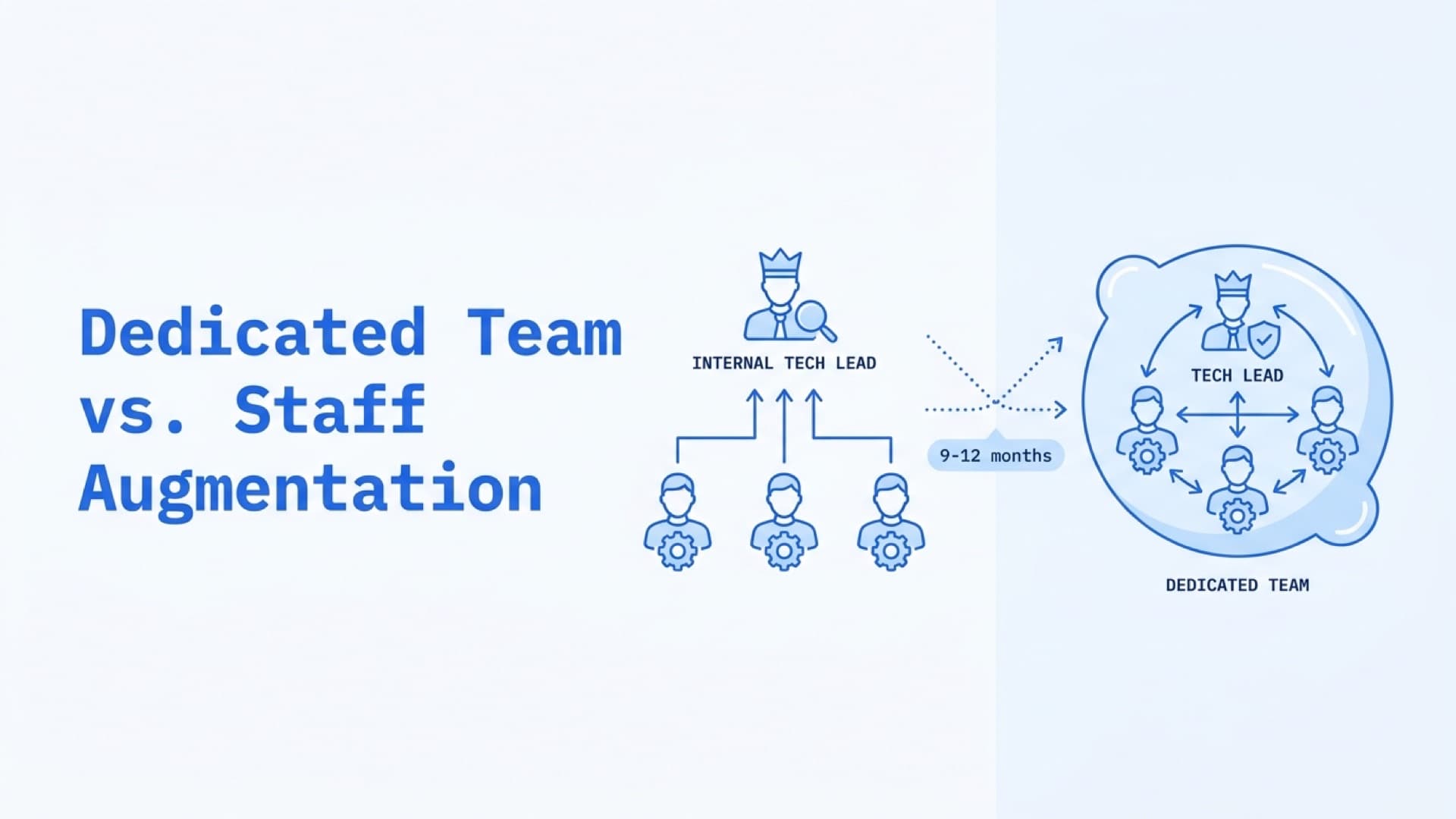
Staff augmentation means the client directs the engineers. That's the model. But "directs" is doing heavy lifting in that sentence. It means: writing clear tickets, reviewing pull requests daily, making architectural decisions, onboarding developers to the codebase, and being available for synchronous questions during overlapping hours.
In practice, each augmented engineer requires roughly six hours per week of technical lead time for effective integration — reviews, context-setting, architectural guidance. That number comes from operational patterns across managed service providers, not a controlled study, but it's consistent enough to be a useful planning figure. At a 3:1 ratio of augmented developers to internal leads, the lead is at capacity. Beyond that, review quality drops, context gets lost, and the augmented team starts making decisions in a vacuum.
The pattern shows up in the data. The Dun & Bradstreet Barometer found that governance — not geography, not language, not technical skill — was the primary predictor of outsourcing failure. And 51% of businesses report communication concerns when choosing offshore partners, but the concern is usually framed as a vendor problem when it's actually a process problem.
Nobody miscommunicates when the ticket is specific, the acceptance criteria are clear, and the PR reviewer has time to provide real feedback. Communication breaks down when none of those things are true — and that's a buyer-side governance failure.
Failure Mode 2: Model Mismatch
Ask five vendors what "staff augmentation" means and you'll get six answers. The outsourcing market has a terminology problem. "Staff augmentation," "dedicated team," "managed services," and "outsourcing" are used interchangeably by vendors and confused by buyers. The distinction matters because it determines who owns management.
In staff augmentation, the client owns delivery management — they direct the engineers. In a dedicated team model, the vendor owns management and the client owns product direction. In managed services, the vendor owns both.
The failure pattern: a buyer who lacks internal engineering leadership signs a staff augmentation contract because it's cheaper. They're paying for capacity but need management. The augmented developers have no one to direct them effectively, and the engagement degrades. The buyer then blames the model — "staff augmentation doesn't work" — when the actual failure was selecting the wrong model for their situation.
The Indiana state welfare system project illustrates the opposite mismatch. The state hired a vendor for a managed engagement but imposed such rigid change management processes that the vendor couldn't adapt to evolving requirements. The project failed, at significant taxpayer cost. Root cause: the governance model (managed services with client-imposed rigidity) created an impossible operating environment.
Failure Mode 3: No IP and Compliance Framework
In 2009, the State of Florida discovered that its payroll data had traveled through three layers of subcontracting it didn't know existed. The Florida State People First system is the canonical example of this quieter, slower failure mode — the one involving intellectual property, data access, and regulatory compliance. The state contracted Convergys Corp. to manage its payroll and HR system. Convergys subcontracted GDXdata for indexing work. GDXdata further subcontracted an offshore team in India — without disclosure to the state. Sensitive employee personal data was exposed through an uncontrolled chain of subcontracting with no security oversight at each handoff.
The Versata vs. Sun Microsystems IP dispute demonstrates another dimension: ambiguous IP assignment language in the outsourcing contract led to a $100M+ lawsuit when the outsourcing partner claimed ownership of delivered software.
The financial exposure goes beyond lawsuits. Buyout clauses alone — the fee for converting an augmented developer to a full-time employee — run $14,000 to 20% of annual salary. That's a $14,000 fee (Lemon.io) to $40,000+ fee (Arc.dev at 20% of a $200K salary) that most buyers discover only after the relationship is working well enough that they want to keep the person. When the IP, data access, and exit terms aren't defined upfront, the Governance Gap expands from an operational problem to a legal one.
Why Geography Gets Blamed
It's easier to say "offshore didn't work" than to admit you didn't have the internal capacity to manage the engagement. Geography is a convenient scapegoat for three reasons.
First, it's external. Blaming a vendor in another country doesn't require any introspection about your own processes. Nobody asks the VP of Engineering why the team's tech lead was managing nine people without support.
Second, the worst-case scenarios are visceral. Boeing's CEO Dave Calhoun acknowledged that outsourcing in the 737 MAX design "probably went 'too far.'" The MCAS software relied on a single angle-of-attack sensor without cross-checking — a fundamental aviation systems design failure. But the narrative becomes "they outsourced to cheap engineers" rather than "there was no governance layer ensuring aviation safety standards were applied to outsourced code." The system failed because nobody at Boeing was reviewing the outsourced work against domain-specific safety requirements. That's governance, not geography.
Third, the time zone argument feels intuitive. San Francisco to Bucharest is a nine-hour gap. But the actual constraint isn't the gap — it's how much synchronous interaction the work requires. Structured sprints with well-defined tickets and clear acceptance criteria can run on an hour of overlapping time per developer per day. Ambiguous requirements with no acceptance criteria at all? Those need four hours or more of real-time conversation, and the time zone becomes a genuine bottleneck. The work determines the time zone sensitivity, not the map.
GitLab operates with 2,000+ employees across 65+ countries with minimal synchronous overlap. They do it with obsessive documentation, asynchronous decision-making processes, and a handbook that replaces most meetings with written proposals. Time zones are a constraint only when your PM process depends on real-time conversation for every decision.
The Honest Boundary
The 50% stat and the 78% satisfaction rate come from published industry surveys (D&B, DemandSage). The 3:1 ratio, the six-hours-per-week figure, and the overlap-time thresholds are operational patterns — consistent across vendor reports and practitioner accounts but not validated by controlled study. Nobody has published a head-to-head comparison of identical projects run with and without the Governance Gap. The observational evidence is strong. The causal claim is directional, not proven.
What we can say with confidence: the same developers, from the same vendors, in the same geographies, succeed on one engagement and fail on the next. The variable that changes between success and failure is almost always on the buyer side.
The Number Nobody Quotes Back
Alongside the 50% failure rate, the same industry data shows 78% of businesses report positive experiences with outsourcing providers. And 92% of G2000 companies maintain active IT outsourcing contracts.
50% failure. 78% satisfaction. 92% adoption. Same industry, radically different outcomes. The variable isn't the vendor — it's the buyer's governance readiness.
The retention data tells the same story. Augmented teams show 8-12% annual attrition versus 40% first-year attrition for direct hires, according to Meduzzen's analysis of vendor-managed vs. in-house teams. The vendor absorbs the recruitment and retention burden. But that advantage only materializes when the buyer-side management structure makes it possible for augmented developers to do their actual job — writing code that meets quality standards and ships on time.
A Self-Diagnostic for the Governance Gap
Before signing a staff augmentation contract, answer three questions honestly. If you say "no" to any of them, you need a different engagement model — probably a dedicated team with vendor-managed delivery.
1. Do you have a technical lead who can dedicate six hours per week per augmented developer to code review, architectural guidance, and onboarding?
If no, you're buying capacity without the management layer to use it. Augmented developers without a dedicated reviewer typically start diverging from codebase conventions within the first quarter.
2. Is your backlog specific enough that a senior developer can pick up a ticket and execute without a 30-minute synchronous conversation about what it means?
If no, you have a ticket quality problem that will manifest as a "communication problem" with remote developers. Fix your tickets before adding headcount.
3. Do you have an IP assignment clause, a data access policy, and an exit clause in the contract — reviewed by someone who understands both the technology and the jurisdiction?
If no, you're building on a legal foundation that could cost you more than the engineering. Buyout fees, IP disputes, and GDPR violations (up to €20M or 4% of global revenue) are the consequences of skipping this step.
Three yeses: staff augmentation works. You're adding senior capacity to a team with the infrastructure to absorb it.
One or more nos: restructure before engaging. Either build the internal capacity first, or choose a model where the vendor owns management — dedicated team or managed services.
50% failure. 78% satisfaction. The variable is never the vendor.
Need help structuring an augmented engineering team? Talk to an engineer — we'll tell you honestly if staff augmentation is the right model for your situation.
Frequently Asked Questions
Why do outsourcing relationships fail so often?
According to the Dun & Bradstreet Barometer of Global Outsourcing, 50% of outsourcing relationships fail within five years. The primary driver is governance failure — specifically, buyers who lack internal technical leadership to manage augmented engineers, choose the wrong engagement model for their management capacity, or skip IP and compliance frameworks in the contract. Geography and time zones are contributing factors, not root causes.
What is the difference between staff augmentation and a dedicated team?
Staff augmentation means the client directly manages the engineers — assigning tasks, reviewing code, making architectural decisions. A dedicated team model means the vendor manages engineering delivery while the client owns product direction. The right choice depends on your internal management capacity: if you have a strong tech lead with bandwidth, staff augmentation works. If not, a vendor-managed dedicated team prevents the Governance Gap.
How many augmented developers can one tech lead manage effectively?
The practical limit is roughly three augmented developers per internal technical lead, assuming each augmented developer requires about six hours per week of code review, onboarding, and architectural guidance. Beyond this 3:1 ratio, review quality drops, context gets lost, and the augmented team starts making autonomous architectural decisions without sufficient codebase context.
What hidden costs should I watch for in a staff augmentation contract?
Key hidden costs include buyout fees — $14,000 flat (Lemon.io) or 18-25% of annual salary (Arc.dev, HighCircl) — if you convert an augmented developer to full-time. Vendor markups run 25-75% over base developer compensation according to DistantJob's market analysis. Knowledge transfer costs can exceed the initial project cost by 30% if IP handover is poorly structured. GDPR violations carry fines up to €20M for engagements involving EU customer data without proper data processing agreements.
How do I know if staff augmentation will work for my team?
Three prerequisites predict success: (1) you have a technical lead who can dedicate six hours per week per developer to reviews and guidance, (2) your backlog is specific enough that a senior developer can execute without extensive synchronous conversation, and (3) your contract includes IP assignment, data access policies, and exit clauses. If all three are in place, staff augmentation at a 3:1 ratio or lower typically succeeds. If any are missing, consider a dedicated team model instead.