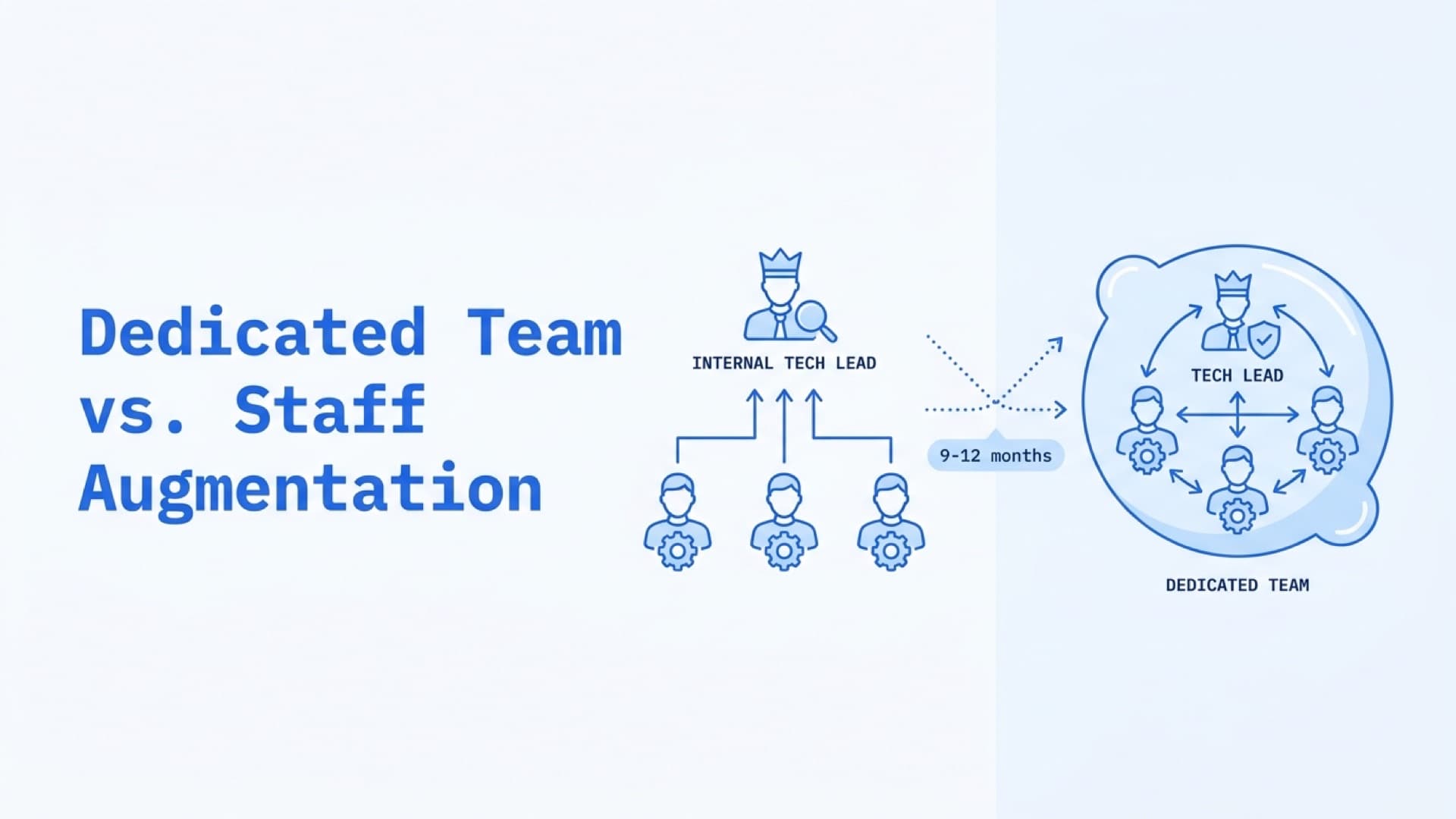
Dedicated Team vs. Staff Augmentation: Which Model Fits Your Engineering Org?
IBM signed a seven-year, $863M contract with the State of Texas to consolidate 27 agency data centers. Four years in, 12% of the work was done. IBM repaid the state and got replaced by Xerox and Capgemini. The failure wasn't offshore quality — IBM ran this domestically. It was governance. Nobody owned delivery on either side, and the contract didn't force anyone to.
The pattern scales down. A buyer signs a contract for a "dedicated team" of four engineers. Two weeks in, the vendor Slack looks like a help desk. Three months in, nobody can name who owns sprint planning. The buyer blames offshore quality. The vendor points at unclear requirements. Both are wrong. The engagement was a dedicated team on the invoice and staff augmentation in practice. Nobody agreed on who owned delivery, so nobody did.
The Dun & Bradstreet Barometer puts the two-year failure rate for outsourcing engagements at 20-25% and the five-year rate at 50%. The same research shows 78% of buyers simultaneously report positive experiences. That gap is almost entirely structural: buyers pick the wrong model for their internal setup, and vendors let them.
There's one question that resolves most of this. Call it The Delivery Ownership Question. Who owns sprint planning, PR review, architectural decisions, and team performance? If the answer is "we do," you're buying staff augmentation. If the answer is "they do," you're buying a dedicated team. Anything else is marketing.
What Staff Augmentation Actually Is
Staff augmentation places individual engineers inside your existing team. They sit inside your standups and your Jira and report to your tech lead. The vendor runs the staffing and payroll layer — recruiting, contracts, HR, benefits, first-line replacement if someone leaves. Everything else is your problem: what the engineer builds, how they build it, when it ships, whether the code passes review.
The rate card reflects this. Senior engineers from Poland run $65-$90/hour; Romania, $45-$75; mid-level developers across CEE, $40-$70. The vendor margin sits in a predictable band: 25-75% over developer compensation, with short-term specialist roles at the top and 12+ month engagements at the bottom. Monthly cost per senior engineer ends up in the $3,500-$15,000 range depending on region and seniority, according to HighCircl's 2026 pricing breakdown.
This model works when three conditions hold at the same time. First, you have an internal technical lead with genuine capacity to direct engineers — not a VP coding on the side. Second, your backlog is mature enough that a new engineer can pick up a ticket and make forward progress without 45 minutes of Slack clarification. Third, your PR review process catches quality problems before they compound.
Miss any one of those and staff augmentation inverts on you. The vendor engineers produce output without adequate direction; PR review becomes rubber-stamp; by month six the codebase carries architectural decisions nobody consciously made. SSNTPL's 2026 cost comparison finds outsourced projects carry a 30-40% higher defect rate when requirements aren't well-defined — the cost of that shows up as rework, not as a line item on the invoice.
The 3:1 Rule
Staff augmentation scales linearly in cost and non-linearly in management overhead. The practitioner ceiling: about three augmented engineers per internal technical lead before quality and velocity both decline. The math is the reason. Empirical team-size research finds 5-7 members optimal, with communication channels growing by n(n-1)/2. Four internal engineers plus one tech lead is 10 channels. Add four augmented engineers and the same tech lead is now inside a 9-person team with 36 channels, half of them with people who are remote, new to the codebase, and unfamiliar with product history.
Below 3:1, management is absorbable within the lead's existing work. Above it, the lead stops writing code and starts running a coordination role they didn't sign up for. The augmented engineers are still productive individually; team output flattens.
What a Dedicated Team Actually Is
A dedicated team is a self-contained unit the vendor manages. Team composition varies — typically 3-8 engineers plus a tech lead or engineering manager, sometimes a QA engineer, occasionally a product-adjacent role — but the structural property is that delivery ownership sits with the vendor. You specify product direction, acceptance criteria, and priority. They run sprint planning, code review, estimation, hiring backfills, on-call rotation, and performance management.
Pricing moves from per-engineer-per-hour to per-team-per-month. A 3-4 person startup-scale team runs $15,000-$25,000/month; mid-size teams of 4-6 engineers, $25,000-$45,000; full product teams of 6-10, $45,000-$80,000. Retainers typically discount 10-25% against equivalent hourly rates for 12- and 24-month commitments.
The cost structure looks more expensive at the hourly blended rate — $80-$150/hour for the team including PM and QA versus $50-$100/hour for individual augmented engineers — and this is where the wrong comparison kills the decision. The blended rate bundles the management layer that staff augmentation pushes back onto you.
This model works when you need delivery you can't staff internally. Not because the vendor's engineers are better, but because you're buying a layer of judgment — architectural, sprint-level, team-level — that staff augmentation explicitly doesn't include.
The 12-Month Crossover
The duration of the engagement is the second-most-decisive variable after The Delivery Ownership Question. Under six months, staff augmentation almost always wins on cost. No vendor-side setup, no management layer markup, faster ramp, clean exit. At the 9-12 month mark, the models cross over.
The crossover math is driven by three things the dedicated team absorbs that staff augmentation doesn't.
Attrition absorption. In-house first-year engineering attrition runs 40%, with replacement costs of $60,000-$90,000 per departure according to Cleveroad's 2026 analysis. Oski's industry data puts staff augmentation attrition around 8-12% annually at reputable providers and up to 40% at low-quality ones. Dedicated team providers carry 15-25% annual turnover in the same data, but the vendor eats the replacement cost — the client sees continuity in billable output, not a hiring gap.
Domain knowledge accumulation. Ramp-up research across 80 engineering organizations found 3-9 months to full productivity as the industry norm, and that cutting that ramp time in half saves the equivalent of 17 developer-years per year across new hires at a typical org. Staff augmentation engagements where engineers cycle out every nine months pay that ramp cost again and again. Dedicated teams have a retention incentive baked into the vendor's economics — they bill the seat regardless — and tenured engineers on a known codebase compound against that curve.
Management layer absorbed. Your internal tech lead spending 6-8 hours per week coordinating each augmented engineer, times three augmented engineers, across 12 months, is roughly 1,000 hours of senior engineering time redirected from product work to team coordination. At a fully-loaded US senior rate of $170,000-$240,000/year, that's $85,000-$120,000 of internal cost that never appears on the vendor's invoice.
Below six months, the setup overhead of a dedicated team isn't recoverable. Above 12 months, the total cost of ownership inverts and the dedicated team wins on cumulative math. Between six and 12 is the judgment zone, where the decision depends more on what you're actually trying to build than on the hourly comparison.
The Hidden Costs Each Side Won't Publish
Beyond the rate card, both models carry costs the vendor won't itemize unless you ask.
Staff augmentation: The 15-25% of internal PM or tech lead time per augmented engineer rarely gets priced explicitly — it shows up as a drag on internal velocity. If you later decide an augmented engineer is worth hiring directly, buyout fees run $14,000-$20,000, or 18-25% of annual salary, and the vendor controls the clock on when that conversion is contractually permitted.
Dedicated teams: Infrastructure and tooling costs of $240-$1,050 per developer per month per Oski's pricing survey — some vendors bundle, some itemize separately, and the difference between a $45K and $55K monthly retainer for the same team often sits inside this line. The onboarding ramp is longer than the sales pitch admits: the IEEE-documented 3-9 month ramp window applies to vendor replacement hires too, so if a core team member leaves at month eight, effective velocity dips for a quarter while the replacement comes up to speed.
The third cost category hits both models: model mismatch. When a buyer picks the wrong model for their internal capacity, the engagement enters the same D&B failure distribution mentioned above — a 50% five-year failure rate that tracks governance, not geography.
The Decision Framework
Three questions resolve most engagements.
1. What is your internal tech lead capacity? Not the title on the org chart. The hours per week a senior internal engineer can spend directing remote developers without dropping their own code. Under 6 hours per augmented developer, augmentation underperforms. Zero hours, and augmentation is the wrong model — you're buying execution you can't direct, which is how code you didn't review ends up in production.
2. How long is the engagement? Under 6 months: staff augmentation, almost always. 12+ months: dedicated team usually wins on total cost. Between 6 and 12 is the judgment zone — are you filling a specific skill gap on an existing team (augmentation) or building new capacity (dedicated team)?
3. What are you buying — execution or delivery? This is The Delivery Ownership Question asked from the buyer's side. Execution is hands on keyboards. Delivery is a team that ships features, absorbs production incidents, makes architectural decisions, and replaces its own attrition. The price gap between the two models is the price of that layer.
If two or more answers point to dedicated team, don't sign a staff augmentation contract and expect the vendor to "just manage them." They won't. It's not in the contract and it's not in the margin.
Honest Boundary
This framework assumes software engineering work on a product or platform. It maps cleanly to backend, frontend, data engineering, DevOps, and ML engineering roles. It maps less cleanly to:
- IT operations and helpdesk. The delivery-vs-execution distinction doesn't apply the same way. Most IT ops engagements are structured as managed services, a third model where the vendor owns both delivery and outcomes against an SLA.
- Mixed engagements. "Two augmented specialists plus a small dedicated team building adjacent capacity" is common and doesn't fit either pure model. In practice, this is usually contracted as two separate agreements.
- Very short surge capacity. A two-week engagement to hit a hard deadline is neither model in the normal sense — it's a specialist contract, closer to consulting.
The framework also assumes a vendor with enough internal structure to actually provide dedicated team infrastructure: tech lead, QA, security review, and a replacement pipeline deep enough to backfill within weeks rather than months. At providers in the low-double-digit headcount range, the "dedicated team" model is typically three engineers plus a founder who reviews PRs on Fridays. That's staff augmentation with a dedicated-team markup, and the delivery ownership in practice sits with the buyer regardless of what the contract says.
Managed Services: Where Neither Model Applies
A third model sits beyond both: managed services, where the vendor owns delivery and outcomes against contractual SLOs. This is common in infrastructure and platform engineering — Kubernetes operations, data pipeline reliability, observability. The economics are different. You're buying an availability percentage and a response time, not engineer-hours or team-months. Managed services sits outside this post's scope but worth naming, because buyers who should be in that model sometimes fit a dedicated team contract onto SLA-driven work instead. The mismatch surfaces when a production incident hits at 2am and the "dedicated team" contractually has no on-call obligation.
Need help? Talk to an engineer.
Execution or delivery. Pick one. If the vendor won't name it, they already picked for you.
Frequently Asked Questions
What is the difference between staff augmentation and a dedicated development team?
Staff augmentation places individual engineers into your existing team, where you manage them directly — sprint planning, PR review, and performance all sit with your internal tech lead. A dedicated development team is a self-managing unit (engineers plus a tech lead or PM) run by the vendor. You own product direction; the vendor owns delivery, code quality, and team performance.
When does staff augmentation cost less than a dedicated team?
For engagements under six months, staff augmentation almost always wins on total cost because there's no vendor-side setup, no management-layer markup, and faster ramp-up. The models cross over at 9-12 months. Past that point, dedicated teams typically cost less in total because the vendor absorbs attrition replacement, domain knowledge stays with the team, and retainer rates discount 10-25% against equivalent hourly billing.
How many augmented engineers can one internal lead manage?
The empirical ceiling is about three augmented engineers per one internal technical lead before quality and velocity both decline. Below 3:1, management fits inside the lead's existing work. Above it, the lead stops writing code and starts running coordination for people they didn't hire. If you need more than three, a dedicated team model with a vendor-provided lead is usually structurally cheaper.
What does a dedicated development team cost per month?
A startup-scale team of 3-4 engineers runs $15,000-$25,000 per month; mid-size teams of 4-6, $25,000-$45,000; full product teams of 6-10 engineers, $45,000-$80,000. Rates depend on region (CEE versus LATAM versus Asia), seniority mix, and composition. Retainer commitments of 12 or 24 months discount 10-25% against hourly-equivalent pricing.
Why do outsourcing engagements fail at a 50% rate?
Governance and model mismatch, not geography. The Dun & Bradstreet Barometer finds 78% of buyers simultaneously report positive experiences — failures cluster around buyers picking staff augmentation without internal tech lead capacity, or contracting a dedicated team without clear product direction. Same vendors, same countries, opposite outcomes, driven by how the engagement was structured.
Related posts
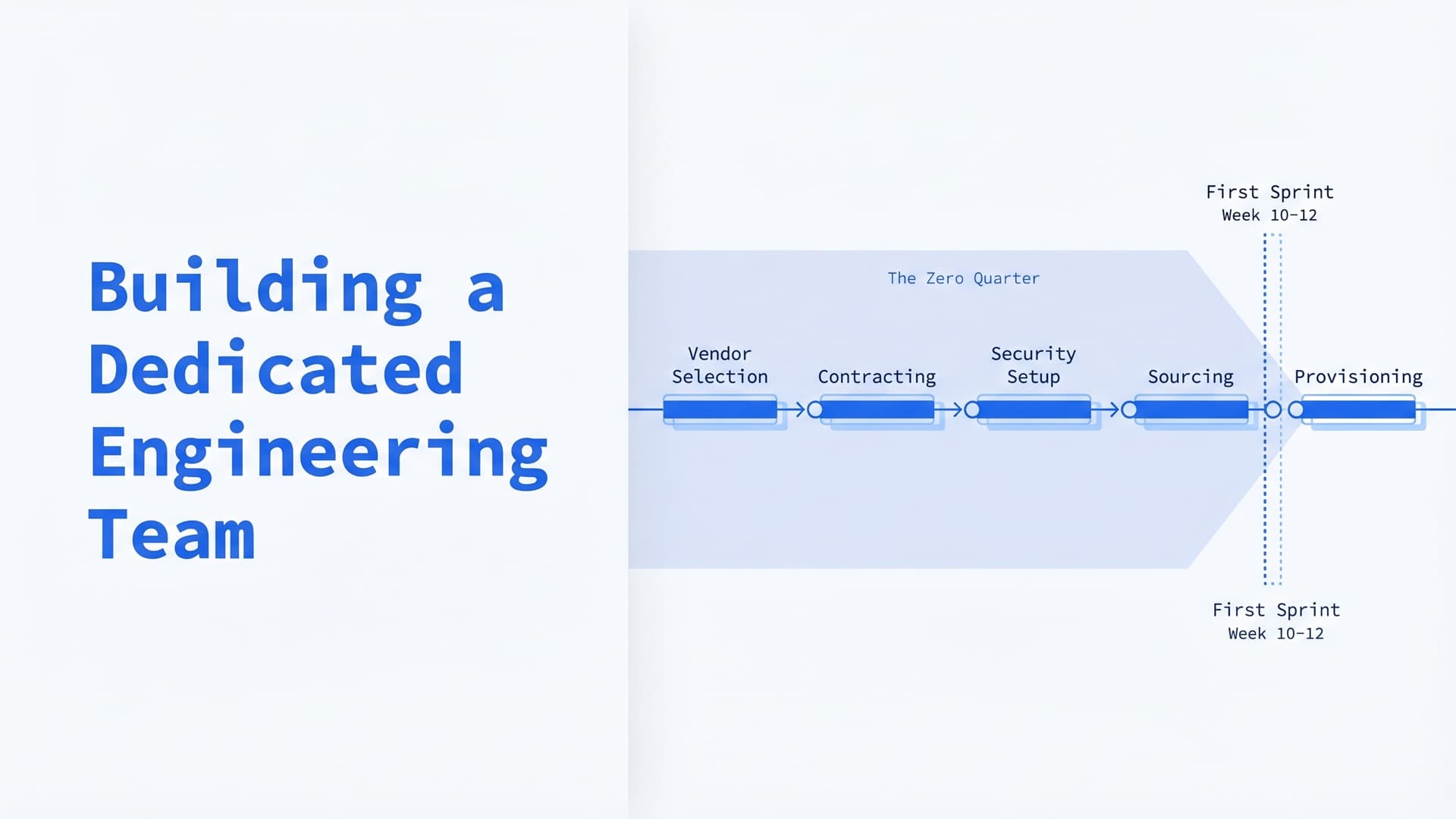
Building a Dedicated Engineering Team from Scratch: Timeline, Cost, and Mistakes
Vendor decks show 2 weeks. The real timeline is 10-16 weeks. Call it The Zero Quarter — everything between decision and first sprint. Cost model, worked example, and the five setup mistakes that compound.
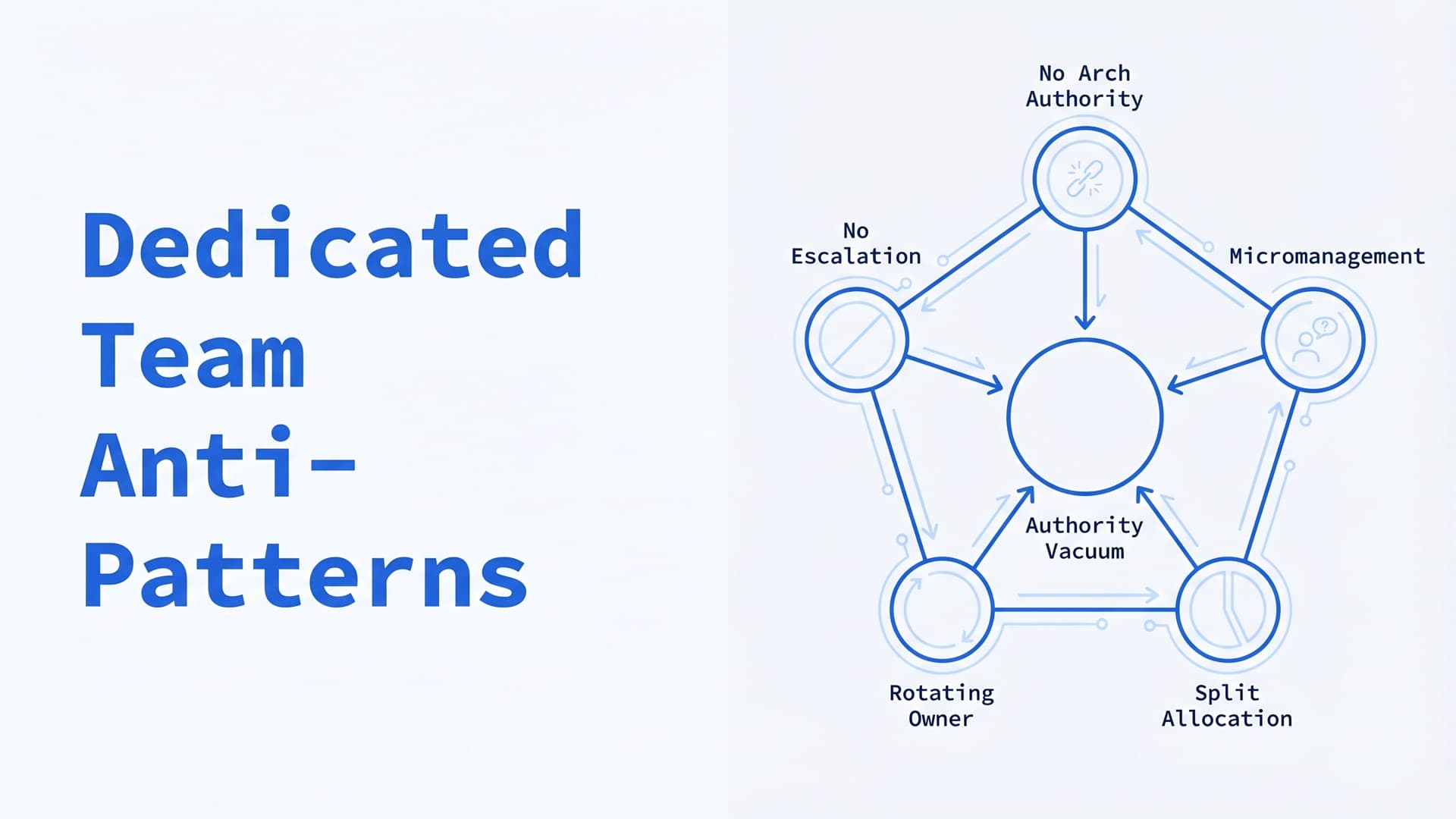
Dedicated Team Anti-Patterns: 5 Governance Failures That Kill Productivity
Five governance failures account for most dedicated team engagement failures — and none of them are about engineer quality. The Authority Vacuum, the five patterns it creates, and how to diagnose which one you have.
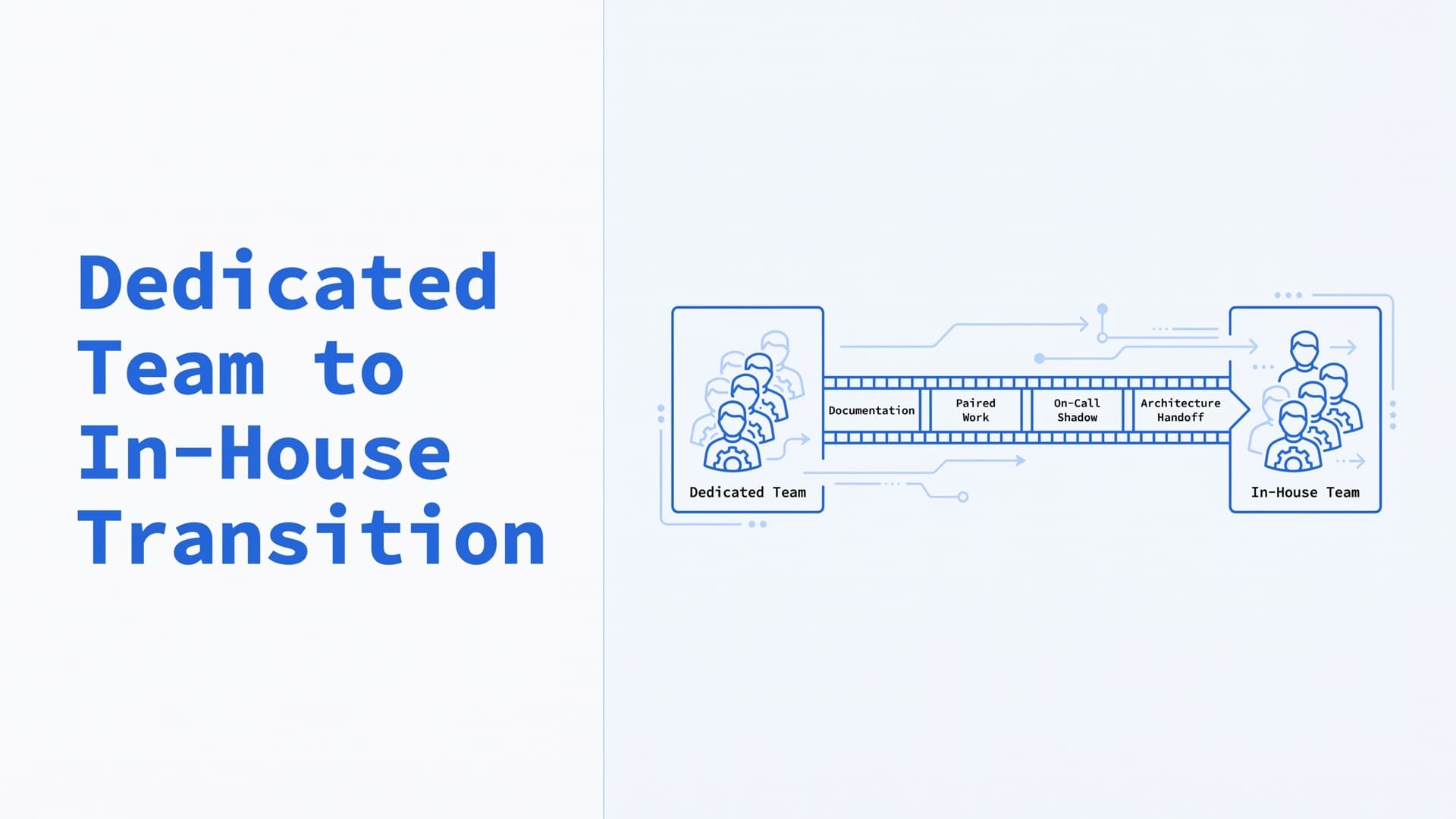
When to Bring a Dedicated Team In-House (And How to Do the Transition)
70% of executives have selectively insourced. The Knowledge Bridge is what separates successful transitions from expensive restarts. Signals, playbook, and the four failure modes that sabotage in-housing.