IT staff augmentation services
Staff augmentation without a single point of failure.
A lead engineer from our team takes tasks from your backlog, and our engineers work on them together. Your context lives with the whole team, so vacations and weekends don't stop the work. Our longest-running client has worked with us for 15 years.
Staff augmentation means adding engineers from an outside company to your own team for as long as you need them. They take tasks from your backlog, follow your process and report to your leads. The staff augmentation company handles hiring, contracts and payroll, and you keep control of the work and the code.
We do it with a team instead of a lone contractor. A lead engineer is your contact and takes the tasks. Inside our team, different engineers pick them up, and several can work in parallel when you need more speed. Your stack and your context belong to the whole team, so the work never depends on one person.
Our engineers work on infrastructure-heavy systems: Kubernetes and DevOps, data pipelines and web data collection, databases and search, and the backend services that run on them.
Why teams bring in augmented engineers
Hiring takes longer than the roadmap allows
Senior DevOps and data engineers are slow to find and slower to close. Meanwhile the work piles up on the people you already have.
One contractor is a single point of failure
When your only augmented engineer goes on vacation, the work stops. When they leave, the context leaves with them.
Developers who can't run what they build
Augmented developers ship features, but every failed deploy and slow query still lands on your core team.
What you get with Ivinco
One lead, a whole team behind them
Your lead from our side joins your standups, takes tasks from your backlog and answers for the result. Your own leads set the priorities and review every pull request.
Your context lives with the team
Several of our engineers learn your stack and your systems, so vacations, weekends and departures don't stop the work.
More hands when you need them
When a release or a migration needs speed, more engineers work on it in parallel. When things are quiet, the team scales back.
Engineers who know the infrastructure
Our engineers work with Kubernetes, CI/CD pipelines, monitoring and databases every day. The code they write is code they can deploy, watch and debug.
What our team covers
DevOps and SRE
Kubernetes in the cloud and on bare metal, CI/CD in GoCD, GitHub Actions or GitLab CI, Ansible, and monitoring with Prometheus, Grafana and VictoriaMetrics.
Data engineering
Data pipelines, web data collection and storage and analytics in ClickHouse. See our data pipelines work.
Databases
MySQL, PostgreSQL, ClickHouse, MongoDB and Redis: replication, upgrades, backups and slow queries.
Search
Full-text search on Manticore Search, Elasticsearch and other engines; we have built search since 2009. Manticore is our close partner, with fast support and custom features when a project needs them.
Backend development
Services and APIs in Python, Go and PHP, written by people who also run them in production.
Most of our work is here, but the list isn't the limit. Our engineers also write Java, Rust and React, and we have written C for a client's hardware. Describe the task and we will tell you whether we can take it. The one thing we don't do in-house is mobile development.
How staff augmentation works with us
- 1
Tell us about the work
Send the stack, the systems involved, the hours of overlap you need and what the first month should deliver.
- 2
Meet your lead engineer
Before anything is signed, you meet the person who will be your contact and take your tasks.
- 3
The team takes your backlog
The lead joins your Slack and standups. Inside our team, each task goes to the engineer best suited for it, and several can work in parallel.
- 4
Adjust as you go
Your lead checks in with your team lead regularly. You can add capacity, cut hours or end the engagement under the notice terms in the contract.
Staff augmentation vs. outsourcing, managed services and consulting
These models get mixed up, and the difference decides who manages the work.
| Model | Who manages the work | Good fit when | Trade-off |
|---|---|---|---|
| Staff augmentation | Your leads set the priorities; the provider's engineers work inside your process | You have a working team and process, and need more capacity or a missing skill | Your leads carry the planning |
| Dedicated team | The provider's lead plans it and answers for the result | You want a whole function, such as a platform or data team, run for you | Less day-to-day control over how the work is done |
| Project outsourcing | The vendor, against a fixed scope | The scope is clear and unlikely to change | Changes cost extra, and the knowledge leaves at handover |
| Managed services | The vendor, against a service level | You want an outcome, such as uptime or patching, rather than people | Changes go through the provider |
| Consulting | The vendor advises, your team implements | You need a decision or a design more than extra hands | It ends when the problem is solved |
With us, your leads set the priorities, and our lead hands each task to the right engineer on our team. We also work as a dedicated team and run Kubernetes clusters as a managed service. For a fixed piece of infrastructure work, see DevOps consulting. The longer comparison is in our post on dedicated teams vs. staff augmentation.
Our engineers have managed more than 1,350 production servers. They are embedded in client Slack channels, attend their standups, and deploy code every day. Clients include Socialgist, BoardReader, SafeTraces, SOAX and Underdog Consulting.
How pricing works
We bill for the hours our team spends on your tasks, against a monthly volume of hours that you can raise or lower. The stack and the time-zone overlap you need set the rate.
We can work on a single project or on a yearly contract.
The rate covers the engineers, their equipment and our overhead, with no recruiting fee on top.
Compare it with the full cost of a hire: salary, benefits, recruiting fees, equipment, and the months the seat sits empty.
Stack our engineers work in
Frequently asked questions
- What are staff augmentation services?
- A staff augmentation company finds and vets the engineers, employs them, and handles their contracts, payroll and equipment. You direct their work the way you direct your own team's, and you get capacity or a missing skill without a hiring cycle.
- What is IT staff augmentation?
- IT staff augmentation is staff augmentation for technical roles: engineers who join your engineering team for as long as you need them. With us that is mostly DevOps, SRE, data, database and backend work, and other stacks on request. Check that a provider has run your stack in production, because these engineers will work on live systems.
- Will the same engineer work on all our tasks?
- Your lead stays your contact. The tasks go to whichever engineers on our team fit them best, and all of them learn your systems. That way nobody is a bottleneck, and the work continues when someone is away.
- How much does staff augmentation cost?
- Most providers bill per engineer, by the hour or by the month. We bill for the hours our team spends on your tasks, against a monthly volume you can change. The stack and the time-zone overlap set the rate. You pay no recruiting fee and no benefits. We quote after the first call, once we know the work.
- Will your engineers' working hours overlap with ours?
- Our team is fully remote. Before we start, we agree on the hours your lead and the team are online with you. If you need it, we provide 24-hour coverage under an agreed SLA: how fast we respond to a problem, and how long systems can be down when the problem is in our scope.
- What is the difference between staff augmentation and outsourcing?
- With staff augmentation, you set the priorities and the work stays inside your process. With outsourcing, the vendor takes a scope and delivers it with its own process and management. Augmentation gives you more control. Outsourcing takes less of your team's time.
- What is the difference between staff augmentation and managed services?
- Staff augmentation gives you engineering capacity to direct. Managed services give you an outcome, such as cluster uptime or patching, under a service level, and the provider decides how to reach it. We do both: staff augmentation, and managed Kubernetes for teams that want their clusters run for them.
- Who owns the code our team writes for you?
- You do. The contract assigns the work to you, and our engineers commit to your repositories under your access rules.
- What happens when an engineer is on vacation or leaves?
- The work continues. Your context lives with the lead and the team, so another engineer who already knows your systems picks up the task.
- Does staff augmentation work for a team without a technical lead?
- Partly. Our lead engineer runs the technical work, but someone on your side still has to set priorities and accept the result. If you want us to own a whole function, a dedicated team is the better fit.
From our blog
View all posts →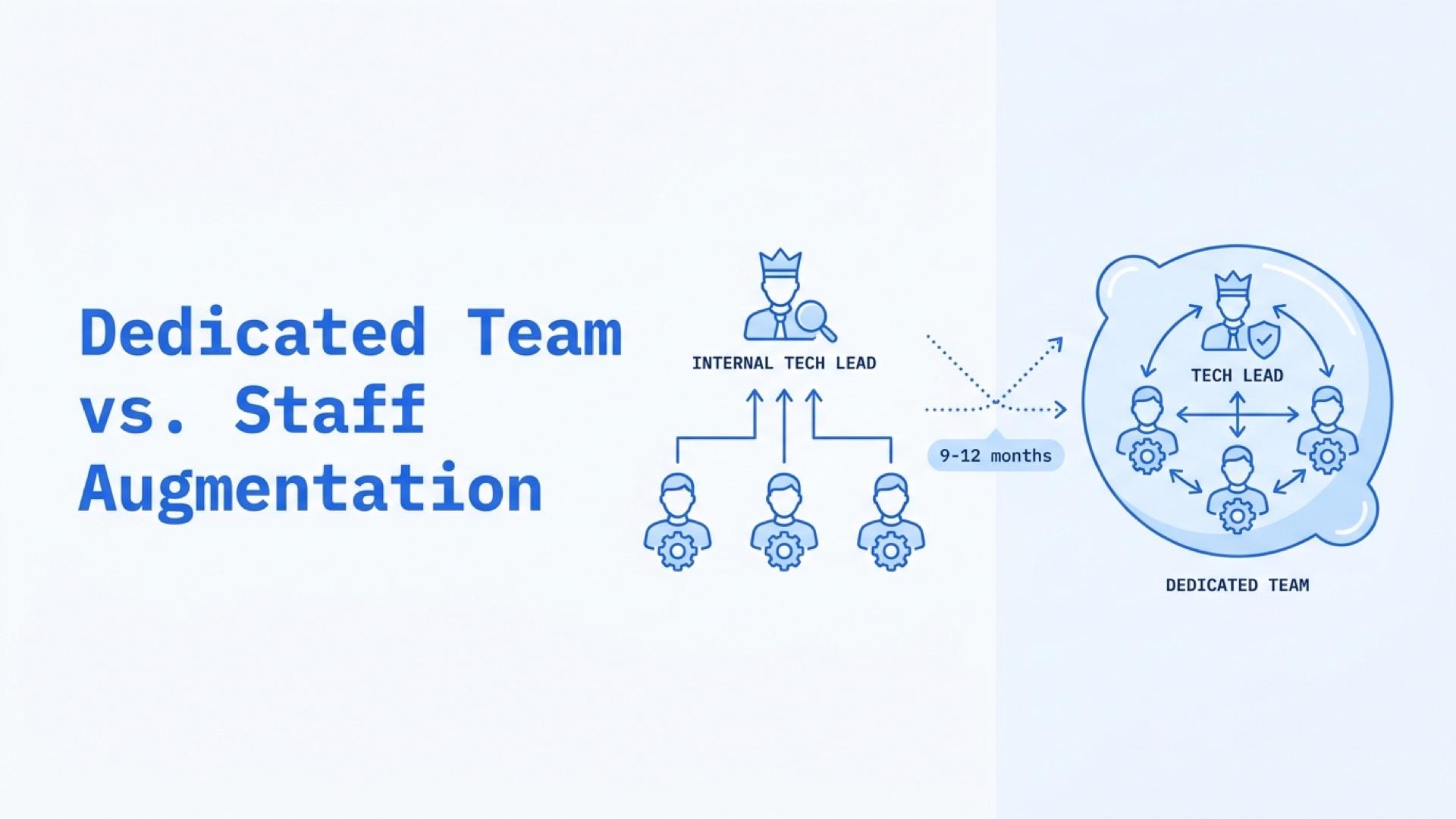
Dedicated Team vs. Staff Augmentation: Which Model Fits Your Engineering Org?
Both models get sold under the same label. The difference that matters: who owns delivery. A decision framework with the 3:1 rule, the 12-month crossover, and the hidden costs each vendor won't publish.

Why Half of All Outsourcing Relationships Fail (And It's Not Geography)
50% of outsourcing relationships fail within five years. The root cause isn't offshore quality or time zones — it's three governance failures that buyers create themselves.
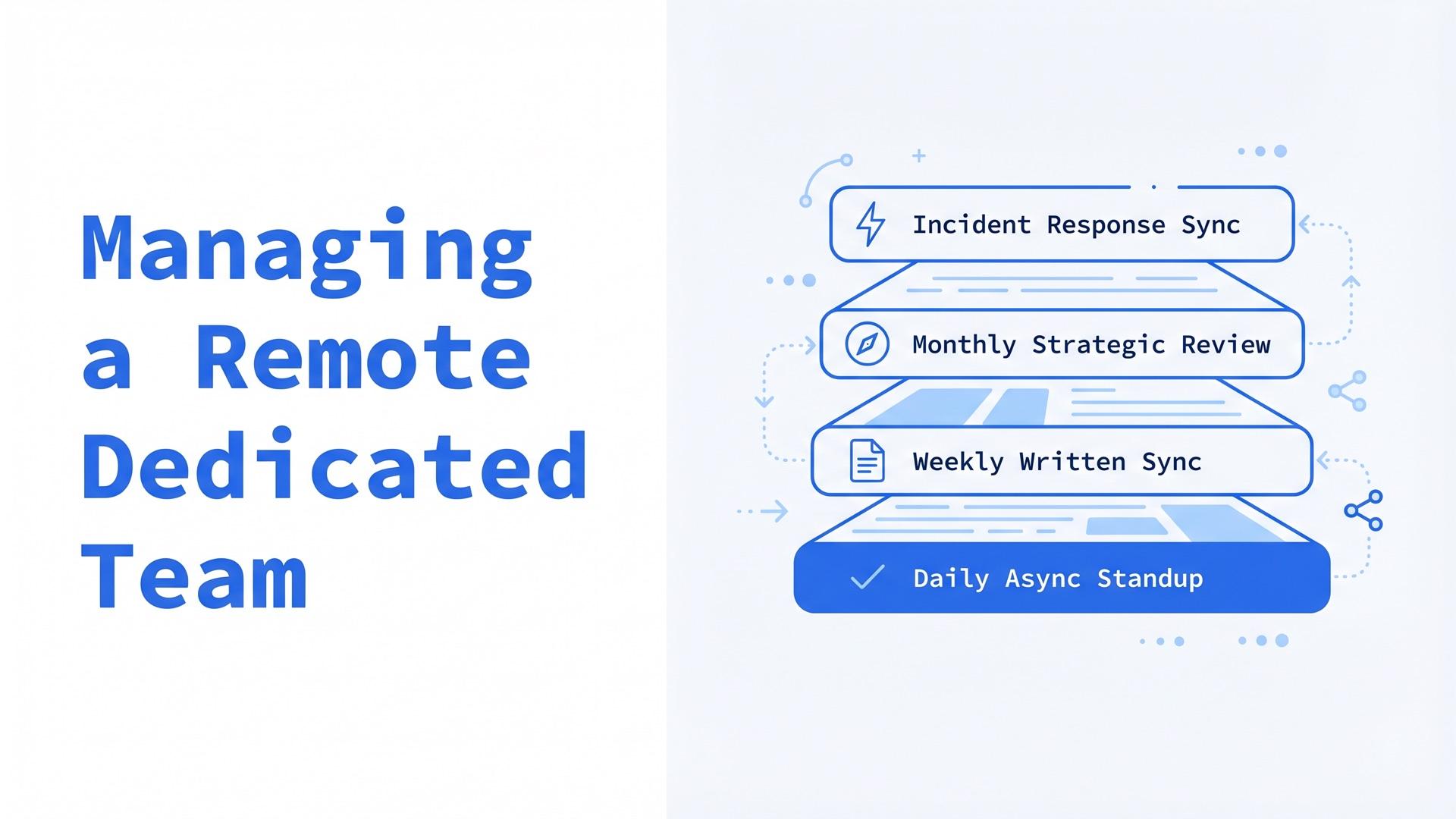
How to Manage a Dedicated Team You Don't See Every Day
The failure mode isn't poor communication — it's poor communication architecture. The Written Default, four distinct cadences that replace meetings, and why trust is an artifact pattern.
You might also need
Tell us about the work
A few lines are enough. We will tell you whether our team fits. If it does, you meet your lead before anything is signed.
- The stack and the systems involved
- The hours of overlap you need
- What the first month should deliver