How to Manage a Dedicated Team You Don't See Every Day
The failure mode of remote dedicated team management isn't poor communication. It's poor communication architecture. The client tech lead has a 30-minute daily standup on video, a weekly 1:1 with the vendor PM, a quarterly business review, and an assumption that the rest will sort itself out. Three months in, the vendor team is waiting for decisions the client didn't realize they needed to make. The client is surprised by work the vendor didn't realize needed input. Both parties describe the problem the same way: "communication issues."
Communication isn't the issue. The issue is that the team never adopted The Written Default: the structural commitment that every significant decision, spec, or architectural choice becomes a written artifact before it becomes a meeting. Without that default, a remote team runs on synchronous bandwidth — and synchronous bandwidth across time zones is the most expensive thing in the engagement.
GitLab's public handbook on async work frames the principle clearly: async-first isn't about fewer meetings. It's about treating writing as the primary unit of collaboration and meetings as a fallback when writing fails. That reframe is the whole management strategy for a remote dedicated team.
Why Synchronous Defaults Break Remote Teams
Imagine a four-person vendor team in Kraków (UTC+1) and a client tech lead in San Francisco (UTC-8). The time zone overlap for live discussion is roughly 8am-11am Pacific, 5pm-8pm Central European. Three hours per day, five days per week, totaling 15 hours of usable synchronous bandwidth.
Into that 15 hours, a synchronous-default team stacks: daily standup (2.5 hours/week), weekly planning (1 hour), weekly PM sync (1 hour), weekly engineering sync (1 hour), ad-hoc questions (3-5 hours), code review clarification calls (2-3 hours). Roughly 10-13 hours of synchronous commitments against 15 hours of overlap, leaving minimal time for actual work inside the overlap.
This is why synchronous-default remote teams feel perpetually behind. Not because the engineers are slow — because the organization is spending its scarcest resource (overlap) on meetings that don't require overlap. Microsoft's 2024 Work Trend Index findings on knowledge worker interruption and meeting density point to the same root cause: synchronous density crowds out focused work time. For a team operating across a 7-9 hour time zone gap, the effect compounds because synchronous time is already the scarcest resource, not the most abundant.
The Written Default flips the order. Every decision starts as a document or ticket. The document circulates async. Comments, objections, and clarifications happen in text. Only the decisions that genuinely need real-time discussion end up in meetings — usually because the writing exposed a disagreement worth resolving live.
The Four Cadences That Replace Meetings
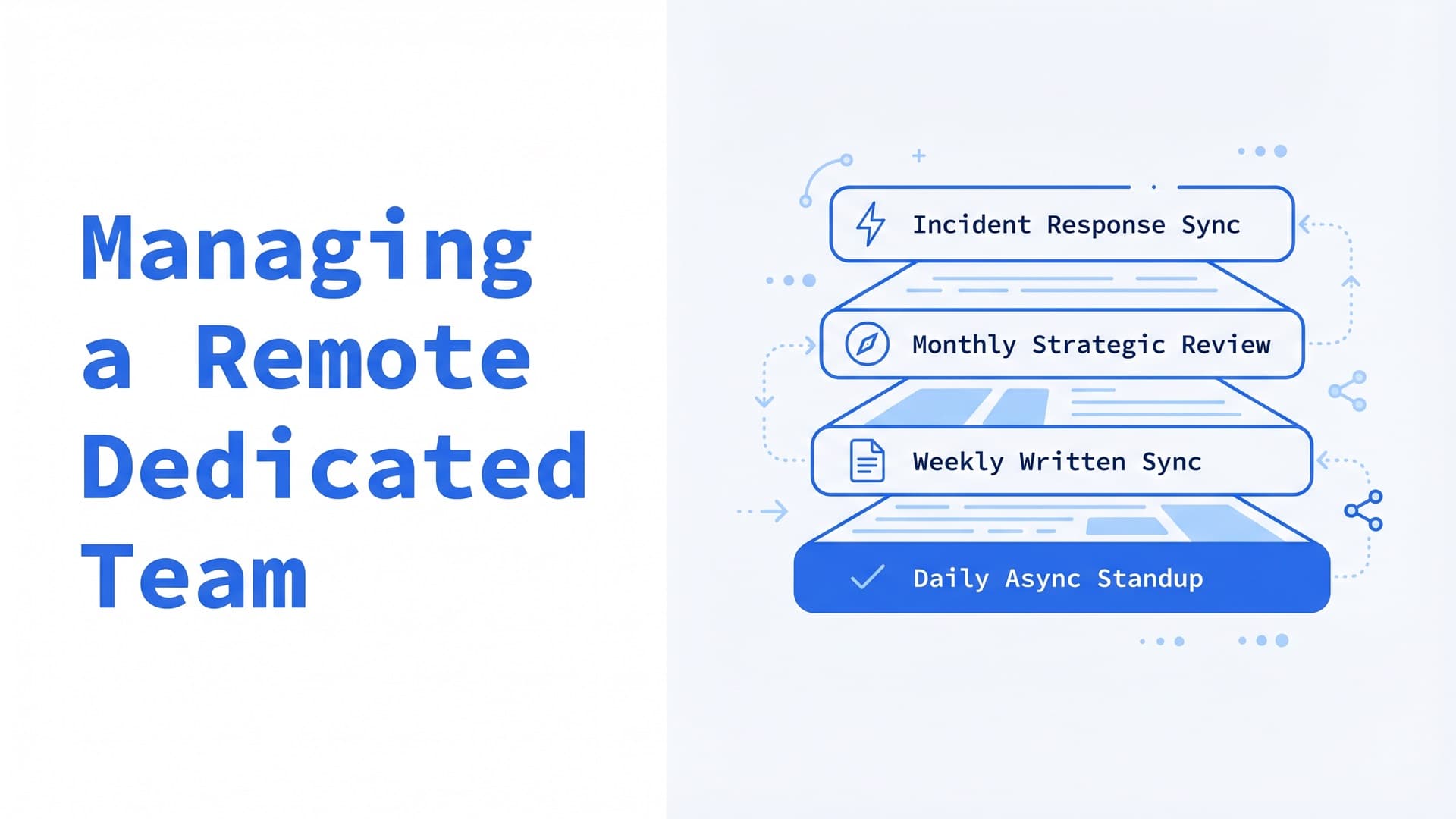
A well-run remote dedicated team operates on four distinct communication cadences, each serving a specific decision timescale. Missing any of them forces work back into synchronous mode by default.
1. Daily async standup
Not a meeting. A written update posted to a team channel — Slack, Linear, or a standup bot — at the start of each engineer's working day. Format: yesterday, today, blockers. Fifteen lines maximum.
The daily async standup does three things a video standup doesn't. It creates a searchable record of what got done, which is evidence for velocity discussions later. It forces engineers to articulate blockers in writing, which makes them specific enough to actually resolve. And it eliminates the timezone tax on a synchronous standup — engineers in different time zones post on their own schedule and read the others' updates on theirs.
Tools that work: the Geekbot or Standuply integrations with Slack do this well. The Linear updates feature serves the same function if the team already uses Linear. The specific tool is less important than the practice.
2. Weekly written sync report
One document per week, written by the vendor tech lead or PM, covering: what shipped, what's in progress, what's blocked, what decisions the client needs to make. Sent by Friday for the client to read Monday morning.
This is the artifact that replaces the 60-minute weekly video call where the PM "updates" the client on status. That call contains roughly 5 minutes of decision content and 55 minutes of scrollable information. The written sync report compresses the scrollable content into 10 minutes of reading and surfaces decision points explicitly.
The video call doesn't disappear entirely. It shrinks to 15-20 minutes focused on the decision points the written report raised. Across a four-person team, 40-45 minutes per participant per week compounds over a year into a meaningful block of engineering capacity that synchronous-default teams don't recover.
3. Monthly strategic review
The only reliably synchronous communication cadence. A 60-minute call where the client's tech lead, the vendor PM, and the client's business stakeholder review the quarter's goals, velocity against roadmap, staffing, and major upcoming decisions.
Bandwidth isn't the problem for this meeting — context-building is. The client stakeholder isn't reading the daily async updates. They need the vendor PM to synthesize a month of work into a 15-minute briefing they can act on.
4. Incident response synchronous
The exception to the async-first default. When a production incident is in flight, you want video, voice, screen share, and everyone in the same Zoom or Google Meet. The Google SRE book codifies this — incidents need an Incident Commander, a Communications Lead, and a direct comms channel. Slack is the running log; voice is the decision layer.
The rule that matters: incident-grade synchronous is opt-in during incidents, not the default pattern for normal work. Teams that run at perpetual incident-pace pay a burnout tax the DORA research has documented repeatedly across its annual State of DevOps reports — low-trust, high-meeting-density environments correlate with elevated burnout and reduced delivery performance.
The Pull Request as Management Artifact
The PR is where distributed team management lives in practice, because it's the only artifact that every stakeholder naturally touches. An effective remote team uses PRs as:
A decision record. The PR description explains not just what the code does, but why this approach was chosen over alternatives. Graphite's guide on tracking PR review turnaround treats review cycle time as a leading delivery indicator — and PRs with clear intent statements consistently clear review faster because reviewers don't have to reverse-engineer the goal from the diff.
A conversation surface. GitHub's line-level comments are lightweight async discussion of concrete code. For a remote team, the PR comment thread replaces the "can you jump on a quick call?" pattern. Threaded, searchable, referenced in commits.
A review SLA. Teams that hit 24-hour PR turnaround ship on pace. Teams at 48 hours or worse accumulate blocked work. CodeRabbit and similar AI review tools compress the first-pass review to minutes, leaving human review focused on judgment rather than style. For distributed teams where review-cycle time is the main delivery bottleneck, AI-assisted first-pass review removes the part of review humans are worst at — catching style drift — and keeps them focused on the parts they're uniquely good at.
A health signal. How much rework a PR takes on review tells you whether the team actually understands the codebase's standards. A dedicated team still accumulating review comments on the same style issues at month five is signaling that the ADRs and conventions aren't being read. Clean review by month two means onboarding actually landed.
Trust Is an Artifact Pattern
The common framing — "trust between client and remote team takes time" — is true but unactionable. The actionable version: trust accumulates through a specific set of artifacts produced on a specific cadence. Miss the artifacts, no trust accumulates regardless of how long the engagement runs.
The artifacts that build trust:
- Predictable daily updates. Engineers post the async standup. If the update goes quiet for two days, something is wrong. Consistency is the signal.
- Shipped work visible in production. Weekly demos of working features, even small ones. Video recordings, not live demos — live demos eat synchronous overlap.
- Clear ownership for incidents. When something breaks, the PagerDuty alert routes to a named engineer. That engineer posts a status update within the first 15 minutes and a postmortem within 5 days.
- Written postmortems. Blameless, specific, with action items tracked to completion. Google's postmortem template is public and free — adopt it verbatim.
- Regular architectural documentation. ADRs written for non-trivial decisions. The decision itself matters less than the commitment to write it down.
Trust doesn't build in verbal sync calls that leave no artifact. It builds in the accumulation of decisions, updates, and incidents that anyone can read three months later and reconstruct what happened.
Honest Boundary
Async-first remote management maps well to product engineering, platform engineering, data engineering, and infrastructure work. It maps less well to:
- Customer-facing work. Support engineering, pre-sales engineering, and customer success are harder to run async — the customer's synchronous expectations drive the cadence.
- High-urgency product spikes. The 2-week pre-launch sprint where everything is in flux often breaks async conventions because feedback loops need to be hours, not days. Good teams return to async defaults after the spike.
- Cross-functional ambiguous work. Projects where the specification is still being figured out with a non-technical stakeholder benefit from more synchronous time than stable engineering workstreams.
The framework also assumes the time zone overlap window is at least 2-3 hours per day. For engagements with under 2 hours of overlap — US West Coast to Tokyo, for instance — the synchronous cadences have to compress further, and the reliance on The Written Default becomes absolute rather than strong. Teams with zero overlap (following-the-sun across three continents) require a different operating model built around handoff rather than collaboration.
Finally: this framework assumes the vendor team has a tech lead or PM capable of producing the written artifacts. If the vendor is really staff augmentation in dedicated-team packaging (the Delivery Ownership pattern), the client ends up writing the artifacts themselves — which defeats the purpose of hiring a dedicated team in the first place.
Need help structuring remote team management without losing your week to video calls? Talk to an engineer.
If it's not written, it didn't happen. That's the whole discipline.
Frequently Asked Questions
What is the best way to manage a remote dedicated development team?
Adopt async-first communication by default. Every significant decision, spec, or architectural choice becomes a written artifact before it becomes a meeting. Use four distinct communication cadences: daily async standups in Slack or Linear, a weekly written sync report from the vendor PM, a 60-minute monthly strategic review, and synchronous-only incident response. GitLab's public async handbook is the reference implementation.
How often should I have meetings with a remote dedicated team?
Far fewer than most teams run. One 60-minute monthly strategic review with the vendor PM and client stakeholder is the minimum. A 15-20 minute weekly call focused on decision points raised in the written sync report replaces the typical 60-minute status update call. Video standups are a net drag on remote teams operating across 5+ hour time zone gaps. Write the standup instead.
What tools support async-first remote team management?
Slack or Teams for daily async standups (with Geekbot, Standuply, or Linear's updates feature); GitHub or GitLab for PR-based collaboration; CodeRabbit or similar AI review tools for first-pass PR review; Notion or Confluence for persistent documentation; Linear or Jira for ticket tracking. The tooling choices are less important than the disciplines: The Written Default, explicit cadences, and blameless postmortems.
How do I build trust with a dedicated team in a different country?
Trust accumulates through consistent written artifacts: predictable daily standups, weekly sync reports, shipped features visible in production (with recorded video demos), named incident owners with 15-minute status updates, blameless postmortems within 5 days, and Architecture Decision Records for non-trivial choices. Trust does not build from verbal synchronous calls that leave no artifact, regardless of how long the engagement runs.
How do I handle incidents with a remote dedicated team?
Incidents are the one permitted exception to async-first defaults. Use video calls, screen share, and a named Incident Commander per the Google SRE incident management framework. Slack channels carry the running log; voice carries the decisions. After resolution, a blameless postmortem lands within 5 days with specific action items tracked to completion. Normal work returns to async defaults; incident synchronous is opt-in during incidents only.
Related posts
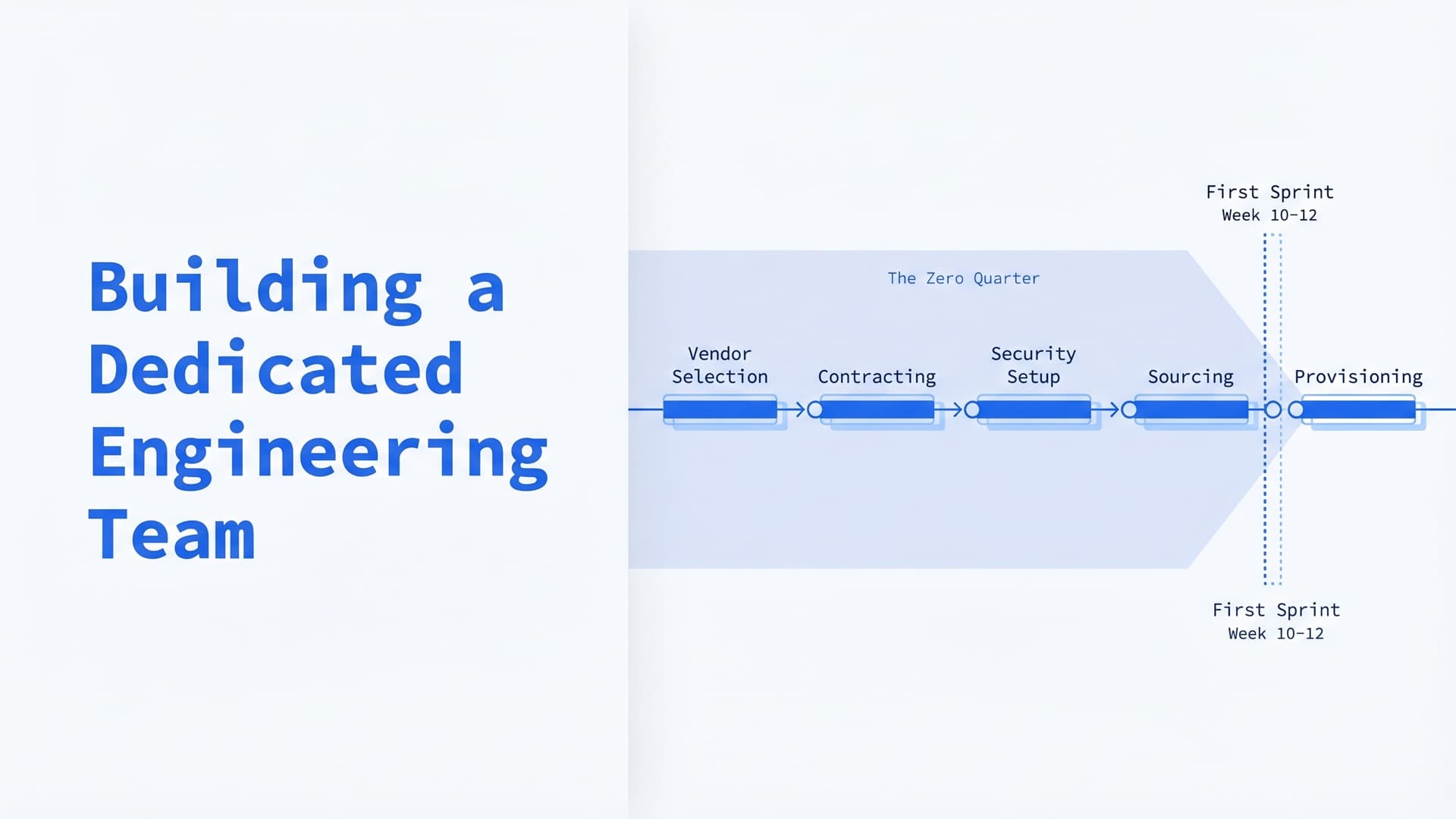
Building a Dedicated Engineering Team from Scratch: Timeline, Cost, and Mistakes
Vendor decks show 2 weeks. The real timeline is 10-16 weeks. Call it The Zero Quarter — everything between decision and first sprint. Cost model, worked example, and the five setup mistakes that compound.
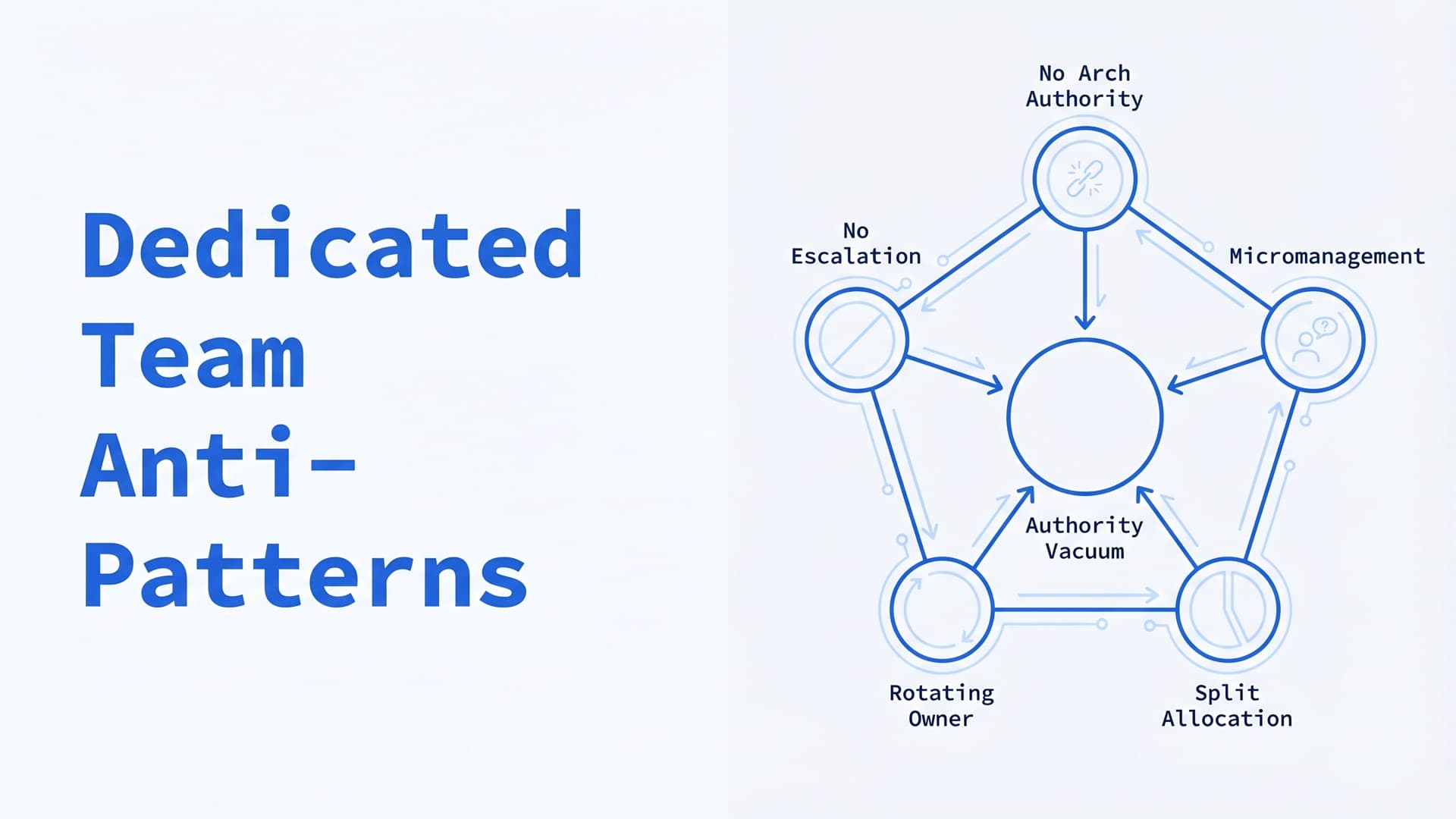
Dedicated Team Anti-Patterns: 5 Governance Failures That Kill Productivity
Five governance failures account for most dedicated team engagement failures — and none of them are about engineer quality. The Authority Vacuum, the five patterns it creates, and how to diagnose which one you have.
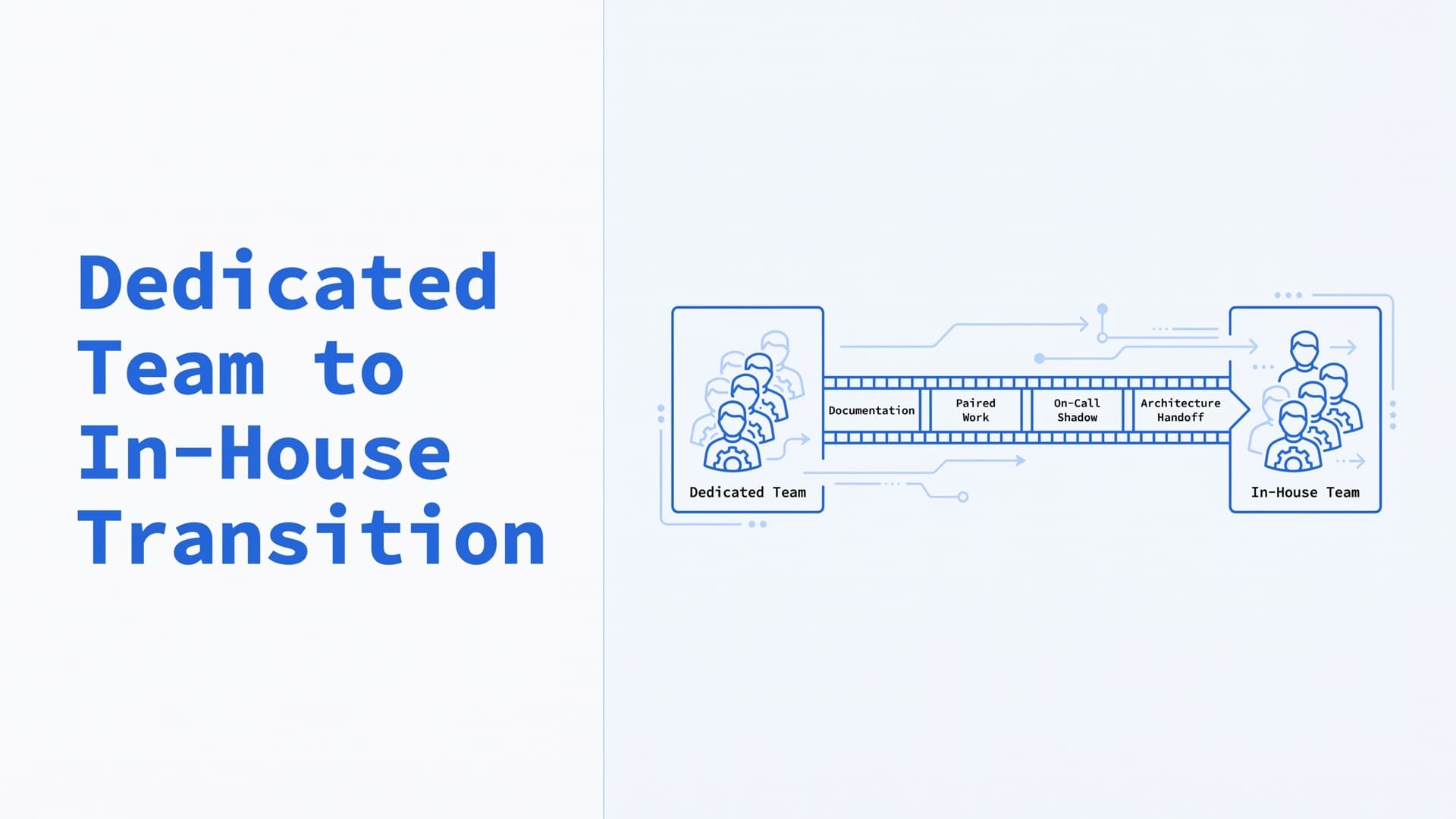
When to Bring a Dedicated Team In-House (And How to Do the Transition)
70% of executives have selectively insourced. The Knowledge Bridge is what separates successful transitions from expensive restarts. Signals, playbook, and the four failure modes that sabotage in-housing.