When to Bring a Dedicated Team In-House (And How to Do the Transition)
Deloitte's 2025 Global Business Services Survey found that 70% of executives have selectively insourced scope previously held by third-party providers over the last five years. The direction of travel is clear: the default is no longer "outsource as much as possible." The default is "outsource where it makes sense, bring in-house when it stops making sense."
For a dedicated team that's grown to 8-15 engineers over 18-24 months, "stops making sense" arrives somewhere around a specific combination of scale, product maturity, and talent market conditions. The transition to in-house is a real strategic move — not a failure of the vendor, not a rejection of the engagement, and not a snap decision. It's the point where the vendor has done its job so well that the work should no longer belong to them.
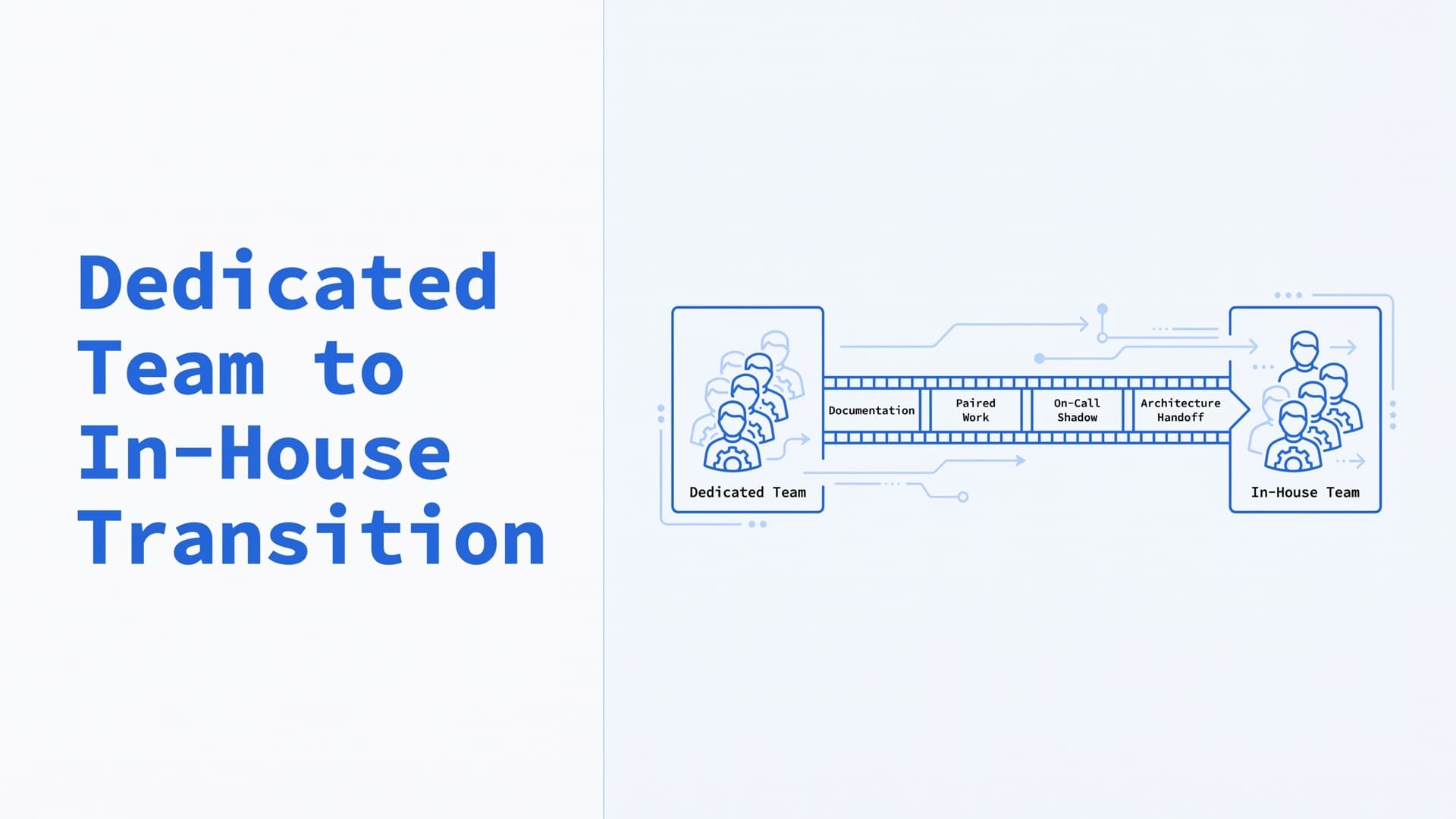
The question then becomes not whether, but how. The failure mode is the same across most transitions: the work transfers, but the context doesn't. Three months after the transition, the newly-hired in-house team is reverse-engineering decisions the dedicated team made casually two years earlier, and losing weeks per decision in the process. This is The Knowledge Bridge: the deliberate, structured transfer of everything the dedicated team knows but hasn't written down. Without it, in-housing is a restart at 50% velocity with all the hiring cost of a full start. With it, in-housing lands with most of the team's accumulated context preserved.
The Signals That Say It's Time
Three signal categories indicate the dedicated team engagement is approaching the in-housing decision. None alone is decisive; two or three together usually are.
1. Product maturity has outpaced the engagement structure.
A dedicated team is optimally suited to a specific kind of work: a well-scoped product area with predictable complexity, ongoing roadmap commitment, and enough ambiguity that the team adds value through judgment, not just execution. When the product transitions to mature operation — where the velocity needs are lower, the work is more predictable, and the coordination tax of external ownership starts to feel heavy — the fit degrades. Symptoms: most sprints are maintenance and small enhancements rather than feature building; the vendor PM spends more time documenting status than resolving decisions; retrospectives repeat the same topics because there isn't much new to discuss.
2. The talent market has shifted in your favor.
One of the original reasons for engaging a dedicated team is typically talent access — senior specialists you couldn't reliably hire directly. That equation changes. The Deloitte 2025 survey notes that 70% of enterprise buyers have selectively insourced in the last five years, driven partly by the rise of remote-first hiring making specialist talent accessible across more geographies. If the specific skill profiles that drove the original engagement are now hirable directly in a compatible time zone and comp band, the arbitrage thesis weakens.
3. The total cost of ownership has flipped.
In the 12-month crossover analysis, dedicated teams beat in-house on total cost for the first 12-24 months because of attrition absorption, knowledge retention, and management layer bundling. Past 24-36 months, the equation often reverses: the dedicated team has become expensive relative to direct hires in the same geography, the client has enough volume to amortize fixed hiring costs, and the internal processes needed to support the team have matured. At that point, the client is paying vendor margin on top of the same cost structure they could operate directly.
Two of these signals for two consecutive quarters is usually the point where the in-housing conversation should start formally. All three is usually a point where it should have started three quarters earlier.
The Transition Playbook
The transition from dedicated team to in-house takes 6-12 months done well, 12-18 months done averagely, and in some cases simply doesn't complete — the knowledge walks out the door and has to be rebuilt. Three phases.
Phase 1: Decision and Structure (months 0-3)
The client decides to in-house and communicates the decision to the vendor explicitly, with a timeline. Vague "we might in-house sometime" signaling is the worst possible path because it creates ambiguity that discourages the vendor from investing in the knowledge transfer they should be helping with.
Decision artifacts in this phase:
- Target team structure. How many engineers, which seniority mix, which roles. Usually maps closely to the current dedicated team composition, though not always 1:1.
- Geographic strategy. Where the in-house team will sit — same region as the current dedicated team (allowing more transfer candidates) or a different market.
- Conversion offers where applicable. The client offers direct employment to engineers on the current dedicated team, with defined start dates and buyout compensation to the vendor. Buyout fees typically run $14,000-$20,000 per engineer according to HighCircl's 2026 benchmarks, or 18-25% of annual salary.
- Retention contract. The vendor continues to run the engagement during the transition, with an agreed end date and milestones that trigger progressive scope reduction as the in-house team ramps.
The critical point: the vendor should be explicitly incentivized to help the transition succeed, not penalized for losing the engagement. A professional relationship survives well-structured transitions; a surprise non-renewal rarely does.
Phase 2: The Knowledge Bridge (months 3-9)
This is where the transition lives or dies. The Knowledge Bridge has four components, each requiring specific work.
Documentation sprint. The dedicated team spends 10-20% of capacity for 3-4 months building documentation that doesn't currently exist — ADRs backfilled for historical decisions, runbooks for operations the team handles by instinct, architectural diagrams, onboarding playbooks. The GitLab handbook's documentation standards are a useful reference for the depth required.
Paired development. For at least 2-3 sprints, new in-house hires pair with dedicated team engineers on real work. Not shadow-observation; actual pairing, where the in-house engineer drives and the dedicated team member advises. This is where tacit knowledge transfers — the "we tried that approach two years ago and it broke because of X" context that documentation can't fully capture.
On-call shadowing. The in-house team joins the incident rotation as secondary responders, with the dedicated team primary, for 2-3 months before inverting the arrangement. Production context transfers fastest through actual incidents.
Architectural review handover. The dedicated team's tech lead runs one final architectural review with the in-house tech lead present, documenting the current state of architectural decisions, known debt, and planned evolution. After this, the in-house tech lead owns architectural authority.
Phase 3: Cutover and Tail (months 9-12+)
The formal transition happens in a defined week: the dedicated team stops owning delivery, the in-house team takes over, the vendor contract scales back to whatever residual scope (if any) was agreed. The tail period matters.
Retain the vendor in a reduced capacity — usually 1-2 engineers or the tech lead on retainer for 3-6 months post-cutover, at a lower weekly hour commitment. This is insurance against the first wave of "what does this variable mean?" questions from the new in-house team. Discontinuing the vendor relationship entirely at cutover saves money in the short run and loses more in the first quarter when the context gaps show up.
What Typically Goes Wrong
Four failure modes account for most unsuccessful transitions.
The context evaporation. The dedicated team knows everything; the in-house team knows the code. When the transition happens without the structured knowledge bridge above, what transfers is the code — what doesn't transfer is the reasoning, the historical trade-offs, the "we chose A because B broke at scale" context. The in-house team reinvents decisions the dedicated team made thoughtfully years earlier, often worse.
The conversion gap. The client assumes they can hire the current dedicated team's engineers directly. Some can be hired; others can't — visa constraints, comp mismatches, vendor non-solicitation clauses, personal preferences. A realistic planning assumption is that 40-60% convert at most; budget for replacing the rest with net-new hires carrying the full ramp-up cost.
Next, the vendor relationship breakdown. The client announces the in-housing decision as a surprise or frames it adversarially. The vendor's response is rational: deprioritize the transition work, let the engagement drift toward its end date, help with knowledge transfer only to the contractual minimum. Transitions against a resistant vendor can take twice as long and leave substantial context on the table.
And finally, cutting over too fast. The in-house team looks ready — they've been shadowing for three months, velocity is climbing, documentation is in place. The client ends the vendor engagement entirely. Month two post-cutover, an architectural question surfaces that nobody on the in-house team can answer, and the relationship that would have resolved it in a Slack message is gone.
Honest Boundary
This framework assumes the transition is going from dedicated team to direct in-house hires. Several variants require different playbooks:
- Build-Operate-Transfer (BOT). Some vendors offer a contractual transition model where the vendor builds a team, operates it under vendor employment for 1-2 years, then transfers the team and its operations to the client. Deloitte's 2025 Global Business Services Survey covers the BOT model in the context of Global In-house Centers. BOT is distinct from a transition from an existing dedicated team engagement — the knowledge bridge dynamics apply, but the contract structure and vendor incentives are different from the start.
- Partial in-housing. A common middle path is in-housing the core team while keeping the vendor for peripheral capabilities (specialist roles, surge capacity, 24/7 on-call coverage). The transition playbook still applies to the scope being in-housed; the remaining scope stays as a smaller ongoing engagement.
- In-housing to a different geography. If the new in-house team sits in a different region from the current dedicated team, time zone overlap matters for the paired development and on-call shadowing components. The transition timeline extends when the overlap window is narrow.
- Transitions driven by vendor failure. If the client is in-housing because the vendor engagement isn't working, the Knowledge Bridge plan needs adjustment — a disengaged or underperforming vendor won't participate constructively, and the client has to accept a higher context-loss rate and budget for rebuilding more from scratch.
One last note: in-housing isn't the right answer for every dedicated team engagement. Teams working on non-core but critical functions (platform infrastructure, compliance-heavy workstreams, specialist ML research) can reasonably stay with a dedicated team indefinitely. The 12-month crossover analysis inverts back for very long-horizon work — a team that's been running 4-5 years at high output with low turnover is probably more valuable to keep than to in-house, regardless of the surface economics.
Need help designing a dedicated team transition that preserves what took years to accumulate? Talk to an engineer.
The work transfers in days. The context takes months. Build the bridge before the cutover, or rebuild the context after.
Frequently Asked Questions
When should I transition a dedicated team to in-house?
When two or three specific signals converge for two consecutive quarters: product maturity has outpaced the engagement structure (sprints shift toward maintenance over feature work), the talent market has shifted so specialist hires are directly accessible, and total cost of ownership has flipped against the vendor arrangement (typically past 24-36 months of engagement). Deloitte's 2025 survey finds 70% of executives have selectively insourced over the last five years, usually driven by this pattern.
How long does it take to transition a dedicated team in-house?
Six to twelve months done well, 12-18 months done averagely. Three phases: decision and structure (0-3 months), the Knowledge Bridge (3-9 months including documentation sprint, paired development, on-call shadowing, and architectural handover), and cutover plus tail (9-12+ months with reduced vendor retainer for post-cutover context questions). Attempting the transition in under six months typically loses substantial context that becomes expensive to reconstruct.
What happens if we just terminate the dedicated team contract and hire directly?
The code transfers; the context doesn't. The in-house team inherits the codebase without the historical reasoning, trade-off decisions, or institutional memory that shaped it. A realistic planning assumption is that effective velocity drops materially for the first 3-6 months while the context gets reconstructed — the same ramp curve documented in the Month-Three Cliff analysis, applied to an already-working team instead of a new one. Structured knowledge transfer — the Knowledge Bridge — is what prevents this productivity tax.
Can I hire the dedicated team's engineers directly?
Some of them. A realistic planning assumption is that 40-60% convert at most — visa constraints, compensation mismatches, vendor non-solicitation clauses, and personal preferences take the rest off the table. Buyout fees for each conversion typically run $14,000-$20,000 per engineer or 18-25% of annual salary per HighCircl's 2026 benchmarks. Budget for replacing the remainder with net-new hires who require full ramp time.
Should we keep any relationship with the vendor after in-housing?
Yes, usually. Retain 1-2 engineers or the former tech lead on a reduced retainer for 3-6 months post-cutover. The insurance value against context questions, "what did you mean in that comment" inquiries, and unfamiliar edge cases typically exceeds the retainer cost. Discontinuing the vendor entirely at cutover saves money in the short run and loses more in the first quarter when the context gaps surface.
Related posts
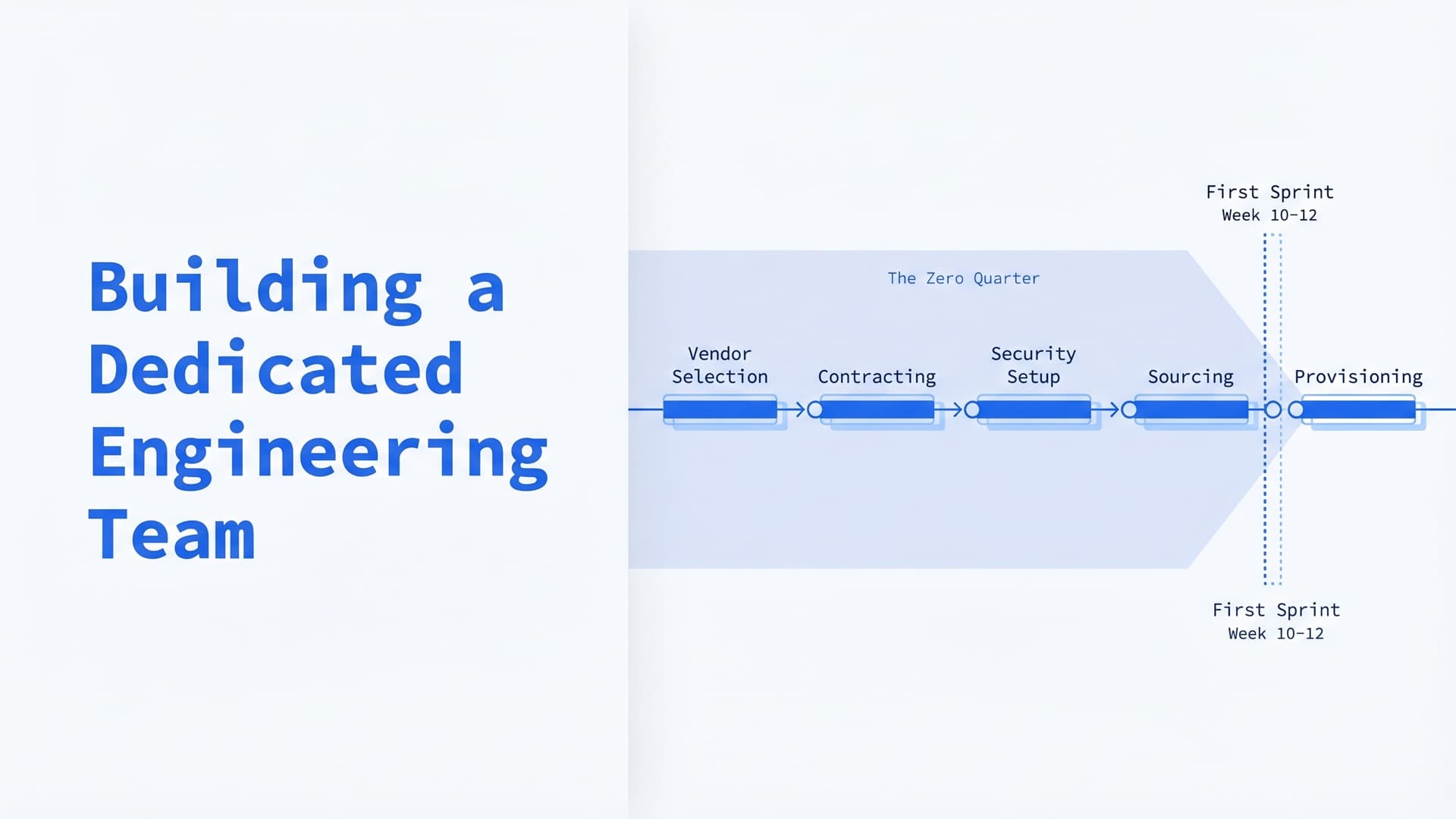
Building a Dedicated Engineering Team from Scratch: Timeline, Cost, and Mistakes
Vendor decks show 2 weeks. The real timeline is 10-16 weeks. Call it The Zero Quarter — everything between decision and first sprint. Cost model, worked example, and the five setup mistakes that compound.
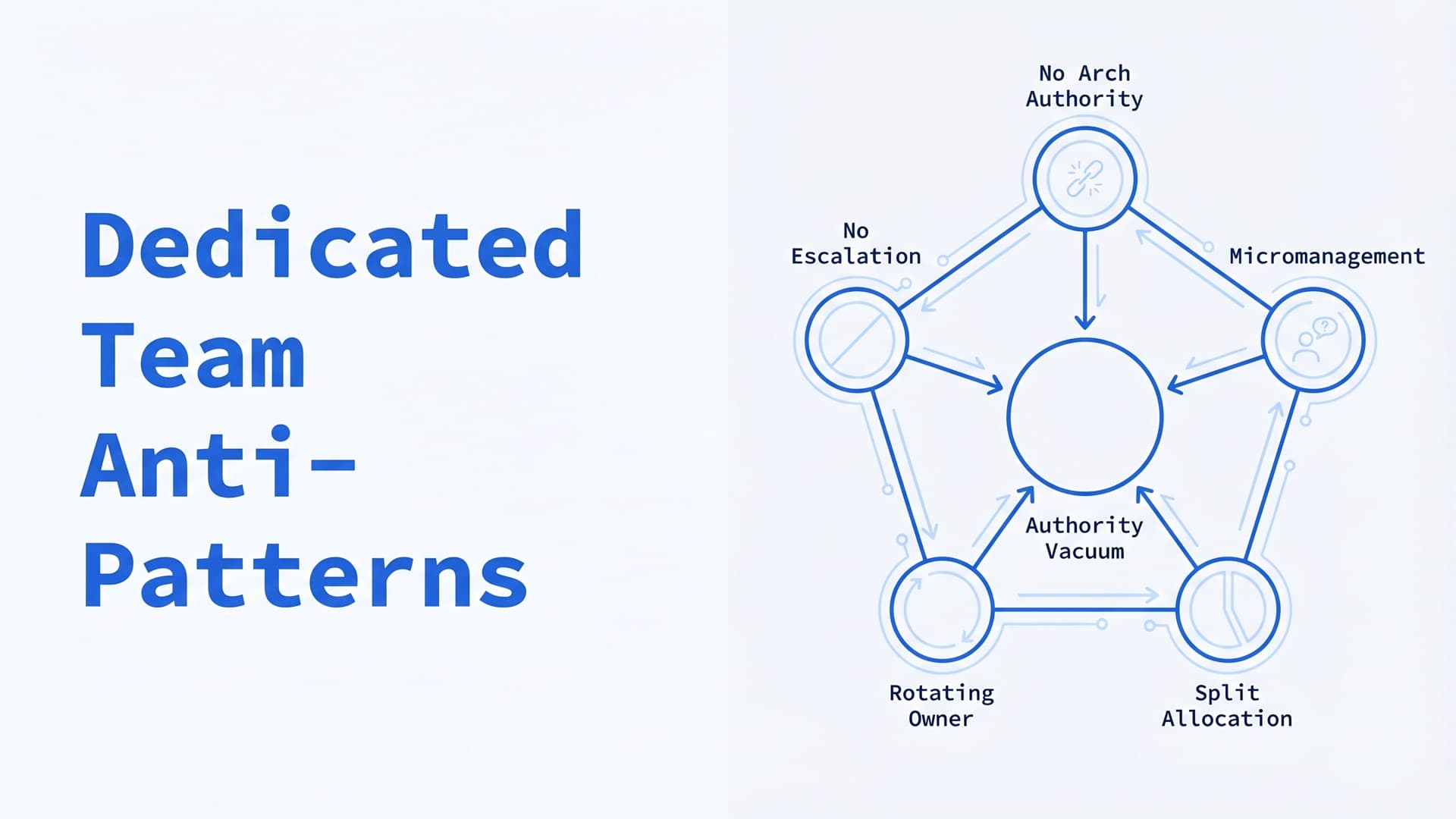
Dedicated Team Anti-Patterns: 5 Governance Failures That Kill Productivity
Five governance failures account for most dedicated team engagement failures — and none of them are about engineer quality. The Authority Vacuum, the five patterns it creates, and how to diagnose which one you have.
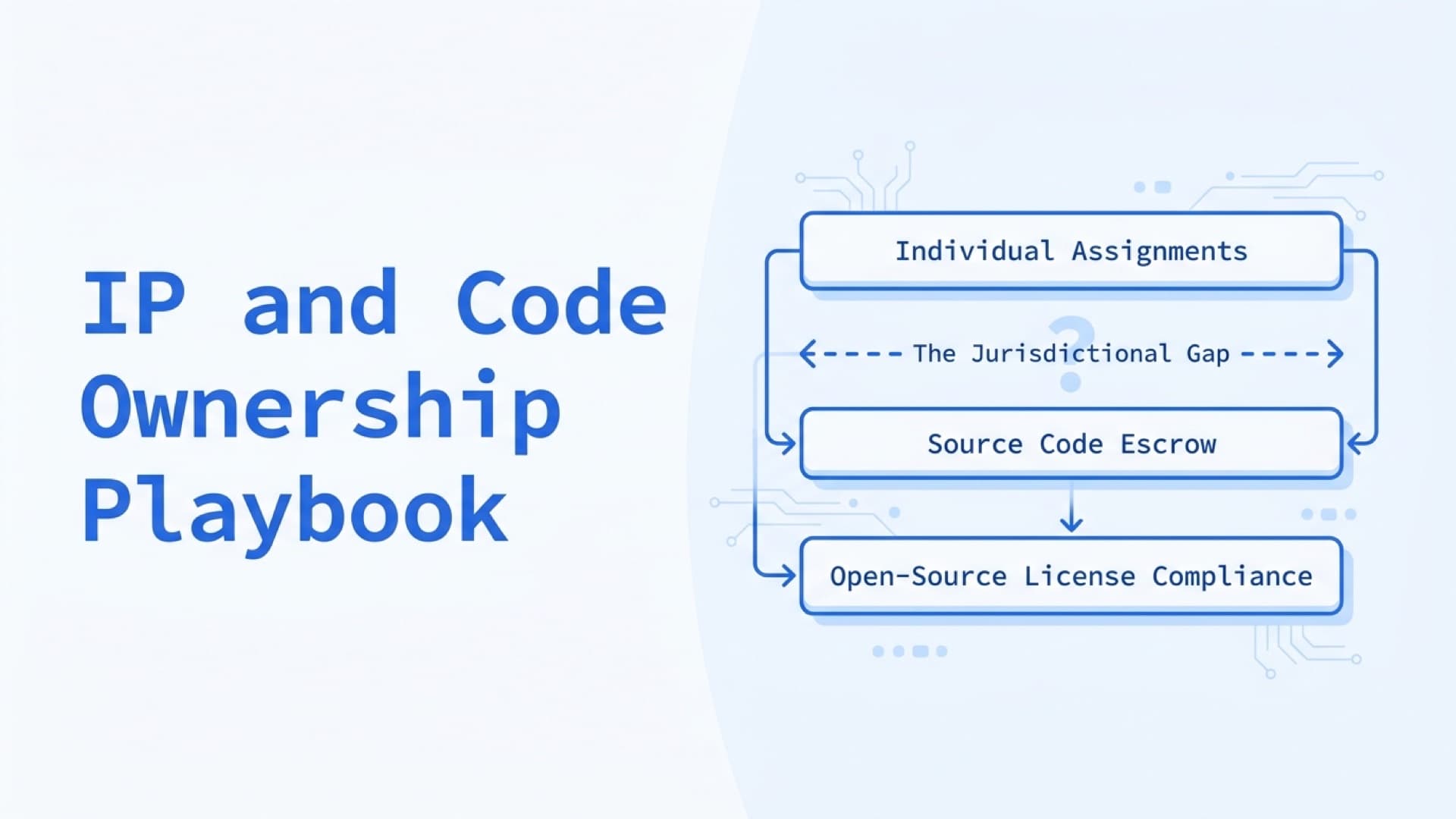
The IP and Code Ownership Playbook for Dedicated Development Teams
Work-for-hire doesn't usually work. The Jurisdictional Gap — between where the contract is signed and where the code is written — is where IP protection fails. Three layers of protection and the contract clauses that close the gap.