Building a Dedicated Engineering Team from Scratch: Timeline, Cost, and Mistakes
Vendor decks show a 2-week setup timeline. The real number for a new dedicated team engagement is 10-16 weeks from decision to first sprint — and most of the gap isn't the vendor's fault.
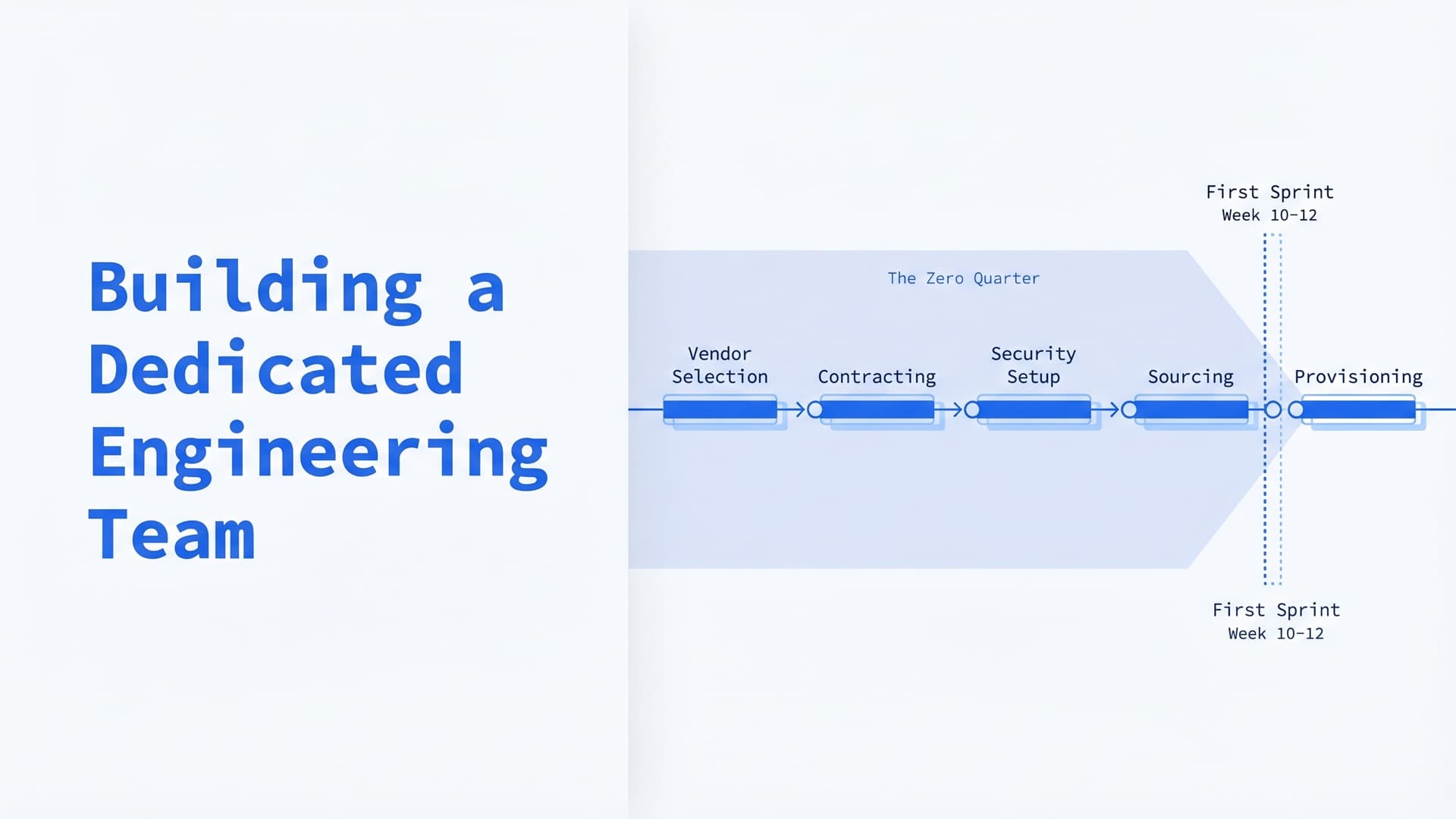
Vendor selection takes two to four weeks. Contracting takes another two to six. Security and access provisioning runs parallel for three to eight weeks depending on compliance requirements. Engineer sourcing against a defined profile runs 4-8 weeks. The critical decisions on a new engagement happen before any engineer writes a line of code. None of that timeline appears in any pitch deck.
Call this The Zero Quarter: the 60-120 days between the decision to hire a dedicated team and the first sprint commit. Everything after is execution. Everything inside The Zero Quarter is where the engagement is built right or built wrong, at a cost that doesn't appear on the invoice but compounds for the life of the contract.
The Realistic Setup Timeline
Most "dedicated team in 2 weeks" pitches describe the staffing step in isolation — the vendor pulling a team together from existing bench. That step genuinely can take 2-4 weeks at a vendor with an active bench. The other steps, which the vendor can't compress because they require the client, typically can't.
A reference timeline for a four-person dedicated team at a mid-market vendor:
| Phase | Duration | Owner | Common Stalls | |-------|----------|-------|---------------| | Vendor selection (RFP, calls, comparison) | 3-6 weeks | Client | Slow internal stakeholder alignment | | Contract negotiation (MSA + SOW) | 2-6 weeks | Client + Vendor Legal | IP assignment language, SLA terms | | Security review and compliance setup | 2-8 weeks | Client Security + Vendor | SOC 2 artifacts, DPA under GDPR | | Engineer sourcing against defined profile | 3-8 weeks | Vendor | Profile ambiguity; fresh hiring vs bench | | Environment provisioning (repo, SSO, cloud access) | 1-3 weeks | Client DevOps | Access policy, secrets management | | Onboarding and first sprint ramp | 4-8 weeks | Both | Missing documentation, unclear first goals |
Parallelized well, the client reaches first sprint at week 10-12. Serialized poorly, 16-20 weeks is common. A Deloitte Global Outsourcing Survey finding worth noting: 70% of enterprise buyers report their Vendor Management Office function is "not fully mature" — the single largest driver of serialization during The Zero Quarter. Client process maturity, not vendor capacity, is usually the pace limit.
The Cost Model Nobody Publishes
Most dedicated team cost conversations focus on the monthly retainer. The Zero Quarter has its own cost structure that buyers regularly omit from budget planning:
Vendor selection cost. Running a proper vendor comparison means 3-5 vendor calls, sometimes with a paid deep-dive (some vendors charge $2,000-$5,000 for a discovery engagement), reference checks, and legal review of contracts. Internal time on this: 40-80 hours across technical lead, PM, and legal. At fully-loaded US senior rates of $170-$240K/year, that's $6,500-$18,000 of internal cost before any vendor is selected.
Contract negotiation cost. MSA negotiation averages 2-6 weeks of legal back-and-forth on a mid-market SOW, longer for enterprise-grade vendors where IP assignment, data protection, and termination clauses all require detailed review. External counsel cost scales with deal size: low-single-digit thousands for under-$500K-annual-value contracts, materially more at enterprise scale. The internal PM and legal time doesn't get invoiced but does get spent.
Security and compliance artifacts. If the engagement requires SOC 2 Type II verification, GDPR Article 28 DPA execution, HIPAA BAA, or a security questionnaire the vendor has to complete from scratch, the client side spends 20-60 hours of security team time. Vendors without existing compliance packages push this work back onto the client at 2-3x the duration.
Environment and access provisioning. Provisioning repo access, SSO integration via Okta or similar, secrets management (Vault, Doppler, or 1Password), VPN access, and cloud IAM for a four-person team is roughly 20-40 hours of DevOps time — one to three weeks elapsed, depending on whether the client has templates or is building access policies during the onboarding.
Ramp-up productivity deficit. Through the IEEE-documented 3-9 month ramp curve, a new team delivers partial velocity while the client pays the full retainer. Priced against a $40K/month contract, the first quarter's deficit runs $30,000-$50,000 in output value that the contract doesn't discount.
Total Zero Quarter cost outside the retainer: $50,000-$120,000 for a standard mid-market dedicated team engagement. None of that appears on the vendor's first invoice. Most of it appears on the client's P&L as undifferentiated "engineering overhead."
The Five Setup Mistakes That Compound
Zero Quarter mistakes don't surface as problems in month one. They surface as structural drag that a team can't overcome in months 4-12.
Mistake 1: Profile ambiguity at the sourcing step
The client asks the vendor for "a four-person full-stack team with Kubernetes experience." The vendor delivers four engineers with varying definitions of "experience." Three months later the team can't deploy to staging without the client's internal DevOps engineer helping.
Fix this by writing an explicit engineer profile per seat before sourcing begins. Specify years of primary-language experience, production system size handled previously, and one or two named toolchain proficiencies (e.g., "shipped production services on EKS with Helm, 3+ years"). Non-ambiguous profiles extend sourcing by 1-2 weeks and eliminate the dominant category of skill mismatch.
Mistake 2: IP assignment language left to the vendor's template
The vendor provides a default MSA with IP assignment terms that look reasonable at first read. Then, per Orrick's cross-jurisdictional analysis of IP assignments, the client discovers that assignments from developers in France or Germany require specific formalities the template doesn't include — so some of the "assigned" IP is actually still owned by the individual developer in their home jurisdiction.
Have IP assignment language reviewed by counsel aware of the jurisdictions where the vendor's engineers actually sit. This matters specifically for vendors with CEE or multi-country teams. The work-for-hire doctrine is particularly weak for US software contractor relationships because software often doesn't fall within the statutory categories and the contractor relationship test frequently fails — an explicit IP assignment with per-jurisdiction formality compliance is the reliable pattern.
Mistake 3: No defined first-sprint scope before engineers start
Engineers arrive on day one, attend the kickoff meeting, and are told "we'll find something for you to work on this week." They spend the first sprint on miscellaneous tickets. Week three passes before they've touched the product's core work.
Triage the first sprint's scope — at least the first 3-5 tickets — before the engineers' first day. The tickets should be real product work, not warm-ups. The Wise CTO's onboarding playbook specifies daily 2-hour pairing on real sprint tasks from day one, which requires day-one-ready tickets.
Mistake 4: Security provisioning compressed into the first week
Engineers arrive, then the client's security team starts setting up SSO, VPN, repo access, and cloud IAM. The engineers sit idle while provisioning works. Five to ten person-days lost across a four-person team in the first two weeks — a setup loss that the engagement's retainer clock still runs through.
Run security and access provisioning parallel with engineer sourcing, not after it. By the time engineers arrive, SSO roles should be pre-defined, repo access should follow a documented role template, and secrets management should be configured. Zero-trust tooling like Tailscale or Cloudflare Access makes this substantially faster than legacy VPN setups that require static configuration per user.
Mistake 5: No client-side owner for the vendor relationship
An absent client owner is the mistake that most reliably turns a promising contract into an underperforming one. It takes four months to show up.
The client signs the contract, the CEO moves on to other work, and the vendor has no counterpart. Questions route to generic inbox addresses. The relationship atrophies over the first 90 days. By month four, the client has no visibility into what the vendor's actually doing and no structure for getting it.
Name one client-side person — tech lead, engineering manager, or VP Engineering — as the vendor relationship owner, with a defined time allocation (usually 4-8 hours/week at minimum for a four-person team). The KPMG 2025 outsourcing analysis identifies client-side governance maturity as a top driver of whether outsourced engagements succeed.
A Worked Example
A client hires a four-person Go + React team for a mid-sized product at a mid-market vendor. Assume a $32K/month retainer and a well-run Zero Quarter.
Week 0: Decision made. Budget approved at board.
Weeks 1-3: Four vendors shortlisted. Three discovery calls per vendor. Technical lead evaluates team composition offered. Reference calls with two existing clients per finalist.
Weeks 3-5: Contract negotiation with selected vendor. MSA has been pre-reviewed by legal against the team's standard outsourcing template (saved 1-2 weeks). SOW scopes first six months.
Weeks 4-6 (parallel): Security review in progress. Client sends vendor its vendor questionnaire; vendor responds with pre-packaged SOC 2 Type II artifacts and HIPAA BAA template. DPA executed under GDPR Article 28.
Weeks 5-8: Engineers sourced against explicit profiles. Vendor's bench has two; hires two externally. Pre-boarding docs sent before start date.
Week 8: Environment and access provisioned. SSO roles, repo permissions, cloud IAM, Vault secrets configured. A pre-built onboarding checklist lives in the client's Notion.
Weeks 9-10: First three sprint tickets triaged and ready. Architectural overview and ADRs shared with team.
Week 11: Team starts. Day-one pairing on real sprint work. First commits land day 3-4.
Weeks 11-14 (first four weeks of engagement): Velocity inside the composite curve range documented in the Month-Three Cliff analysis. The buddy assignment holds. PR review turnaround under 24 hours by week 3.
Week 22 (month 3): Team has crossed the cliff on the healthy side — independent ticket closure, 24-hour PR review, architectural questions instead of permission questions.
Total calendar time from decision to first sprint: 10-11 weeks. Zero Quarter cost outside retainer: roughly $55,000. Retainer run-rate: $32,000/month, with full value returning by month 4-6.
Honest Boundary
The timelines and costs here assume a vendor with actual dedicated-team infrastructure — an engineer bench, compliance artifacts, onboarding templates, dedicated PM roles. At smaller providers (low double-digit headcount), most of those artifacts don't exist pre-engagement; they get built during The Zero Quarter, which typically extends it by 4-6 weeks.
The cost ranges also assume a non-regulated engagement. Healthcare, fintech, and defense work add compliance overhead that can double the Zero Quarter cost. A dedicated team shipping PHI for a healthcare client runs an additional 2-4 weeks for HIPAA BAA and technical safeguards review, plus 20-40 hours of security team time the base model doesn't price.
Two other caveats worth flagging:
- Greenfield engagements shift the cost. Building a new service from scratch removes the "learn the existing codebase" ramp cost but adds architectural decision-making that extends the first-sprint scope definition step. The Zero Quarter tends to come out in the same calendar range, with the costs distributed differently.
- Staff augmentation with dedicated-team language is the dominant trap. A vendor pitching "dedicated team" for 2-3 engineers without a tech lead or PM is really selling staff augmentation. The Delivery Ownership Question applies. The Zero Quarter for real staff augmentation is 2-4 weeks, not 10-12 — the trap is paying a dedicated-team Zero Quarter timeline for staff augmentation capabilities.
Need help running a Zero Quarter that doesn't cost six months? Talk to an engineer.
The first sprint feels like the start. It isn't. It's the output of everything The Zero Quarter already decided.
Frequently Asked Questions
How long does it take to set up a dedicated development team from scratch?
Realistically 10-16 weeks from the decision to hire through first sprint kickoff. Vendor selection runs 3-6 weeks; contract negotiation 2-6 weeks; security and compliance setup 2-8 weeks; engineer sourcing 3-8 weeks; environment provisioning 1-3 weeks. Poorly parallelized setups run 16-20 weeks. The Deloitte Global Outsourcing Survey finds 70% of enterprise Vendor Management Offices aren't fully mature — client-side process, not vendor capacity, is the typical pace limit.
What does it cost to set up a dedicated team before the first sprint?
$50,000-$120,000 outside the monthly retainer for a standard mid-market four-person engagement. Components: vendor selection cost ($6,500-$18,000 of internal time), contract negotiation ($3,000-$8,000 external legal plus internal time), security and compliance artifacts (20-60 hours of security team effort), environment provisioning (20-40 hours of DevOps), and ramp-up productivity deficit ($30,000-$50,000 in the first quarter against a $40K/month retainer).
What are the most common mistakes when hiring a dedicated development team?
Five: ambiguous engineer profiles that produce skill mismatches, IP assignment language that doesn't account for the jurisdiction where developers actually sit, no defined first-sprint scope when engineers arrive, security provisioning compressed into the first week instead of parallelized with sourcing, and no named client-side owner for the vendor relationship. KPMG's 2025 analysis identifies absent client ownership as a top-three driver of failed outsourced engagements.
When should I start onboarding preparation before engineers arrive?
Begin onboarding artifact preparation at contract signing — six to ten weeks before engineers start. Minimum: one-command local environment setup, architectural overview with system boundaries, deploy path documentation, and Architecture Decision Records explaining codebase history. Teams with those artifacts in place reach first-PR-in-production in days; teams without them typically take weeks, as documented in the Month-Three Cliff ramp analysis.
How do I structure a dedicated team contract to protect against setup failures?
Require an explicit engineer profile per seat before sourcing, specify IP assignment with per-jurisdiction formality compliance (Orrick documents significant variance across US/UK/France/Germany), include a replacement SLA measured in weeks, name a dedicated vendor PM or tech lead by role not by person, require pre-packaged SOC 2 Type II or equivalent artifacts, and bind the vendor to a ramp milestone KPI — first PR by week 2, first feature by week 6, first solo sprint by month 3.
Related posts
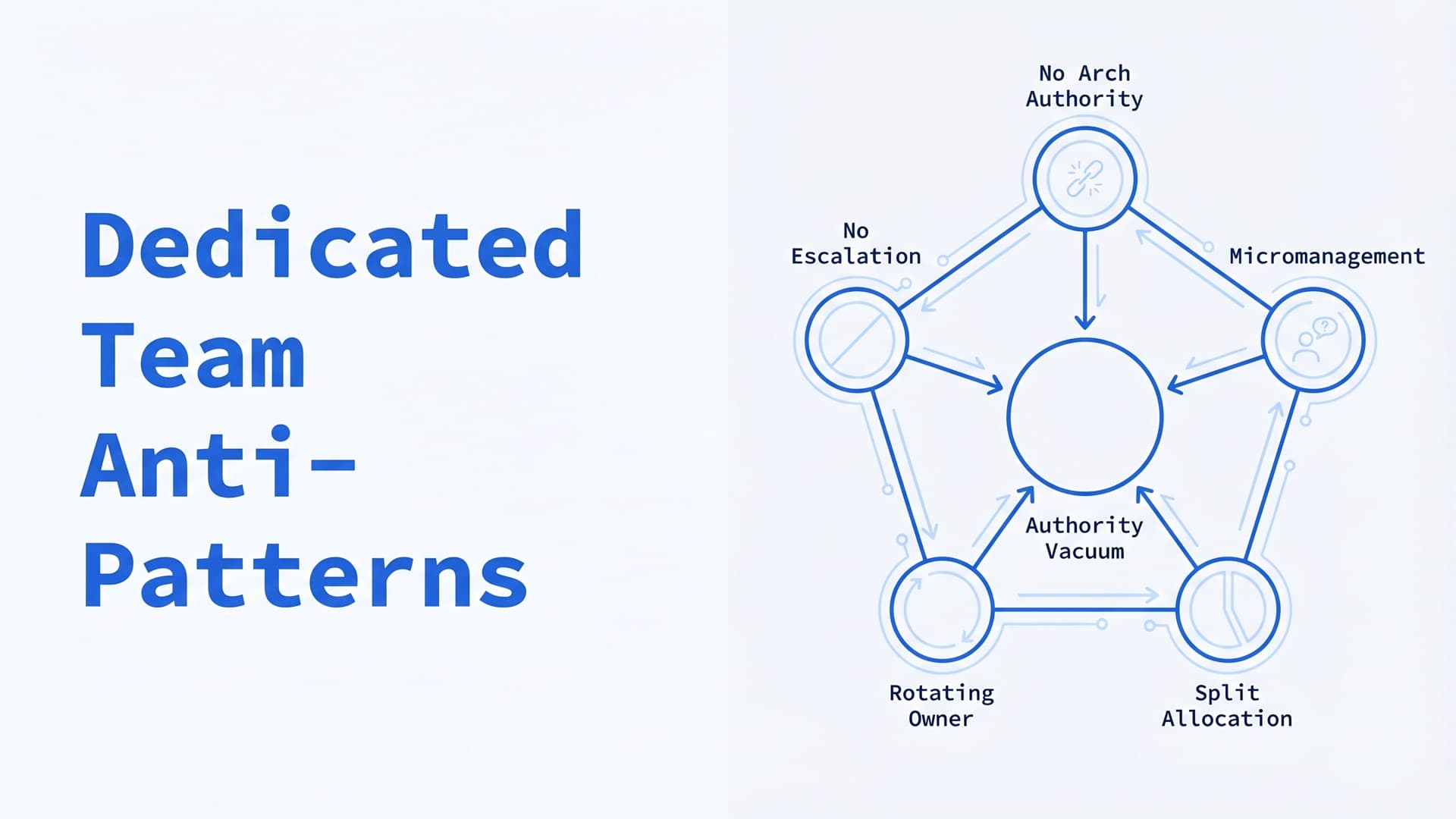
Dedicated Team Anti-Patterns: 5 Governance Failures That Kill Productivity
Five governance failures account for most dedicated team engagement failures — and none of them are about engineer quality. The Authority Vacuum, the five patterns it creates, and how to diagnose which one you have.
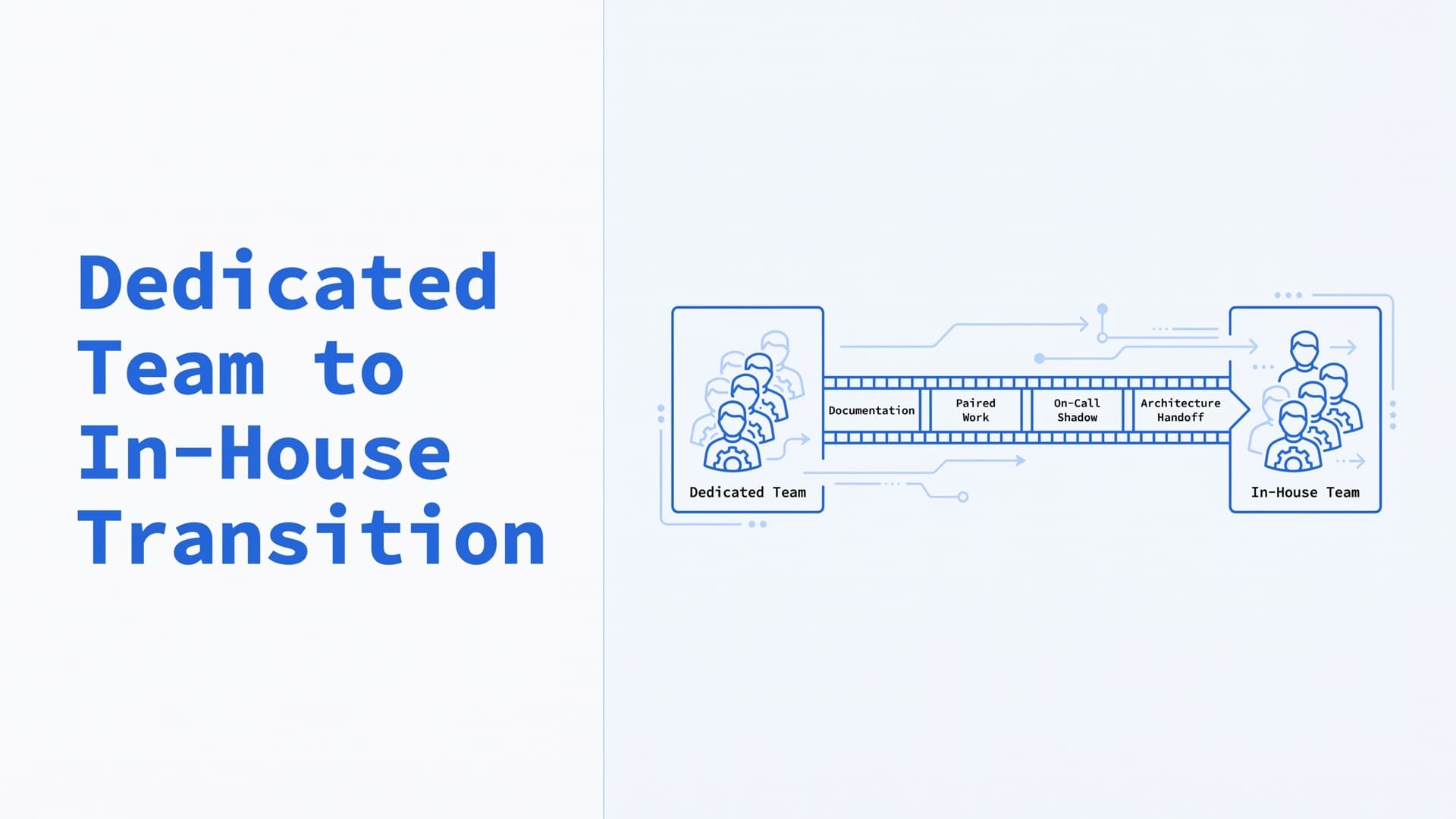
When to Bring a Dedicated Team In-House (And How to Do the Transition)
70% of executives have selectively insourced. The Knowledge Bridge is what separates successful transitions from expensive restarts. Signals, playbook, and the four failure modes that sabotage in-housing.
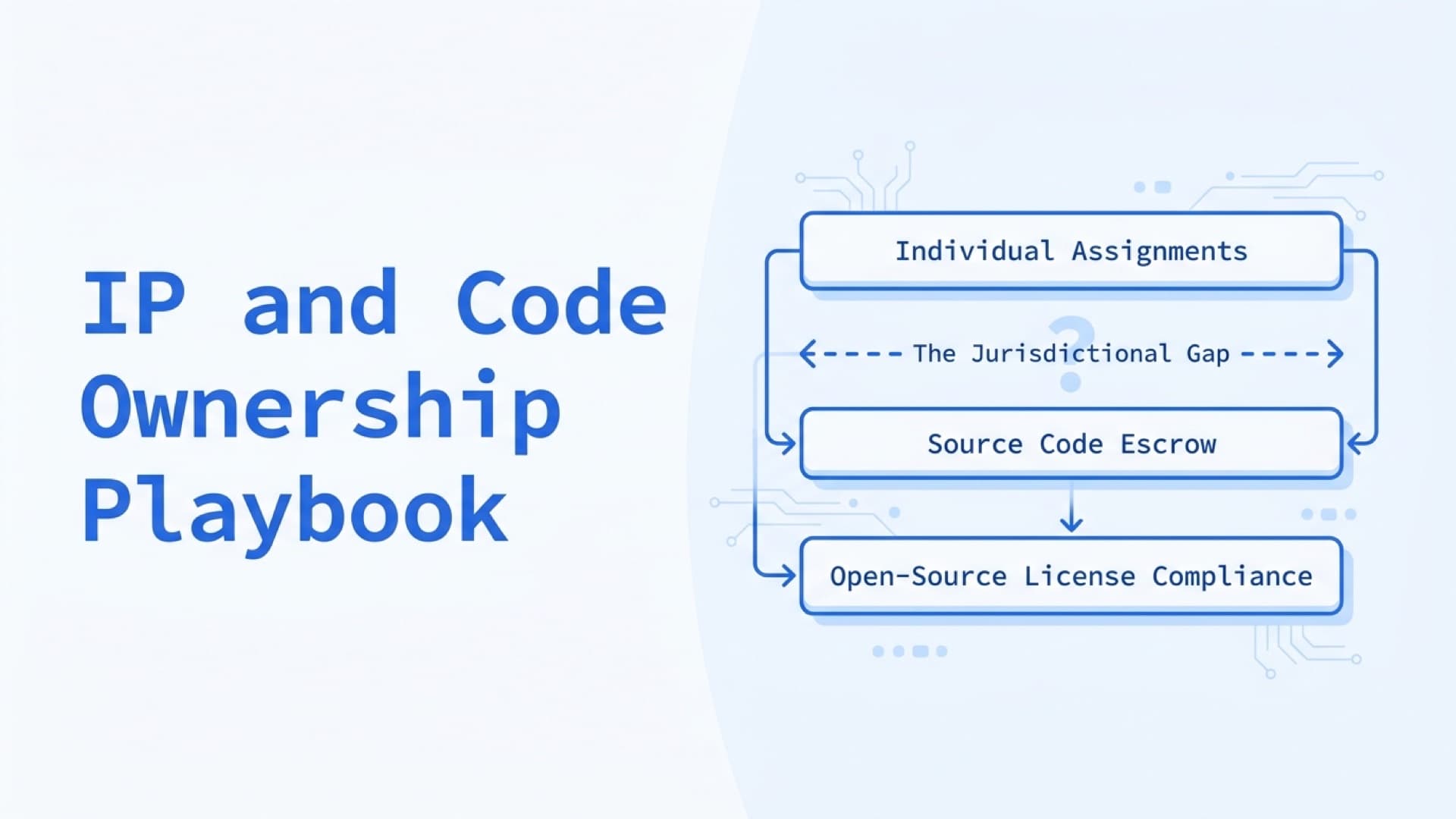
The IP and Code Ownership Playbook for Dedicated Development Teams
Work-for-hire doesn't usually work. The Jurisdictional Gap — between where the contract is signed and where the code is written — is where IP protection fails. Three layers of protection and the contract clauses that close the gap.