Dedicated Team Anti-Patterns: 5 Governance Failures That Kill Productivity
Fire the bad engineers. Replace the underperforming PM. Micromanage the remote team harder. Ask the vendor for a tech lead upgrade. None of these moves will fix a dedicated team engagement that's failing from governance, and most will accelerate the decline. The interventions miss the mechanism.
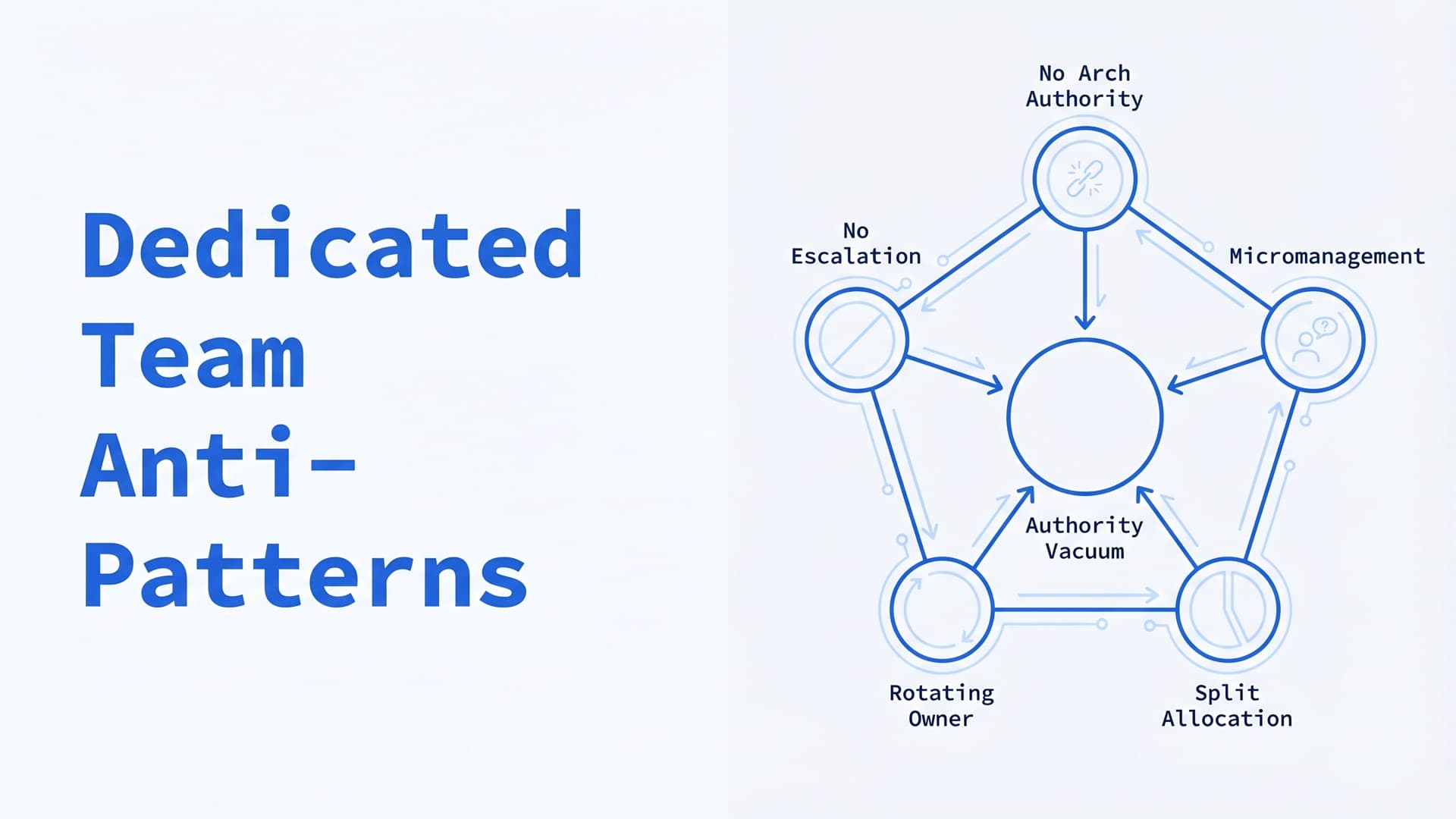
Five governance failures show up repeatedly in dedicated team engagements that end prematurely or quietly underperform. They're not about engineer quality. They're about the absence of specific structural decisions the client and vendor should have made together and didn't. All five share a common mechanic: The Authority Vacuum — when no one is clearly accountable for a class of decisions, someone fills the vacuum, and it's almost always the wrong person making calls they don't have context for.
The Dun & Bradstreet Barometer's 50% five-year outsourcing failure rate is real, and the driver isn't offshore quality. It's governance structure. These are the five patterns that tend to surface when engagements get unwound and the teardown happens — not in the pitch deck version of outsourcing, but in the quieter conversation afterward.
Anti-Pattern 1: No Named Architectural Authority
The symptom. Six months in, the codebase has absorbed three incompatible approaches to service boundaries, two different ORM patterns, and a mix of REST and GraphQL that nobody explicitly chose. Every technical decision gets relitigated when a new ticket touches it. The client's VP Engineering asks who owns architecture and discovers that nobody does.
The mechanism. In a dedicated team, architectural authority should sit with the vendor's tech lead, operating within guardrails the client sets. What happens when the authority isn't named: the client assumes the vendor is making consistent decisions; the vendor assumes the client is approving them; individual engineers make calls based on what they happen to know. Three months of that and the codebase reflects the absence of architectural coherence rather than anyone's actual intent.
The fix. Name the architectural authority explicitly in the SOW. Usually this is the vendor's tech lead, with escalation to the client's VP Engineering for decisions that cross defined thresholds — new service creation, database technology choices, cross-cutting concerns like auth or observability. Use Architecture Decision Records (ADRs) for the actual decisions. IT Revolution's work on cognitive load and team boundaries is the backing theory; ADRs are the practical artifact.
Anti-Pattern 2: Client Micromanagement Replacing Vendor Management
The symptom. The client PM attends every standup and reviews every PR. They write the detailed ticket descriptions. When vendor engineers disagree on approach, the client adjudicates — because by now, nobody else has the authority to. The vendor's tech lead becomes decorative: present at meetings, absent from decision-making. Velocity plateaus well below target and stays there. It's the same stall pattern documented in the Month-Three Cliff analysis for teams that don't cross the cliff cleanly.
The mechanism. The client is paying the vendor for delivery management. When the client inserts themselves into that management layer, the vendor stops doing the job they were hired for. Two things happen simultaneously. First, the client's tech lead burns out managing a team twice as large as their title implies. Second, the vendor's tech lead atrophies — they can't build the product ownership muscle when someone else is pre-chewing every decision.
The failure mode looks like engagement. The client is paying attention, staying close to the work, being helpful. Good management, by every in-house instinct. In a dedicated team, those same behaviors are exactly what break the model.
The fix. Define a written RACI (Responsible, Accountable, Consulted, Informed) matrix covering the decision categories that actually matter in the engagement — sprint planning, architectural calls, hiring backfills, PR review, incident response. The client is Accountable on priority and product direction; the vendor is Accountable on execution and delivery quality. AWS's guidance on cloud operating RACI matrices is a practical reference. If the client finds themselves in the Accountable column for execution calls, they're running staff augmentation, not a dedicated team.
Anti-Pattern 3: Split Engineer Allocation
The symptom. Vendor engineers are slower than expected. PR reviews that were supposed to land in 24 hours take 48-72. Slack goes quiet for half a day, then catches up in a burst. Two engineers' availability drops to sporadic for two weeks, then picks back up. The vendor attributes it to "workload balancing." The client suspects the engineers are being pulled onto other clients.
The mechanism. This is the trust violation the dedicated team model is structurally vulnerable to. The client is paying for full-time allocation and receiving something less. Oski's cost analysis identifies this as a driver of the 15-25% headline-to-actual cost inflation at lower-tier providers — allocating "full-time" engineers across two or three clients based on whose deadline looks most urgent that week. The client pays the full retainer and gets shared capacity.
The Authority Vacuum here is around allocation transparency. The vendor owns staffing decisions, but without the client's visibility into actual engineer utilization, there's no mechanism to detect split allocation until velocity reveals it at month four.
The fix is contract-level. Specify 100% allocation in writing. Require weekly hour reports by engineer, produced automatically by Geekbot or the team's standup tool of record. If the vendor resists producing that transparency, they're telling you why velocity feels off.
Anti-Pattern 4: The Rotating Product Owner
The symptom. The dedicated team reports to a different client-side stakeholder every quarter. Q1 it's the VP Engineering. Q2 she's promoted, and the team reports to the newly-hired CTO. Q3 the CTO reassigns the team to a specific engineering manager. Each transition loses two to four weeks of context while the new owner figures out what the team has been doing.
The mechanism. Product ownership requires continuity, which is exactly what the KPMG 2025 analysis identifies as a top driver of whether outsourced engagements succeed. A dedicated team builds against the product owner's understanding of priorities, trade-offs, and acceptance criteria. When that ownership rotates, the team defaults to what's written down — which is always less complete than what the previous owner held in their head. The implicit context evaporates.
The fix. Name one client-side product owner per dedicated team and commit them for at least 12 months. If the role needs to change, execute a documented handoff: a half-day session with the vendor tech lead, a shared priorities document updated and re-validated, and overlapping attendance at one sprint retrospective. Without that handoff, every transition forces the team into the Authority Vacuum while the new owner builds context.
Anti-Pattern 5: Unclear Escalation Path for Disagreements
The symptom. The vendor tech lead thinks the client is pushing unrealistic deadlines. The client thinks the vendor is sandbagging estimates. Both sides raise the concern in 1:1s but not formally. The disagreement compounds quietly for two sprints. By sprint three, the relationship has degraded to passive-aggressive ticket comments, and both sides are privately considering exit.
The mechanism. Disagreements need a mechanism to surface and resolve. In-house teams have an implicit one: the manager-reports-to-VP chain. Dedicated team engagements don't — not by default. So disagreements either get suppressed (compounding into resentment) or blow up at quarterly reviews. Neither is recoverable cleanly.
The fix. Build an explicit escalation path into the SOW: day-to-day disagreements resolved between the vendor tech lead and the client's engineering manager; unresolved items escalate to the vendor's engagement director and the client's VP Engineering; structural disputes escalate further. Set tier-specific SLAs so that escalations can't sit indefinitely. The Google SRE book's guidance on embracing risk uses error budgets as an analogous mechanism for removing politics from reliability discussions — the same pattern works for engagement disagreements.
How to Diagnose Which Anti-Pattern You Have
The five anti-patterns have different leading indicators, observable in the first 90 days if you're watching for them:
- No architectural authority: Inconsistent patterns in code review comments. The vendor team asks "how do you want us to do X?" for decisions that should be within their judgment.
- Client micromanagement: The client PM is spending a meaningful fraction of their week on vendor-team coordination that the vendor PM should be owning. The vendor's tech lead rarely speaks up in meetings.
- Split allocation: PR response times drift past 24 hours. Slack response inconsistency. Engineers "unavailable" intermittently.
- Rotating product owner: More than one client-side owner transition in the first two quarters. Written priorities get reset at each transition.
- Unclear escalation: Disagreements surface in 1:1s but not in sprint retros. Phrases like "I didn't want to bring this up, but..." appear in meeting notes.
Two or more of these signals in the first 90 days is a governance problem, not an engineer problem. Replacing engineers in that case is the most expensive form of treating the wrong disease.
Honest Boundary
This framework covers governance failures that typically surface in months 1-6 of a dedicated team engagement. It's less useful for:
- Late-stage engagements with embedded dysfunction. At month 18+, anti-patterns have compounded into culture. Fixing them requires leadership change on one or both sides, not just process change.
- Staff augmentation engagements. Many of these anti-patterns don't apply in the same form. Staff augmentation is structurally the client micromanagement model — it's just called by the right name. The Delivery Ownership Question separates these cases.
- Managed services with hard SLAs. These engagements have their own failure modes around SLA measurement and escalation, distinct from the governance patterns here.
- Vendor quality problems masquerading as governance problems. Sometimes engineers really are unsuited for the work. The diagnostic: if you've fixed the governance structure and the team still underperforms after a full sprint, the problem may actually be the engineers. Before concluding that, confirm the fixes actually took hold — most governance fixes fail in implementation, not in design.
The framework also assumes the vendor is acting in good faith. Vendors with active billing fraud (phantom engineers, widespread split allocation) require different interventions — legal review of contracts, usage audits, and often contract termination. Anti-patterns assume honest misalignment; fraud is a different problem.
Need help diagnosing whether a struggling dedicated team engagement has a governance problem or an engineer problem? Talk to an engineer.
Engineers don't usually kill dedicated team engagements. The absence of someone clearly accountable for specific decisions does.
Frequently Asked Questions
What are the most common dedicated team management mistakes?
Five governance failures account for most premature endings: no named architectural authority (nobody owns technical coherence), client micromanagement that replaces vendor management (paying for delivery while doing it yourself), split engineer allocation (vendor sharing "dedicated" engineers across clients), rotating product owners (context lost at each transition), and unclear escalation paths (disagreements compound into resentment). All five share the same mechanism: an Authority Vacuum where no one is clearly accountable for a class of decisions.
How do I know if my dedicated team has a governance problem or an engineer problem?
Track leading indicators in the first 90 days. Inconsistent patterns in code review comments, vendor engineers asking permission for decisions inside their scope, client PM time exceeding 10 hours per week, PR response times drifting past 24 hours, and disagreements surfacing in 1:1s but not formal retros all point to governance. Two or more signals means fixing engineers is treating the wrong disease — the structure needs the intervention.
Should I attend every standup with my dedicated development team?
No. Daily standup attendance by the client PM is a classic client-micromanagement anti-pattern. The vendor's tech lead runs standup; the client PM reads the written summary after. Client attendance at daily standups signals distrust, replaces vendor management rather than supplementing it, and structurally prevents the vendor tech lead from growing into the role you're paying them to perform.
How do I prevent vendor engineers from being shared across clients?
Contract-level enforcement. Specify 100% engineer allocation in the SOW, require written notice before any deviation, and request weekly status reports listing each engineer's hours and completed tickets. Watch for leading indicators: PR response times drifting past 24-48 hours, Slack response inconsistency, intermittent engineer unavailability. Reputable vendors produce allocation transparency as part of standard process; opaque vendors resist it, which is itself diagnostic.
Who should own architectural decisions in a dedicated team engagement?
The vendor's tech lead, operating within explicit guardrails the client sets, with escalation to the client's VP Engineering for threshold-crossing decisions (new service creation, database choice, auth model, cross-cutting concerns). Document the split in a RACI matrix included in the SOW. Decisions actually made should land in Architecture Decision Records. Without named ownership, the codebase absorbs incoherent decisions nobody intended.
Related posts
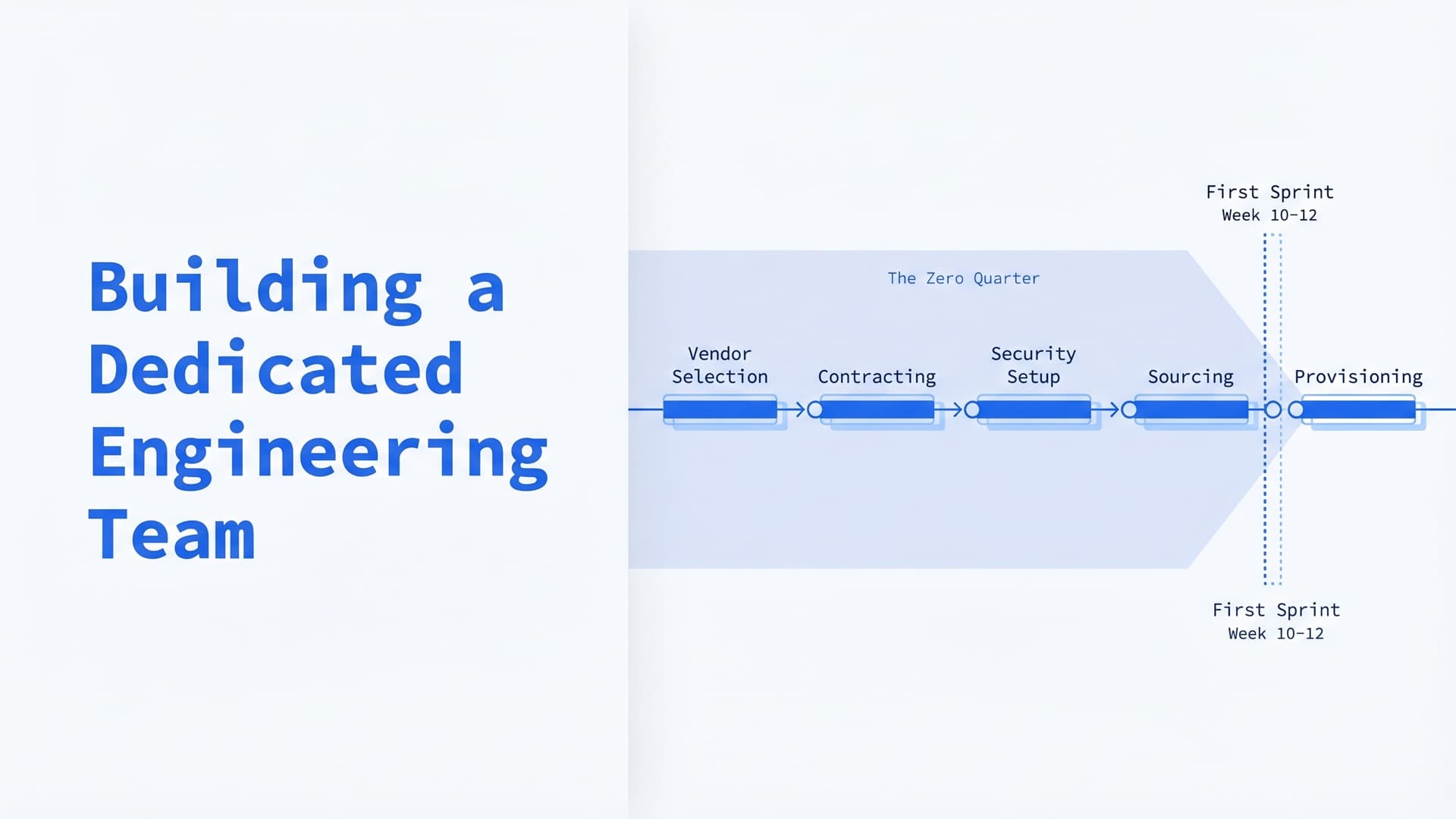
Building a Dedicated Engineering Team from Scratch: Timeline, Cost, and Mistakes
Vendor decks show 2 weeks. The real timeline is 10-16 weeks. Call it The Zero Quarter — everything between decision and first sprint. Cost model, worked example, and the five setup mistakes that compound.
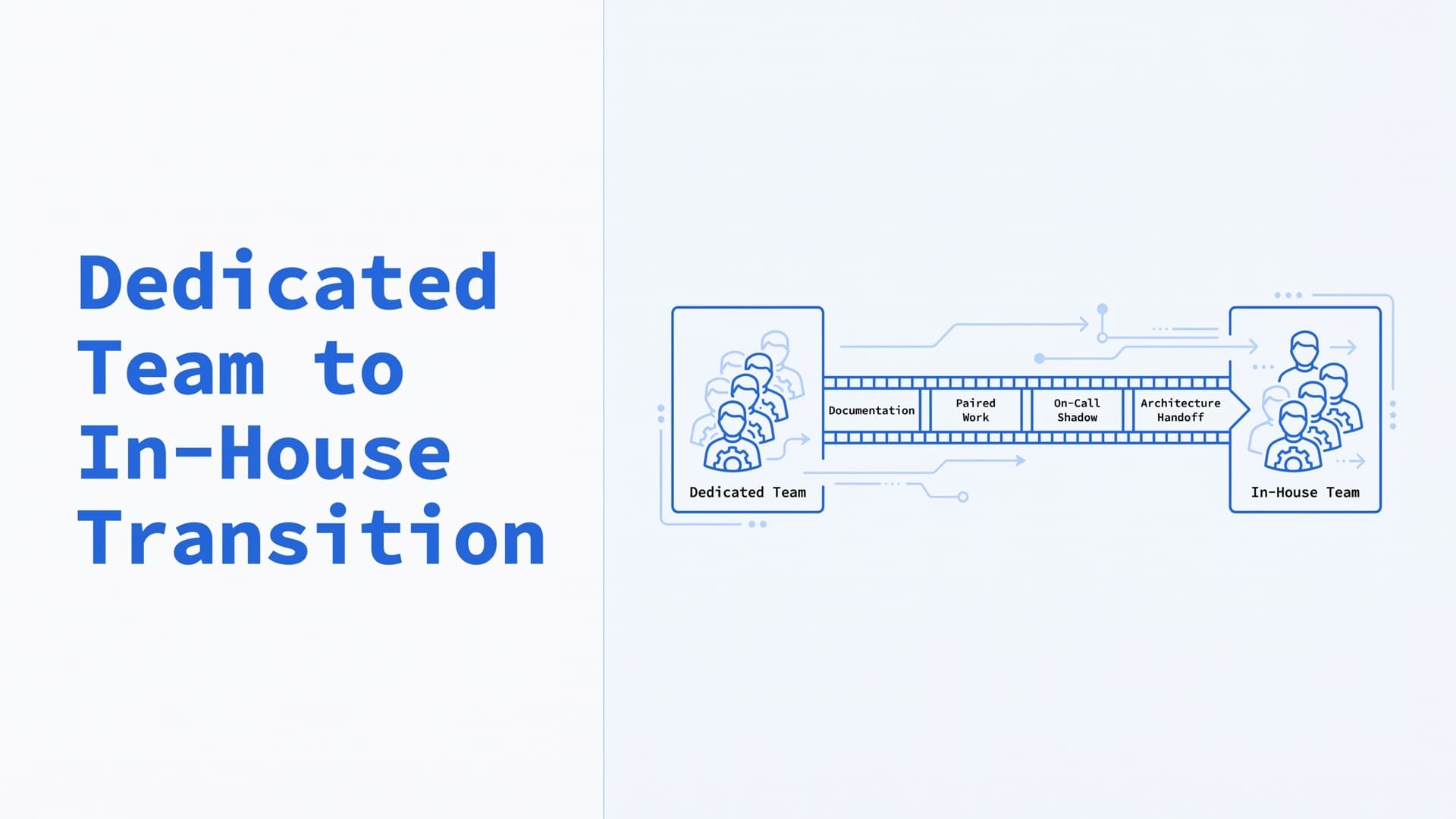
When to Bring a Dedicated Team In-House (And How to Do the Transition)
70% of executives have selectively insourced. The Knowledge Bridge is what separates successful transitions from expensive restarts. Signals, playbook, and the four failure modes that sabotage in-housing.
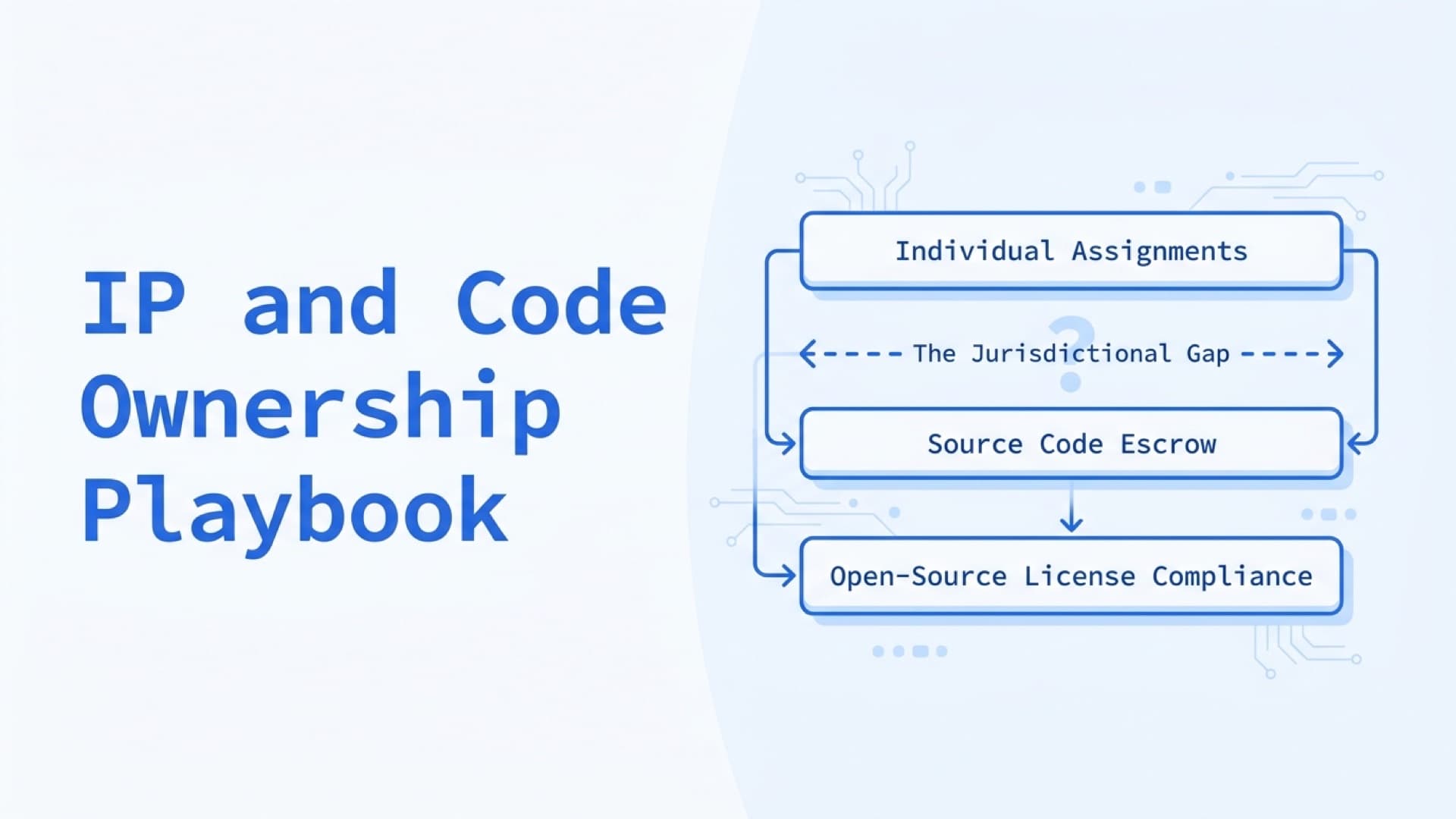
The IP and Code Ownership Playbook for Dedicated Development Teams
Work-for-hire doesn't usually work. The Jurisdictional Gap — between where the contract is signed and where the code is written — is where IP protection fails. Three layers of protection and the contract clauses that close the gap.