Residential vs. Datacenter vs. ISP Proxies: The Complete 2026 Comparison
We modeled proxy costs for a multi-target scraping pipeline last month — datacenter IPs for public APIs, residential for Amazon product pages, ISP proxies for daily price monitoring. The sticker prices suggested datacenter was cheapest by 5x. Then we ran the math on retries.
Proxyway tested 12 proxy providers across 2 million connection requests in their 2025 benchmark. On infrastructure-level tests, success rates were nearly identical: 99.56% for residential, 99.87% for datacenter, 99.78% for ISP. The proxy type barely mattered.
Then they tested against real targets — Amazon, Google, Instagram — sites running Cloudflare, DataDome, and Akamai.
Datacenter proxies dropped to 59.80%. Residential held at 94.30%. ISP landed at 89.34%.
That gap is the entire proxy type decision in one number. But sticker price per gigabyte won't tell you which type to buy. What matters is the cost per successful request — a calculation most teams never run, and the one that flips the obvious answer on its head.
The Detection Gradient
Every website that runs anti-bot protection classifies incoming traffic by IP type before doing anything else. Services like IPQualityScore, MaxMind GeoIP2, and IP2Proxy maintain databases that categorize every IP address by connection type: residential, hosting (datacenter), corporate, mobile, or satellite.
This classification happens at the network edge. Before Cloudflare scores your browser fingerprint, before DataDome analyzes your mouse movements, before Akamai checks your TLS handshake — the IP itself has already been labeled.
That label is the first filter. Everything else is second.
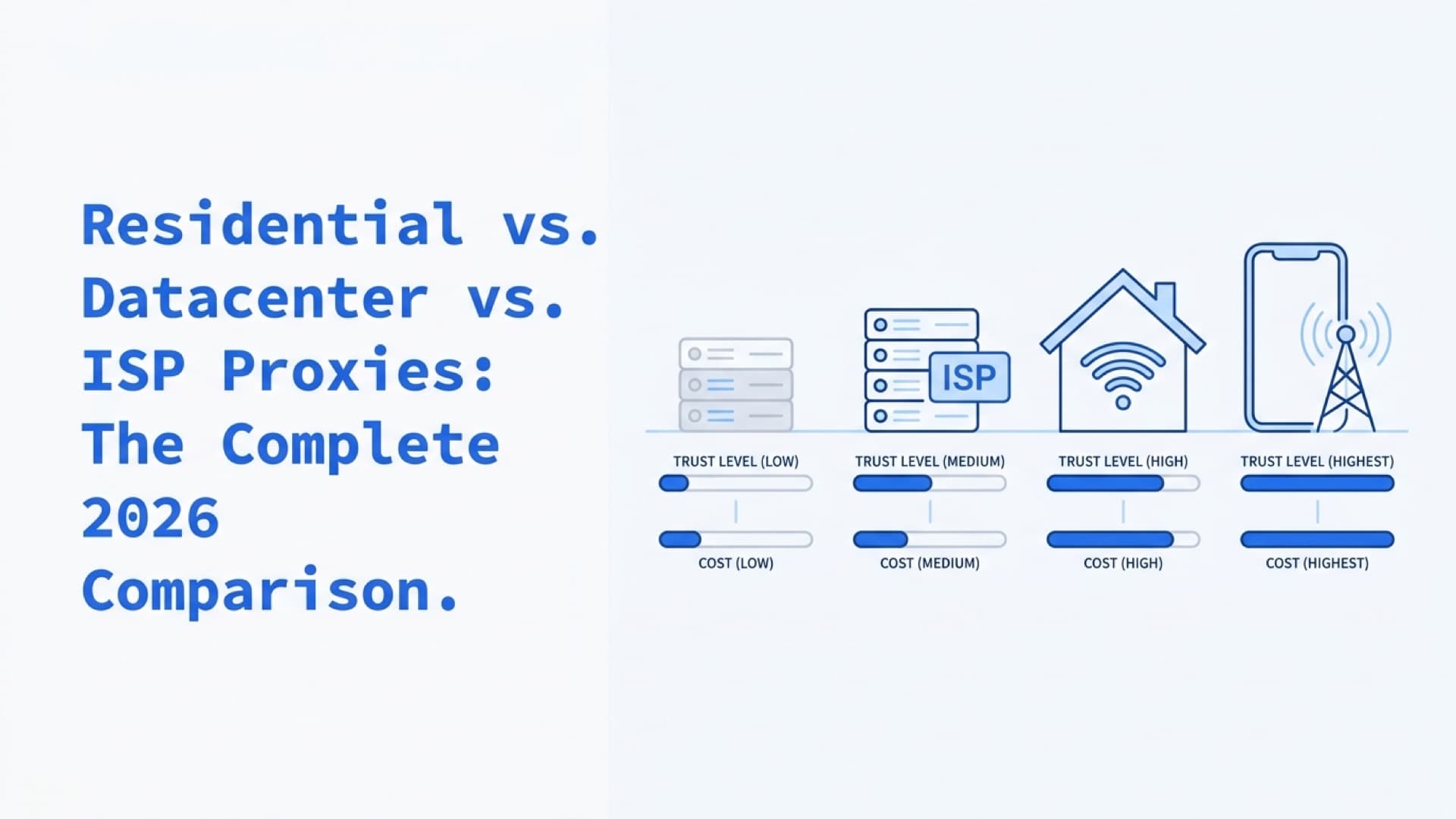
The result is the Detection Gradient: a trust hierarchy that determines your baseline success probability before any other evasion technique kicks in.
Datacenter → ISP → Residential → Mobile
Each step to the right costs more per gigabyte but starts from a higher trust position. Datacenter IPs sit in hosting ASNs — classification databases flag them instantly. Residential IPs pass the first gate because they're registered under consumer ISP ASNs. Mobile IPs are the hardest to block because of CGNAT — a single carrier IP serves hundreds of legitimate users simultaneously.
Rotation strategies, fingerprint evasion, session management — none of it compensates for starting from the wrong trust tier.
Datacenter Proxies: Fast, Cheap, and Increasingly Filtered
Datacenter proxies run on servers in commercial hosting facilities. The IPs are registered under hosting ASNs — Amazon Web Services, DigitalOcean, OVH, Hetzner. They're fast because the path is short: your request hits a server rack in a data center, not a phone in someone's pocket.
The numbers
According to Proxyway's 2025 benchmark:
- Infrastructure success rate: 99.87% (highest of all types)
- Protected target success rate: 59.80% (lowest of all types)
- Median latency: 0.29 seconds (fastest of all types)
- Cost: $0.60/GB at 50-250GB; $0.41-$0.50/GB at 1TB+
The latency advantage is real. At 0.29 seconds median response time, datacenter proxies are 3x faster than residential (0.93s) and 4.5x faster than mobile (1.32s). For high-volume operations where speed matters and the target doesn't run sophisticated bot protection, datacenter wins on pure throughput.
Why the success rate collapses on protected targets
IP classification databases have been categorizing hosting ASNs for over a decade. When MaxMind labels an IP as "hosting," every anti-bot system downstream uses that signal. Cloudflare's Bot Management documentation explicitly describes IP reputation as the first layer of their detection stack.
The 59.80% median on protected targets is actually the optimistic number — it's an average across all tested protected sites. Individual targets diverge sharply. Proxyway's per-site breakdown shows some providers falling well below 50% on Amazon and Instagram with datacenter IPs.
That's not a proxy problem. That's a proxy type problem.
When your success rate sits at 60%, you need roughly 1.67 attempts per successful response. That multiplies your bandwidth consumption by 2-3x. A proxy that costs $0.50/GB but requires 2.5 attempts per success effectively costs $1.25/GB in consumed bandwidth — and you still eat the latency of the failed attempts.
When datacenter proxies still make sense
Datacenter proxies aren't dead. They're misapplied.
They remain the right choice when:
- The target doesn't run anti-bot protection. Many internal APIs, government data portals, and smaller sites don't use Cloudflare or equivalents. For these, datacenter delivers the best speed-to-cost ratio.
- You're scraping at massive volume on tolerant targets. Price aggregation from sites that welcome structured data access. Public data APIs with rate limits but no IP filtering.
- You need consistent, predictable latency. Datacenter connections don't depend on device availability. There's no peer going offline at 3 AM.
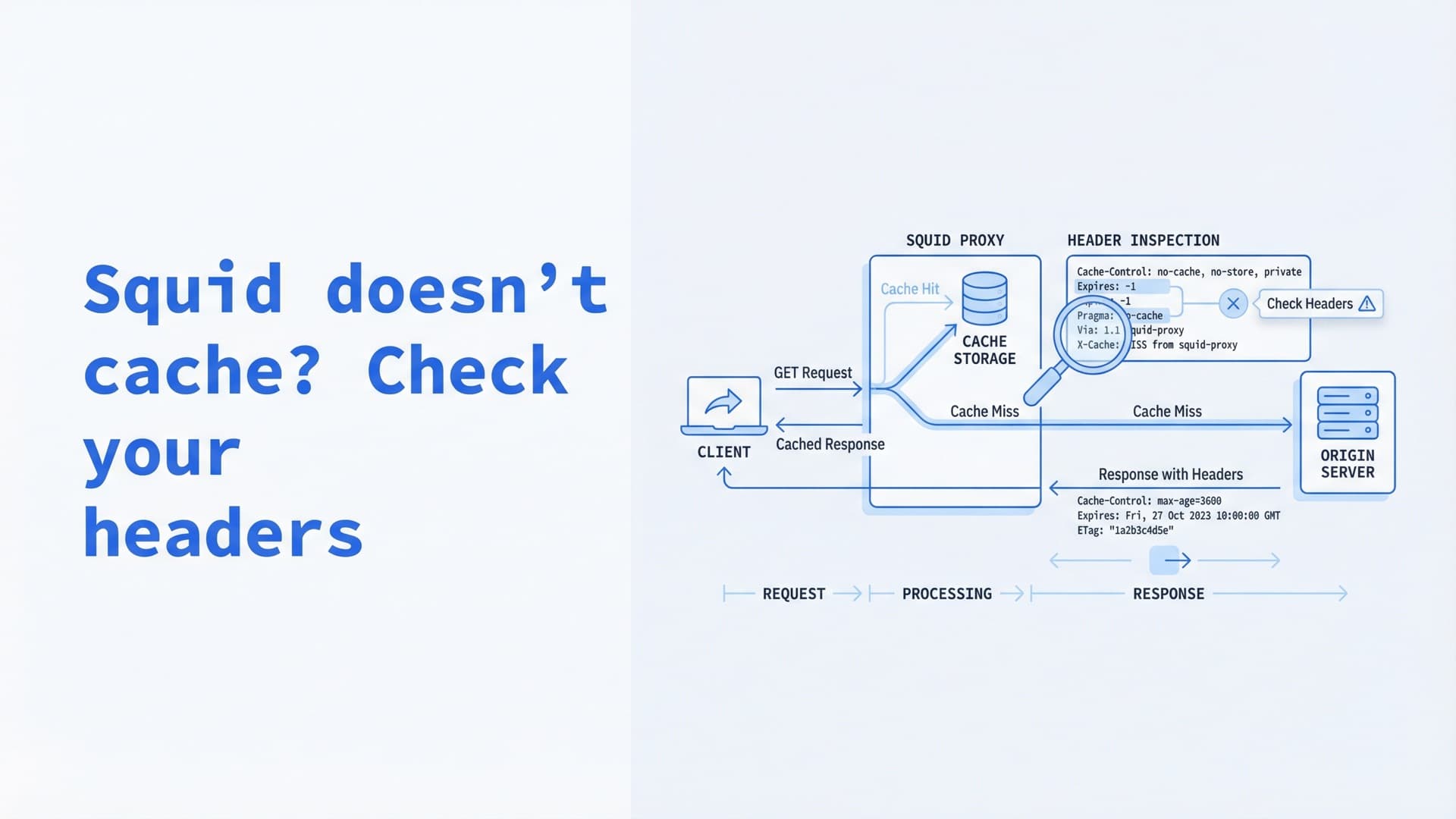
- You control the proxy infrastructure. Self-hosted datacenter proxies running on Squid or 3proxy give you full control over headers, rotation, and retry logic at the lowest possible cost.
Residential Proxies: The Trust Premium
Residential proxies route traffic through IP addresses assigned by consumer ISPs to actual homes and devices. The IPs belong to real subscribers on networks like Comcast, AT&T, Vodafone, or Telefónica.
Most residential proxy networks operate through peer-to-peer SDK models. A user installs an application that bundles proxy relay functionality — typically embedded in a free VPN app, ad-supported utility, or similar consumer software. The provider compensates the user (or the app developer) for bandwidth, and sells access to the resulting pool.
The numbers
From Proxyway's 2025 benchmark:
- Infrastructure success rate: 99.56%
- Protected target success rate: 94.30%
- Median latency: 0.93 seconds
- Cost: $4.02/GB at 5GB tier (-53% year-over-year); $3.15/GB at 50GB; $2.41-$2.58/GB at 500GB+
- Pool sizes: Oxylabs claims 175M IPs, SOAX 155M, Bright Data 150M, Smartproxy/Decodo 115M
The 94.30% success rate on protected targets is the headline number, but the pricing story matters equally. Residential proxy prices dropped 53% year-over-year at the 5GB tier, according to Proxyway's 2025 pricing analysis. At scale (500GB+), the per-gigabyte cost has fallen to $2.41-$2.58 — less than half what it was in 2023.
Pool size claims require context
Proxyway's research found that advertised pool sizes should be "divided by 10 to 20 times to get a realistic amount" of concurrently available IPs. A provider claiming 150 million IPs doesn't have 150 million devices online simultaneously. They have 150 million unique IPs that have appeared in their pool over a measurement period — with availability depending on whether those devices are currently powered on, connected, and opted in.
In one test scenario, "some providers returned less than 100,000 unique IPs from nearly 2 million connection requests." The practical implication: pool diversity is not a function of advertised size. It's a function of concurrent availability and geographic distribution.
The latency trade-off
Residential connections route through real consumer devices. The extra hop adds latency — 0.93 seconds median versus 0.29 seconds for datacenter. On protected targets, where the anti-bot system adds its own processing time, residential response times climb to 4.63 seconds median.
For scraping operations that need sub-second response times — real-time price monitoring, live inventory checks — this latency can be a dealbreaker. For batch operations where you're collecting 100,000 product pages overnight, the extra 0.6 seconds per request is noise.
When residential proxies are the right choice
- Protected targets are your primary workload. E-commerce sites (Amazon, Walmart, Target), social platforms, search engines. The 94.30% success rate versus 59.80% for datacenter is the deciding factor.
- Geographic accuracy matters. Residential pools offer city-level targeting through real ISP assignments. When your scraping operation needs to see prices, inventory, or content as shown to users in a specific city, residential IPs provide genuine geo-targeting.
- You need to blend with real traffic. On sites that analyze traffic patterns, residential IPs look identical to real users because they are real user connections. There's no ASN-based signal to distinguish your request from someone browsing from their apartment.
ISP Proxies: The 2024-2025 Growth Story
In Proxyway's 2025 benchmark, ISP proxies were the fastest type tested — 0.21 seconds median latency, beating even datacenter — while hitting 89.34% on protected targets. That combination of speed and trust is why ISP adoption has surged since 2024.
The architecture is simple: ISP proxies run on datacenter hardware but carry IP addresses registered under consumer ISP ASNs rather than hosting ASNs. Same servers, same speed, different label in the autonomous system registry. And that label is what IP classification databases check first.
This distinction matters because IP classification databases make their first-pass decision based on ASN registration. When MaxMind or IPQS sees an IP registered under a residential ISP's ASN block, it classifies the connection as residential or ISP — not hosting. The IP passes the first gate of the Detection Gradient without triggering the datacenter flag.
The numbers
From Proxyway's 2025 benchmark:
- Infrastructure success rate: 99.78%
- Protected target success rate: 89.34%
- Median latency: 0.21 seconds (fastest of all types — faster than datacenter)
- Pricing model: Per-IP rather than per-GB. Median $3.80/IP at 10 IPs; $2.70-$3.06/IP at 500+ IPs
The latency number is the surprise. At 0.21 seconds, ISP proxies are faster than datacenter (0.29s). This makes sense: ISP proxies run on dedicated infrastructure with direct peering to target networks, without the shared congestion of large datacenter proxy pools.
The pricing model difference
ISP proxies are typically sold per-IP-per-month rather than per-gigabyte. This fundamentally changes the economics for sustained operations.
If you're monitoring 10,000 product pages daily and each page averages 500KB, your daily bandwidth is roughly 5GB. On residential proxies at $3.15/GB (50GB tier), that's ~$470/month. With ISP proxies, 50 static IPs at $3.00/IP costs $150/month with unlimited bandwidth on those IPs.
The math favors ISP proxies when:
- You scrape the same targets repeatedly (price monitoring, inventory tracking)
- Your per-session bandwidth is high (large pages, many assets)
- You need persistent sessions (login-state scraping, multi-page workflows)
The math favors residential when:
- You hit a diverse set of targets that aggressively fingerprint
- You need high IP diversity per session (not just per month)
- Your operation requires city-level geo-targeting across hundreds of locations
Where ISP proxies fit in the gradient
The 89.34% protected-target success rate puts ISP proxies between datacenter (59.80%) and residential (94.30%). On unprotected targets, they match datacenter performance. On moderately protected targets — sites running basic Cloudflare or Akamai configurations — they perform close to residential.
The 5-point gap between ISP (89.34%) and residential (94.30%) on protected targets is the cost of not having real device connections behind the IP. Proxyway doesn't publish a per-target breakdown by proxy type, so we can't say exactly where ISP fails and residential succeeds. But the likely explanation: sites that look past the ASN label and into connection behavior — session patterns, device fingerprints, peer characteristics — can distinguish a static datacenter-hosted IP from a real home connection, regardless of which ASN it's registered under.
Advanced anti-bot systems like DataDome's intent-based detection and Cloudflare's behavioral scoring look past the ASN label. They analyze session behavior, TLS fingerprints, HTTP/2 header ordering, and navigation patterns. Against these systems, starting from an ISP IP rather than a datacenter IP buys you past the first gate — but not past all of them.
The Effective Cost Multiplier
Every proxy has two prices: sticker price per gigabyte, and the Effective Cost Multiplier — what you actually pay per successful response after retries eat your bandwidth. The multiplier is the number that makes datacenter proxies expensive on protected targets despite having the lowest sticker price.
Here's the math. A 10,000-request scraping job, each request averaging 200KB of payload:
| Metric | Datacenter | ISP | Residential | |--------|-----------|-----|-------------| | Success rate (protected target) | 59.80% | 89.34% | 94.30% | | Requests needed for 10K successes | 16,722 | 11,194 | 10,604 | | Total bandwidth consumed | 3.27 GB | 2.19 GB | 2.07 GB | | Cost per GB | $0.60 | ~$0.50* | $3.15 | | Total proxy cost | $1.96 | ~$1.10* | $6.52 | | Cost per 1K successful requests | $0.20 | $0.11 | $0.65 |
*ISP cost estimate: 50 IPs at $3.00/IP = $150/month. At 5GB/day sustained usage (150GB/month), the amortized cost is $1.00/GB. The table uses ~$0.50/GB reflecting higher sustained volume on a per-IP plan.
The Effective Cost Multiplier for datacenter on this target mix: 1.67x (you pay 67% more than sticker price in consumed bandwidth). For ISP: 1.12x. For residential: 1.06x. On raw proxy cost, datacenter still wins. But factor in the engineering cost of handling 6,722 extra failed requests — retry logic, error handling, increased scrape time, potential IP burns — and the gap narrows fast.
For operations where data freshness matters (you need those 10,000 results within an hour, not a day), the retry overhead of datacenter proxies can push the effective cost above ISP or even residential.
This math varies dramatically by target. A site with basic Cloudflare might see 90% datacenter success. Amazon's product pages might drop to 30%. The Proxyway medians are a starting point — run the calculation against your actual target list, not industry averages.
Decision Framework: Which Proxy Type for Which Job
Choose datacenter when:
- Targets don't run anti-bot (APIs, government portals, open data)
- Speed is the priority and failure rate is tolerable
- Budget is the binding constraint and you'll handle retries
- You're self-hosting with Squid, 3proxy, or HAProxy
Choose ISP when:
- You scrape the same targets daily (price monitoring, inventory, SEO tracking)
- You need datacenter speed with higher trust classification
- Your targets run moderate protection (basic Cloudflare, standard Akamai)
- Bandwidth consumption per session is high
- Per-IP pricing works better than per-GB for your usage pattern
Choose residential when:
- Primary targets are heavily protected (Amazon, Google, social platforms)
- You need city-level geo-targeting accuracy
- IP diversity per session matters more than speed
- Your operation needs to be indistinguishable from real user traffic
- You're part of the 43.1% of scraping teams using multiple providers — residential handles the hardest targets in the rotation
Consider mobile when:
- The target blocks everything else. Mobile IPs behind CGNAT are shared by hundreds of legitimate users, making individual IP blocking impractical. Cloudflare built a CGNAT classifier with 0.9946 AUC specifically because they can't block CGNAT IPs without collateral damage.
- Budget justifies the premium. Mobile proxy pricing starts at $8/GB and can exceed $15/GB at low volumes. Reserve for the highest-value targets where other types fail.
What the Benchmarks Don't Capture
Proxyway's benchmark is the best data available, but three factors it doesn't capture affect the real-world proxy type decision:
Session stability. Residential IPs are dynamic — the peer device can disconnect mid-session, killing your cookies and state. If you're running a multi-page checkout flow or scraping behind a login, one dropped connection means restarting the entire session. ISP and datacenter IPs don't have this problem because they're hosted on persistent infrastructure. For stateful workflows, session reliability matters as much as success rate.
Pool contamination over time. The benchmark measures a snapshot. Operations running 24/7 face degradation curves: IPs get blocked, pools shrink, success rates drift downward over days and weeks. Large residential pools (155M+ IPs across Oxylabs and SOAX, according to Proxyway) recover faster because new IPs cycle into the pool organically. An ISP allocation of 50 static IPs has no such self-healing mechanism — once those IPs are burned on a target, you need new allocations from your provider.
Target-specific routing. No single proxy type wins everywhere. The 43.1% of scraping professionals running 2-3 providers simultaneously — and the 12.1% running 4-5 — have learned this the expensive way. The operations that perform best route by target: datacenter for unprotected endpoints, ISP for sustained price monitoring, residential for Amazon and social platforms. Building that routing logic is engineering work, and it's where most of the operational complexity lives.
Residential proxy prices dropped 53% in a year, according to Proxyway. Yet 58.3% of scraping professionals increased their proxy budgets over the same period, per Apify's 2025 survey. They're not paying less — they're climbing the Detection Gradient, buying more expensive proxy types to maintain the same success rates that cheaper types delivered a year ago.
The proxy got cheaper. The successful request didn't.
Need help building a proxy stack? Talk to an engineer — we'll tell you honestly which proxy type fits your targets.
Frequently Asked Questions
What is the difference between residential and datacenter proxies?
Residential proxies use IP addresses assigned by consumer ISPs to real homes and devices, routing traffic through actual subscriber connections. Datacenter proxies use IPs hosted in commercial data centers registered under hosting ASNs. The key difference is trust classification: anti-bot systems flag datacenter IPs as hosting, dropping success rates to 59.80% on protected targets versus 94.30% for residential, according to Proxyway's 2025 benchmark.
Are ISP proxies better than residential proxies?
ISP proxies combine datacenter speed (0.21s latency) with higher trust classification than datacenter IPs, achieving 89.34% success on protected targets. They're better for sustained monitoring of moderately protected targets — price tracking, inventory checks, SEO monitoring — where per-IP pricing delivers lower cost than residential's per-GB model. Residential proxies still outperform on heavily defended targets (94.30% vs 89.34%) and offer superior geo-targeting granularity.
How much do residential proxies cost in 2026?
Residential proxy prices dropped 53% year-over-year according to Proxyway's 2025 benchmark. Current median pricing: $4.02/GB at the 5GB tier, $3.15/GB at 50GB, and $2.41-$2.58/GB at 500GB+. At enterprise volume (100TB+), direct provider partnerships push rates below $1/GB — SOAX's enterprise tier starts at $0.32/GB, for example. Mobile proxies sit at $8/GB for small volumes (1GB), dropping to $5/GB at 250GB+ (Proxyway 2025).
Which proxy type is fastest?
ISP proxies are fastest at 0.21 seconds median latency, followed by datacenter at 0.29 seconds, residential at 0.93 seconds, and mobile at 1.32 seconds (Proxyway 2025 benchmark, infrastructure-level measurements). On protected targets, all types slow down due to anti-bot processing: datacenter rises to 3.71 seconds, ISP to 2.76 seconds, and residential to 4.63 seconds. For latency-sensitive applications, ISP proxies offer the best speed-to-trust ratio.
Can datacenter proxies still be used for web scraping?
Datacenter proxies remain effective for scraping targets that don't run sophisticated anti-bot protection — government data portals, public APIs, smaller websites, and internal applications. At $0.41-$0.60/GB, they're 4-8x cheaper than residential. The limitation is protected targets: 59.80% median success rate on sites running Cloudflare, DataDome, or Akamai means most requests fail, multiplying effective costs through retries. Many operations use datacenter for unprotected targets and route protected targets through residential or ISP proxies.