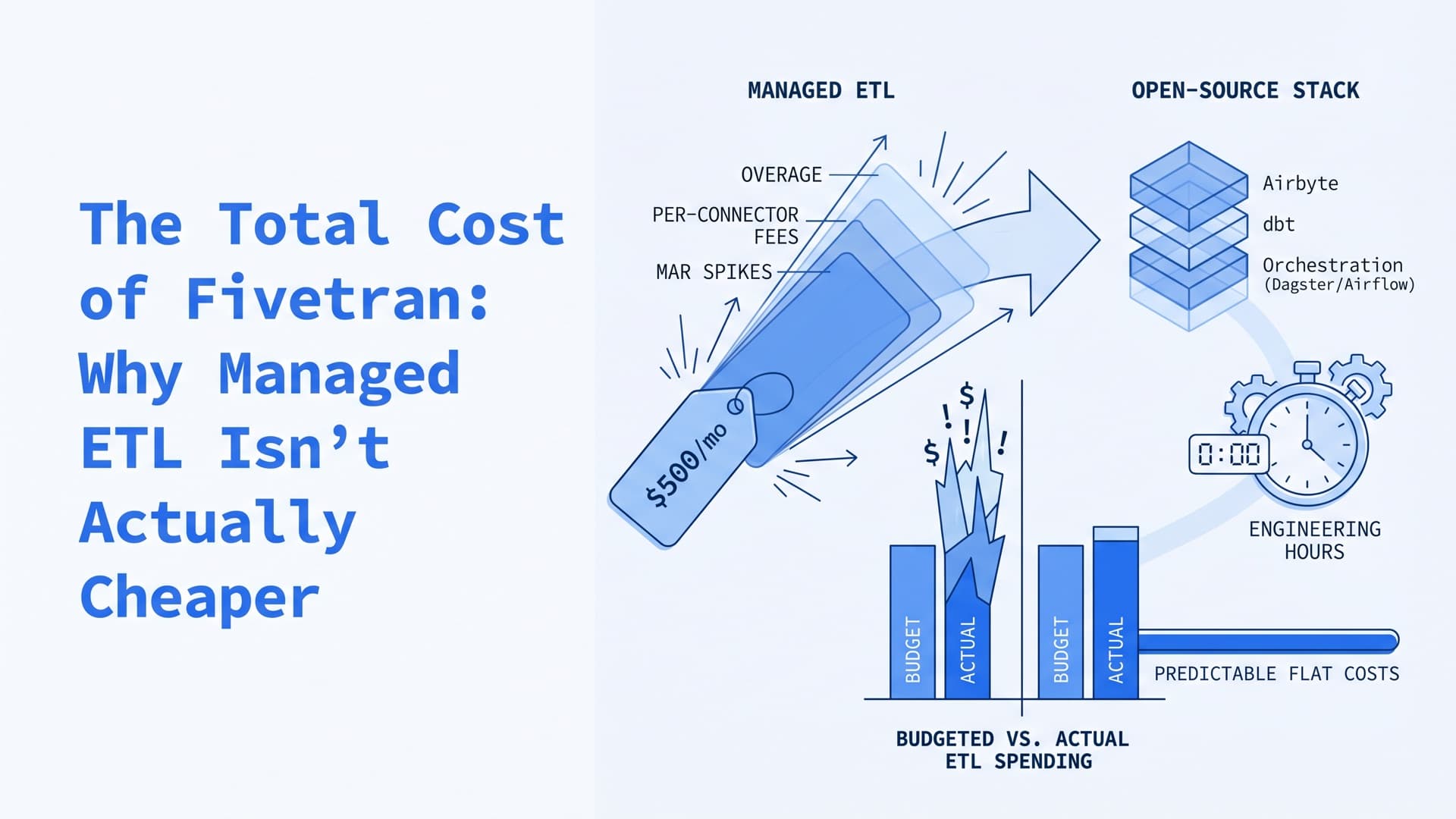
The Total Cost of Fivetran: Why Managed ETL Isn't Actually Cheaper
We ran the numbers on a 10-connector Fivetran setup after the March 2025 pricing change. The gap between budgeted and actual cost was 40-70%.
Fivetran shifted from account-level MAR pooling to per-connection billing. For teams running a single large connector, the impact was neutral. For teams running 10-15 — the typical mid-market setup — bills jumped overnight.
Nobody publishes the total cost math. So we did.
The MAR Trap
Fivetran's pricing looks straightforward: $500 per million MAR on the Standard plan, with a $12,000 annual minimum commitment. A team budgeting $1,000/month for data ingestion might assume they're covered.
The trap is in the details.
MAR counts every change, including deletes. A row that's inserted, updated twice, and deleted in the same month counts as one MAR. But a row that's deleted counts as a MAR because Fivetran registers the deletion as a change. For data sources with high churn — ad platforms where campaign metrics get replaced daily, CRM systems where contacts are frequently merged — delete volume alone can double your MAR count.
Per-connection billing compounds with connectors. Before March 2025, MAR was pooled across your account. A small Salesforce connector and a large PostgreSQL connector shared a single MAR budget. Now each connector has its own meter. A 10-connector setup where each connector processes 500K MAR per month isn't 5 million MAR at $2,500. It's 10 separate calculations at $500/million each — and if any single connector spikes, you pay the overage on that connector alone.
Ad platform connectors are the worst offenders. Facebook Ads, Google Ads, and similar connectors generate MAR on every metric recalculation. A campaign performance row that updates daily for 30 days generates 30 MAR — one per day of metric changes. Multiply by thousands of campaigns across multiple ad accounts, and a connector that looked like 100K MAR at budget time hits 2M MAR in practice.
We call this the MAR Trap: the gap between what Fivetran costs when you budget it and what it costs when you run it. According to analyses of the pricing change, the typical mid-market team that budgeted $500-$1,000/month for Fivetran discovered actual bills past $3,000 after the March 2025 change.
The Real Cost Stack: Fivetran vs. Alternatives
Sticker price comparisons are misleading in both directions. Fivetran looks expensive until you account for engineering time. Airbyte looks cheap until you account for ops overhead. The honest comparison is total cost of ownership: tool costs, engineering time, infrastructure.
Scenario: mid-market data team
- 10 data connectors (Salesforce, PostgreSQL, Google Ads, Stripe, HubSpot, Zendesk, GitHub, MySQL, Google Analytics, Slack)
- 5 million total MAR/month across all connectors
- 3 data engineers at $150K/year loaded cost (~$75/hour)
- Snowflake as the warehouse ($15K/month — typical mid-market spend)
Option 1: Fivetran Standard
| Line Item | Monthly Cost | |-----------|-------------| | Fivetran Standard (10 connectors, ~5M MAR) | $2,500-$5,000 | | Overage risk (ad platform MAR spikes) | $500-$2,000 | | dbt Cloud Starter (2 seats) | $200 | | Snowflake | $15,000 | | Engineering time: connector config + monitoring | ~10 hrs/mo = $750 | | Total | $18,950-$22,950 |
The Fivetran line has a wide range because MAR is unpredictable. The engineering time is low — Fivetran's value proposition is that you don't need to build or maintain connectors. That's real.
Option 2: Airbyte self-hosted
| Line Item | Monthly Cost | |-----------|-------------| | Airbyte Open Source (self-hosted on EC2/GKE) | $200-$500 infrastructure | | dbt Core (free) + Great Expectations (free) | $0 | | Snowflake | $15,000 | | Engineering time: setup, monitoring, upgrades, connector issues | ~30-40 hrs/mo = $2,250-$3,000 | | Total | $17,450-$18,500 |
Airbyte's 600+ connectors cover the same sources as Fivetran. The software is free. Infrastructure costs for a self-hosted deployment on a modest EC2 instance or GKE cluster run $200-$500/month. The trade-off is engineering time: Airbyte's own documentation acknowledges that self-hosted deployments require ongoing attention for connector updates, schema change handling, and infrastructure maintenance. Budget 30-40 hours/month for a healthy self-hosted deployment.
The math: Airbyte saves $2,000-$4,500/month on Fivetran licensing. It costs $1,500-$2,250/month more in engineering time. Net savings: $0-$2,250/month depending on how well your team operates the self-hosted stack.
Option 3: dlt (data load tool) — Python-native
| Line Item | Monthly Cost | |-----------|-------------| | dlt (open source, runs on existing infra) | $0-$100 | | dbt Core (free) + Soda Core (free) | $0 | | Snowflake | $15,000 | | Engineering time: build + maintain custom pipelines | ~50-60 hrs/mo = $3,750-$4,500 | | Total | $18,750-$19,600 |
dlt is an open-source Python library for building ELT pipelines with automatic schema inference and incremental loading. It positions as "Fivetran for developers who write Python." The advantage: full control over extraction logic, no connector limitations, no MAR billing. The disadvantage: you're building and maintaining custom connectors for every source. At 10 connectors, that's significant engineering investment.
dlt makes economic sense when your sources are non-standard — internal APIs, custom databases, proprietary formats that Fivetran and Airbyte don't have pre-built connectors for. For standard SaaS sources, the pre-built connector advantage of Fivetran and Airbyte is hard to beat.
Option 4: Custom pipelines (Airflow + Python)
| Line Item | Monthly Cost | |-----------|-------------| | Airflow (self-hosted or Astronomer $1,500-$5,000) | $500-$5,000 | | Custom Python extraction scripts | $0 | | dbt Core + Great Expectations | $0 | | Snowflake | $15,000 | | Engineering time: build, maintain, debug everything | ~80-100 hrs/mo = $6,000-$7,500 | | Total | $21,500-$27,500 |
This is the most expensive option for standard connectors. Building a custom Salesforce extractor, maintaining OAuth token refresh, handling API rate limits, tracking schema changes — this is the work that Fivetran and Airbyte exist to eliminate. Custom pipelines make economic sense only when your extraction logic is genuinely unique — custom data transformations during extraction, complex multi-source joins, or regulatory requirements that prohibit third-party data access.
The Short Version
Fivetran for predictable, standard SaaS connectors where engineering time is scarce. Airbyte when you have 10+ connectors and the ops capacity to self-host. dlt or custom only when no pre-built connector exists or regulations prohibit third-party data access.
The Migration Path
For teams currently on Fivetran facing the MAR Trap, the migration doesn't have to be all-or-nothing.
Step 1: Audit your MAR. Fivetran's usage dashboard shows MAR by connector. Identify which connectors are driving the most cost. Ad platform connectors are almost always the worst offenders — and they're the easiest to replace with Airbyte or custom scripts because the APIs are well-documented.
Step 2: Migrate the expensive connectors first. Move the 2-3 highest-MAR connectors to Airbyte or dlt. Keep the rest on Fivetran. This hybrid approach captures most of the savings without requiring a full migration.
Step 3: Evaluate the remaining Fivetran spend. After migrating the expensive connectors, your Fivetran bill might drop below the $1,000/month annual minimum. At that point, migrating everything makes sense — the per-connector savings compound.
What We Haven't Calculated
This analysis uses Snowflake at $15K/month as the warehouse. For teams running DuckDB or PostgreSQL for analytics, the warehouse line drops to near-zero — and the total cost picture changes dramatically. Okta cut Snowflake spending from $60K/month to distributed DuckDB. That's a separate optimization with its own trade-offs, but it compounds with the ingestion savings described above.
We also haven't accounted for the organizational cost of vendor lock-in. Fivetran's schema normalization, metadata format, and connector-specific behaviors create dependencies that make migration harder the longer you stay. This is real but difficult to quantify — the longer you stay on any platform, the harder migration becomes.
The cheapest pipeline is the one your team can actually operate. For most mid-market stacks, that's Airbyte for standard connectors, dlt for custom sources, and Fivetran only where the MAR premium buys you sleep.
Need help evaluating your ETL costs? Talk to an engineer — we'll tell you honestly if we can help.
Frequently Asked Questions
How much does Fivetran actually cost per month?
Fivetran Standard charges $500 per million Monthly Active Rows (MAR) per connector, with a $12,000 annual minimum. A mid-market team running 10 connectors at 5 million total MAR typically pays $2,500-$5,000/month before overage. Ad platform connectors (Facebook, Google Ads) often spike MAR 2-3x above budget due to daily metric recalculations. Real-world bills frequently exceed initial estimates by 40-70%.
Is Airbyte cheaper than Fivetran?
Airbyte's software is free (open source) with 600+ connectors matching Fivetran's coverage. Infrastructure for self-hosting costs $200-$500/month. The trade-off is engineering time: budget 30-40 hours/month for a healthy self-hosted Airbyte deployment. Net savings vs. Fivetran range from $0-$2,250/month depending on your team's operational capacity and Fivetran MAR volume.
What is the MAR Trap in Fivetran pricing?
The MAR Trap is the gap between budgeted and actual Fivetran costs caused by per-connection billing, delete operations counting as MAR, and ad platform metric recalculations inflating row counts. Teams that budget $500-$1,000/month often discover actual bills exceeding $3,000 after Fivetran's March 2025 pricing change from account-level to per-connection MAR calculation.
Should I migrate from Fivetran to Airbyte?
Migrate the 2-3 highest-MAR connectors first (typically ad platforms and high-churn CRM sources) while keeping stable, low-MAR connectors on Fivetran. This hybrid approach captures most savings without a full migration. Evaluate the remaining Fivetran spend after the partial migration — if it drops below $1,000/month, completing the migration makes economic sense.
What is dlt and when should I use it instead of Fivetran?
dlt (data load tool) is an open-source Python library for building ELT pipelines with automatic schema inference. Use dlt when your data sources are non-standard (internal APIs, proprietary formats), when regulatory requirements prohibit third-party SaaS access, or when you need custom transformation logic during extraction. For standard SaaS sources (Salesforce, Stripe), pre-built connectors in Fivetran or Airbyte are usually more cost-effective.
Related posts
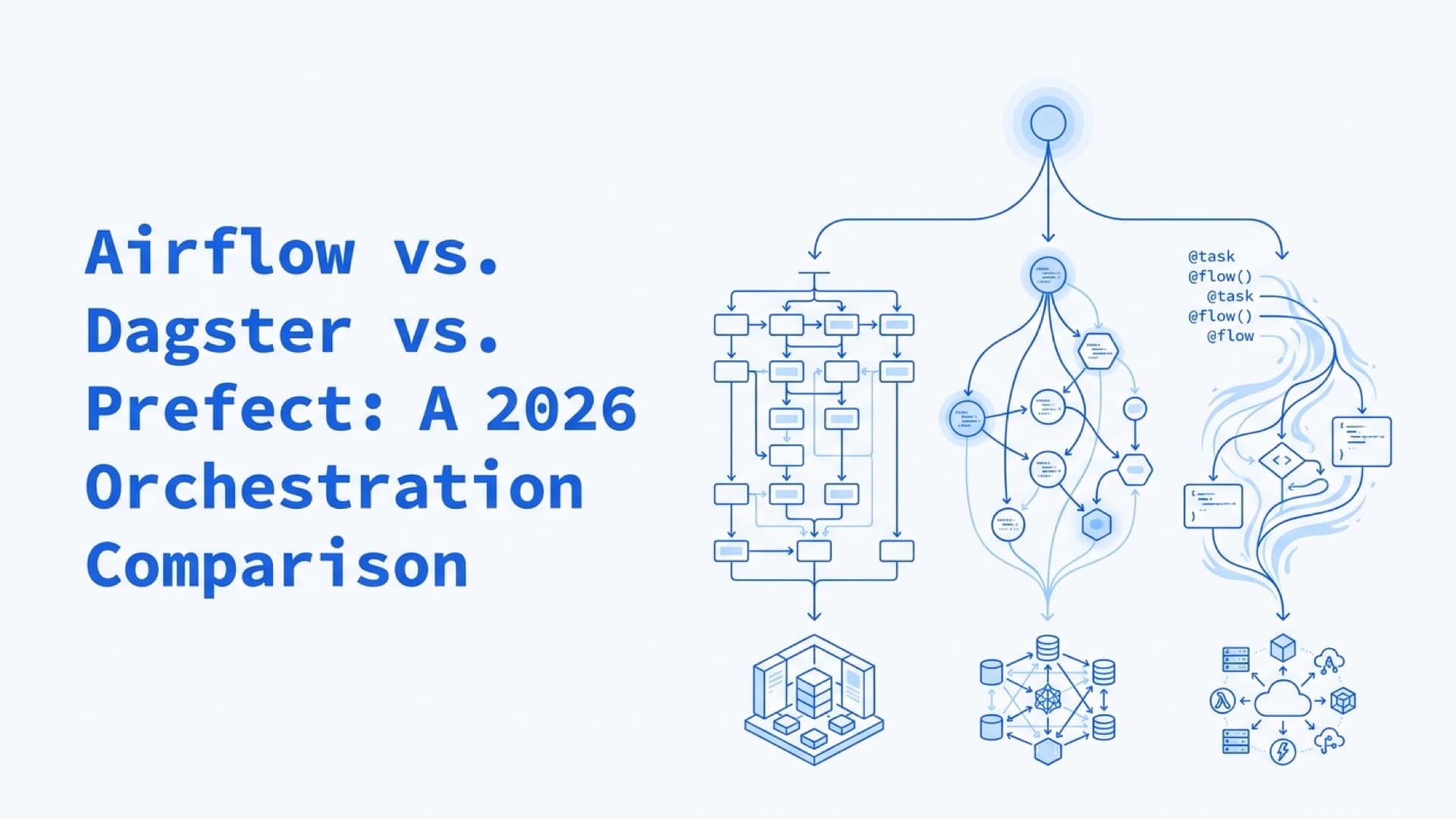
Airflow vs. Dagster vs. Prefect: A 2026 Orchestration Comparison
Airflow 3 shipped breaking changes, Dagster bet on assets over DAGs, Prefect cut 90% of runtime overhead. A decision framework based on team size, not feature lists.
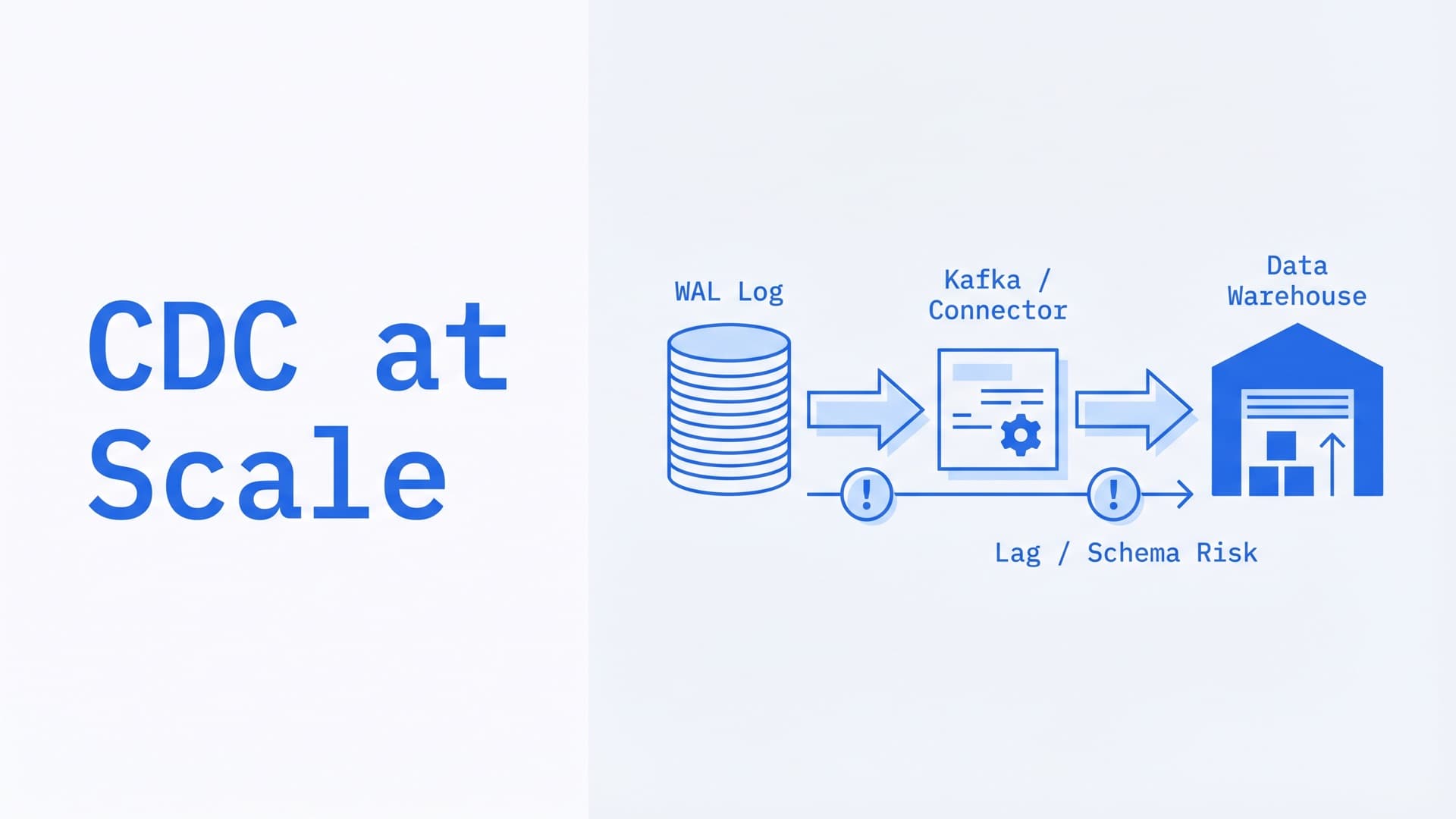
CDC at Scale: Debezium, Flink CDC, and the Real-Time Replication Problem
CDC looks simple — stream row-level changes from database to warehouse. In production it's schema drift, replication slot management, and full resyncs every time DDL runs. The honest guide.
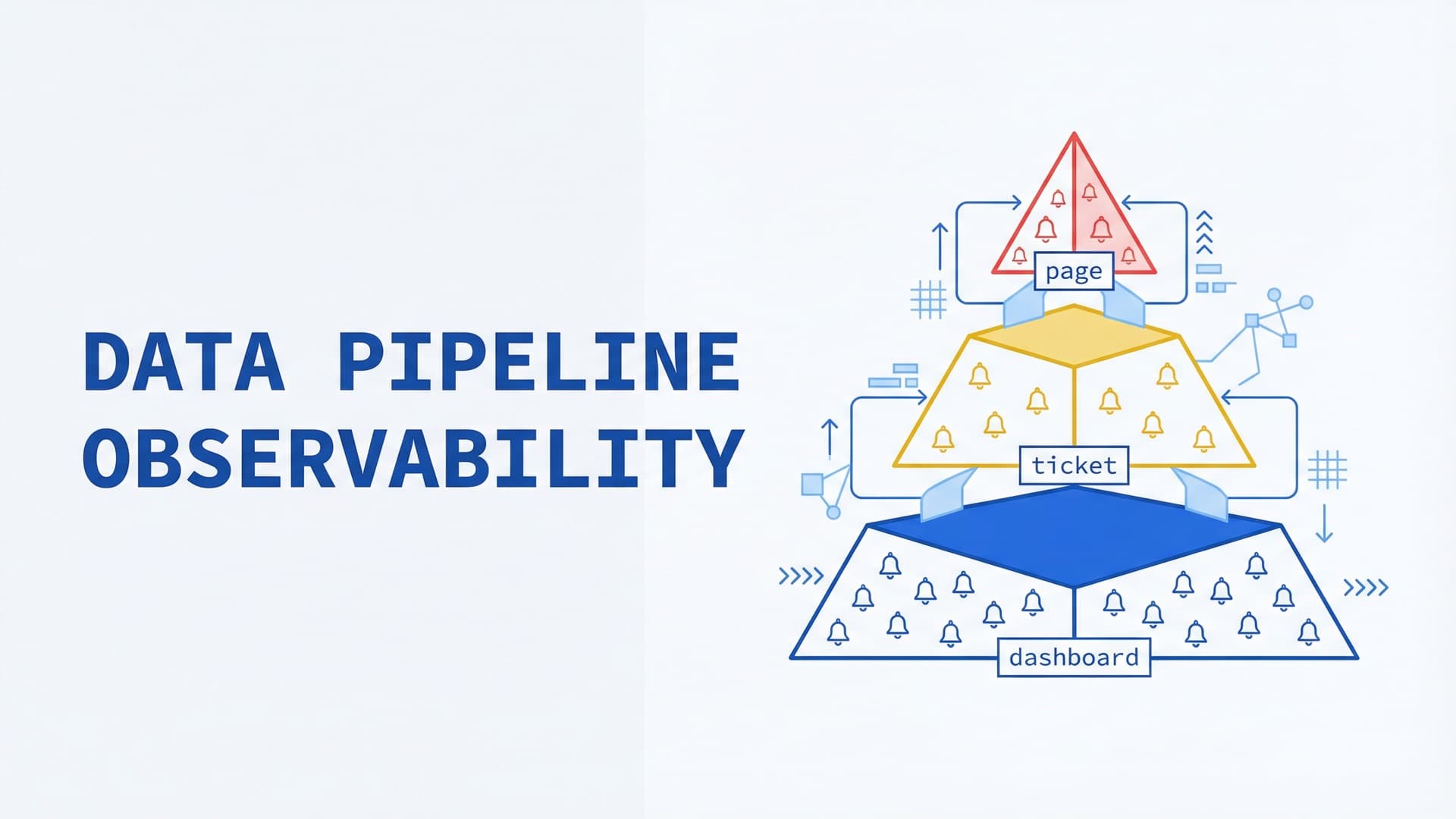
Data Pipeline Observability: Monitoring Airflow + dbt Without Drowning in Alerts
200 tests, 80 weekly alerts, and a Slack channel nobody reads. That's alert debt. The monitoring stack that catches real failures without burying your team.