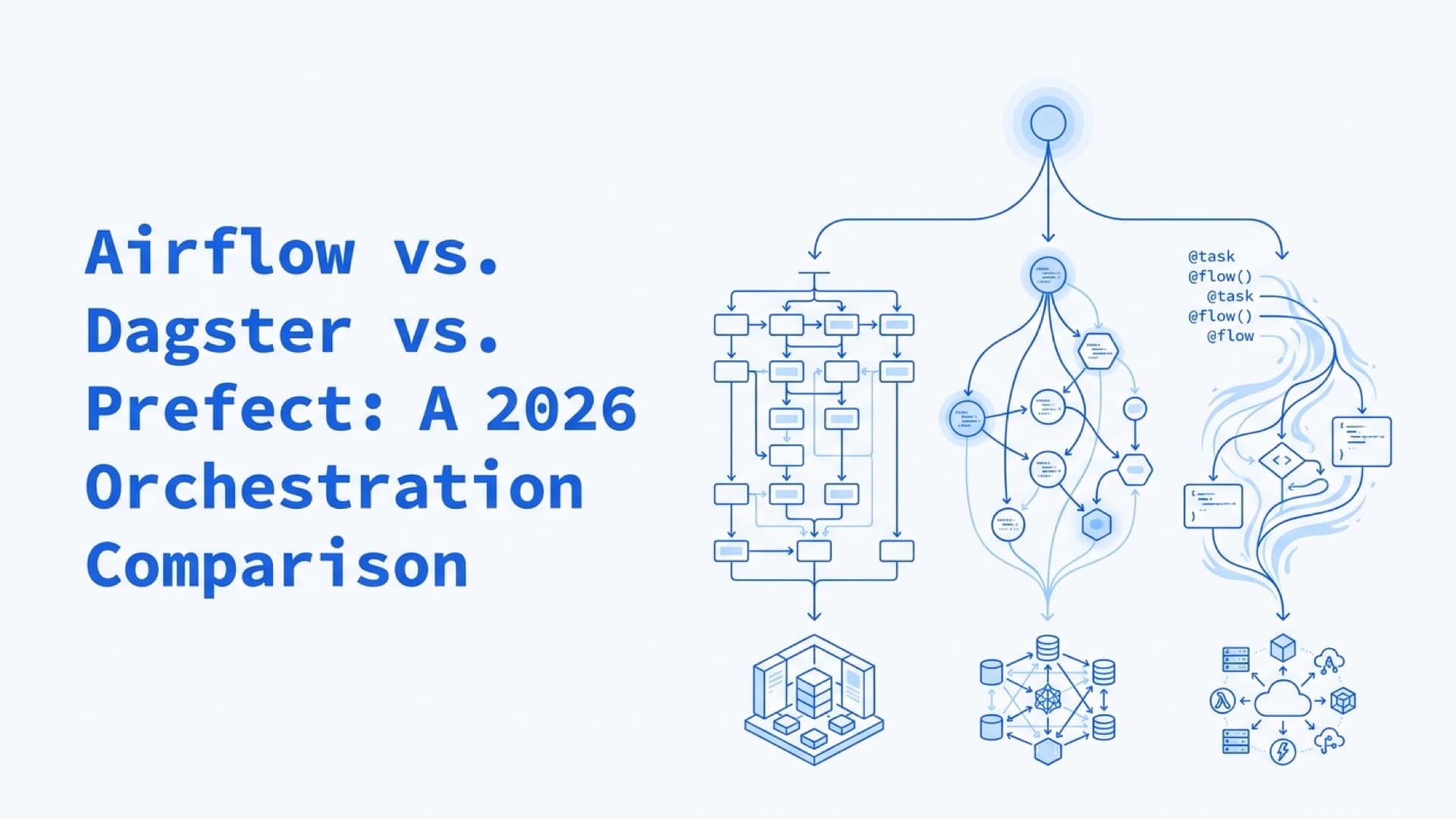
Airflow vs. Dagster vs. Prefect: A 2026 Orchestration Comparison
Airflow 3 shipped breaking changes. Dagster bet everything on assets over DAGs. Prefect cut 90% of runtime overhead. Three orchestrators, three fundamentally different architectural bets about how data engineering should work.
Every comparison you'll find online is a feature table — Airflow has this, Dagster has that. Feature tables don't help you make a decision because they treat orchestrators as interchangeable tools with different checkboxes. They aren't. Choosing the wrong architectural bet costs your team months of migration later. The right orchestrator depends on your team's operating model, not on a feature matrix.
The State of the Field in 2026
The State of Airflow 2026 survey of 5,800+ data professionals shows the field clearly: Airflow is still dominant, with 26% already on Airflow 3 and 84% of those on Airflow 2 planning to upgrade. dbt is the most common pairing at 44% adoption. But the survey also reveals pain — 43% cite hallucinations in AI-generated DAG code, and only 9% are satisfied with auto-generated DAGs.
Dagster has grown steadily as an Airflow alternative, particularly among teams that want observability built into the orchestration layer rather than bolted on. Prefect 3 shipped with 90% less runtime overhead than Prefect 2 and now has nearly 30,000 engineers in its community.
Three Architectural Bets
Airflow: the task-centric DAG
Airflow's model is straightforward: you define tasks, wire them into a Directed Acyclic Graph, and the scheduler runs them in order. This was the original insight when Maxime Beauchemin created Airflow at Airbnb in 2014 — and it remains the mental model most data engineers learn first.
Airflow 3 shipped significant improvements: a modern React-based UI replacing the dated Flask interface, a FastAPI-based REST API, DAG versioning, and data-aware scheduling through the Assets feature. But it also shipped breaking changes. Direct database access from tasks is gone. SubDAGs are removed. Context variables like execution_date are deprecated. The migration is, according to independent analysis, "weeks of work, not days" for teams with large DAG libraries.
The fundamental architecture remains task-centric. You define what to run and in what order. Airflow tells you whether each task succeeded or failed. It does not tell you whether the data those tasks produced is correct, current, or complete. That's your problem.
Dagster: the asset-centric graph
Dagster makes a different bet: software-defined assets. Instead of defining tasks that produce data as a side effect, you define the data assets themselves — tables, ML models, reports — and declare their dependencies. The orchestrator infers the execution graph from the dependency declarations.
This inversion changes what the orchestrator can answer. With Airflow, you can ask: "Did my pipeline run?" With Dagster, you can ask: "Is this table current? What upstream data would I need to reprocess to fix it? Which downstream dashboards are affected if this source changes?"
The practical difference: when a source schema changes and breaks a downstream model, Airflow shows you a failed task. Dagster shows you every asset affected and what needs to be recomputed. At 100+ data assets, that difference compounds — instead of manually tracing dependencies through DAG code, the asset graph tells you the blast radius immediately.
Dagster also ships with built-in asset checks (data quality tests attached to assets), partitioning that understands your data's time boundaries, and Airlift — a migration tool specifically designed to move Airflow DAGs into Dagster's asset model incrementally.
Prefect: the Python-native runtime
Prefect's bet is that orchestration should feel like writing Python, not configuring infrastructure. A @flow decorator turns any Python function into an orchestrated workflow. A @task decorator turns any function into a retryable, observable unit of work. No DAG files, no YAML configuration, no operator classes.
from prefect import flow, task

@task(retries=3, retry_delay_seconds=60)
def extract_data(source: str) -> dict:
    return api_client.fetch(source)

@task
def transform(raw: dict) -> pd.DataFrame:
    return pd.DataFrame(raw).pipe(clean).pipe(validate)

@flow
def etl_pipeline(source: str):
    raw = extract_data(source)
    transformed = transform(raw)
    load_to_warehouse(transformed)
The architecture is hybrid: Prefect Cloud (or self-hosted Prefect Server) handles scheduling, monitoring, and state management. Workers run in your infrastructure — Kubernetes, ECS, bare metal, Docker. The separation means the control plane never touches your data and your compute isn't tied to a vendor.
Prefect 3's claim of 90% runtime overhead reduction is significant for teams running hundreds of lightweight flows. The original Prefect 2 architecture added substantial latency to flow execution for state tracking; Prefect 3 addressed this by rearchitecting state management to be asynchronous by default.
The Configuration Cliff
Every orchestrator hits a point where the configuration complexity exceeds the complexity of the pipelines it's orchestrating. We call this the Configuration Cliff — and each tool hits it at a different scale.
Airflow's cliff is at the trailhead. A simple ETL job requires: a DAG file with scheduling config, operator imports, connection definitions in the Airflow UI or environment variables, and often a custom Docker image if your dependencies don't match the default Airflow image. You're configuring the orchestrator before you've orchestrated anything. At 200+ DAGs, the surface compounds — scheduler tuning, connection management, 80+ provider package upgrades, DAG deployment patterns, and now the Airflow 2-to-3 migration. Astronomer estimates managed Airflow costs $1,500-$5,000/month minimum at production scale, which reflects the operational complexity they're absorbing on your behalf.
Dagster moves the cliff but doesn't remove it. The asset model pushes upfront configuration out — execution order is inferred from declared dependencies, not manually wired. Adding a new asset doesn't require editing a shared DAG file. This scales better to 100+ assets. But Dagster's own configuration surface grows with complexity: I/O managers, resources, partitioning schemes, and the Definitions object that ties everything together require real design decisions as the project grows. The cliff is further away. It's still there.
Prefect hides the cliff until you're past it. Minimal configuration to start — flows are Python functions, deployments are CLI commands. But when you need multi-tenant scheduling, complex concurrency limits, or cross-flow dependencies at enterprise scale, Prefect's configuration model is less mature than Airflow's. The hybrid model (cloud control plane + self-hosted workers) adds its own operational surface that only becomes visible at scale.
When Each Orchestrator Wins
Choose Airflow when:
- Your team already runs Airflow. Migration cost is real. If you have 100+ DAGs running in production, the cost of migrating to Dagster or Prefect exceeds the benefit for most teams. Upgrade to Airflow 3 instead.
- You need the ecosystem. Airflow has 80+ provider packages covering every cloud service, database, and SaaS API. If your pipeline integrates with obscure systems, the operator probably already exists.
- Your organization mandates a managed platform. Astronomer (Astro), Google Cloud Composer, and Amazon MWAA provide managed Airflow with enterprise support. No managed Dagster or Prefect service offers comparable enterprise coverage.
- You run at true platform scale. Astronomer reports running billions of Airflow tasks globally. At 1,000+ DAGs with dedicated platform engineering, Airflow's maturity and battle-tested scheduler win.
Choose Dagster when:
- You're building a data platform, not just pipelines. If your team thinks in terms of data assets (tables, models, reports) rather than ETL jobs, Dagster's model matches that mental model. This is especially true for analytics engineering teams already using dbt — Dagster's dbt integration treats dbt models as first-class assets.
- Observability is a first-class requirement. Dagster's built-in asset checks, lineage graph, and partition-aware monitoring provide observability that Airflow requires additional tools (Great Expectations, Elementary, Monte Carlo) to achieve.
- You're migrating from Airflow. Dagster's Airlift tool allows incremental migration — run Airflow DAGs alongside Dagster assets during transition. This is a better migration path than a big-bang rewrite.
- Your team is 3-15 data engineers. Large enough to benefit from the asset model, small enough that Dagster's operational complexity is manageable without a dedicated platform team.
Choose Prefect when:
- Your team writes Python and wants to keep it that way. If your data engineers come from a software engineering background and think in functions rather than configs, Prefect's decorator model minimizes the mental overhead of orchestration.
- You run many lightweight, dynamic workflows. Prefect excels at flows where the execution graph isn't known until runtime — for example, processing each file in a directory, where the number of files varies daily. Airflow requires pre-defined DAGs; Prefect generates the execution graph dynamically.
- You want hybrid infrastructure. Prefect's separation of control plane and execution plane means you can schedule from Prefect Cloud while running all compute in your VPC. No data leaves your infrastructure.
- Your team is 1-5 data engineers. Prefect's minimal configuration makes it the fastest to production. The
@flowdecorator plus aprefect deploycommand is a complete setup — no DAG files, no scheduler config, no connection management UI.
The Migration Question
Airflow 3's breaking changes created a forced decision point. Azure's ADF Workflow Orchestration Manager (managed Airflow) shut down in January 2026. Airflow 2 is approaching end-of-life. Teams have to do something.
The question is whether that "something" is upgrading to Airflow 3 or migrating to a different orchestrator entirely. Our recommendation:
If you have fewer than 50 DAGs: evaluate Dagster or Prefect seriously. The migration cost is low enough that moving to a better-fitting tool makes sense. Dagster's Airlift makes this incremental.
If you have 50-200 DAGs: upgrade to Airflow 3. The migration is real work — Ruff-based linter rules (AIR301/302) auto-detect breaking changes, but manual refactoring remains necessary for SubDAG removal, XCom backend changes, and deprecated context variables. That said, the core scheduling and operator concepts haven't changed, and Airflow's 80+ provider packages represent months of integration work you'd have to replicate elsewhere.
If you have 200+ DAGs: the migration cost to a different orchestrator almost certainly exceeds the benefit. Upgrade to Airflow 3, invest in a platform team, and consider running Dagster alongside Airflow for net-new projects while the legacy stack stays on Airflow.
What This Comparison Leaves Out
This is a comparison of three Python-native orchestrators. It deliberately excludes Kestra (YAML-based, polyglot — worth evaluating if your team includes non-Python users), Temporal (durable execution model — a different category entirely, designed for long-running stateful workflows), and managed zero-code platforms like Fivetran and Airbyte (which are ETL tools, not orchestrators, even though they handle scheduling).
We also haven't addressed cost in depth. Airflow's total cost of ownership is heavily dependent on whether you self-host (free software, expensive operations) or use a managed service ($1,500-$5,000+/month). Dagster Cloud and Prefect Cloud both offer managed tiers with different pricing models. The cost comparison deserves its own analysis — and it's impossible to generalize because it depends entirely on scale, team size, and the value of engineering time at your organization.
Pick the orchestrator your team can operate. If you need a platform team to run it, you've already made the choice — and that choice is Airflow.
Need help choosing or migrating your orchestration stack? Talk to an engineer — we'll tell you honestly if we can help.
Frequently Asked Questions
Should I upgrade to Airflow 3 or switch to Dagster?
If you run fewer than 50 Airflow DAGs, evaluate Dagster seriously — migration cost is low and the asset model provides better observability. For 50+ DAGs, upgrading to Airflow 3 is usually more cost-effective. Dagster's Airlift tool enables incremental migration if you want to run both simultaneously during transition.
What is the main difference between Airflow and Dagster?
Airflow is task-centric — you define tasks and their execution order. Dagster is asset-centric — you define data assets and their dependencies. Airflow tells you whether your pipeline ran. Dagster tells you whether your data is current, what's affected when something breaks, and what needs reprocessing. The asset model provides built-in observability that Airflow requires additional tools to achieve.
Is Prefect easier than Airflow?
For small teams (1-5 engineers), yes. Prefect uses Python decorators instead of DAG configuration files, requires minimal infrastructure setup, and supports dynamic workflow generation at runtime. One engineer can have a production workflow running in a day. At enterprise scale (200+ workflows), Prefect's configuration model is less mature than Airflow's ecosystem.
What is the Configuration Cliff in data orchestration?
The Configuration Cliff is the point where managing the orchestrator's configuration becomes more complex than the pipelines it orchestrates. Airflow hits it early due to DAG files, connection management, and provider packages. Dagster delays it through dependency inference. Prefect avoids upfront complexity but encounters it differently at enterprise scale with multi-tenant scheduling.
How much does managed Airflow cost?
Astronomer's Astro platform starts at approximately $1,500-$5,000/month for production workloads. Google Cloud Composer and Amazon MWAA pricing varies by cluster size. Self-hosted Airflow is free software but requires significant platform engineering time at 200+ DAGs — scheduler tuning, provider upgrades, and migration work that compounds with scale. Total cost depends heavily on DAG count, task volume, and whether you have platform engineering capacity in-house.
Related posts
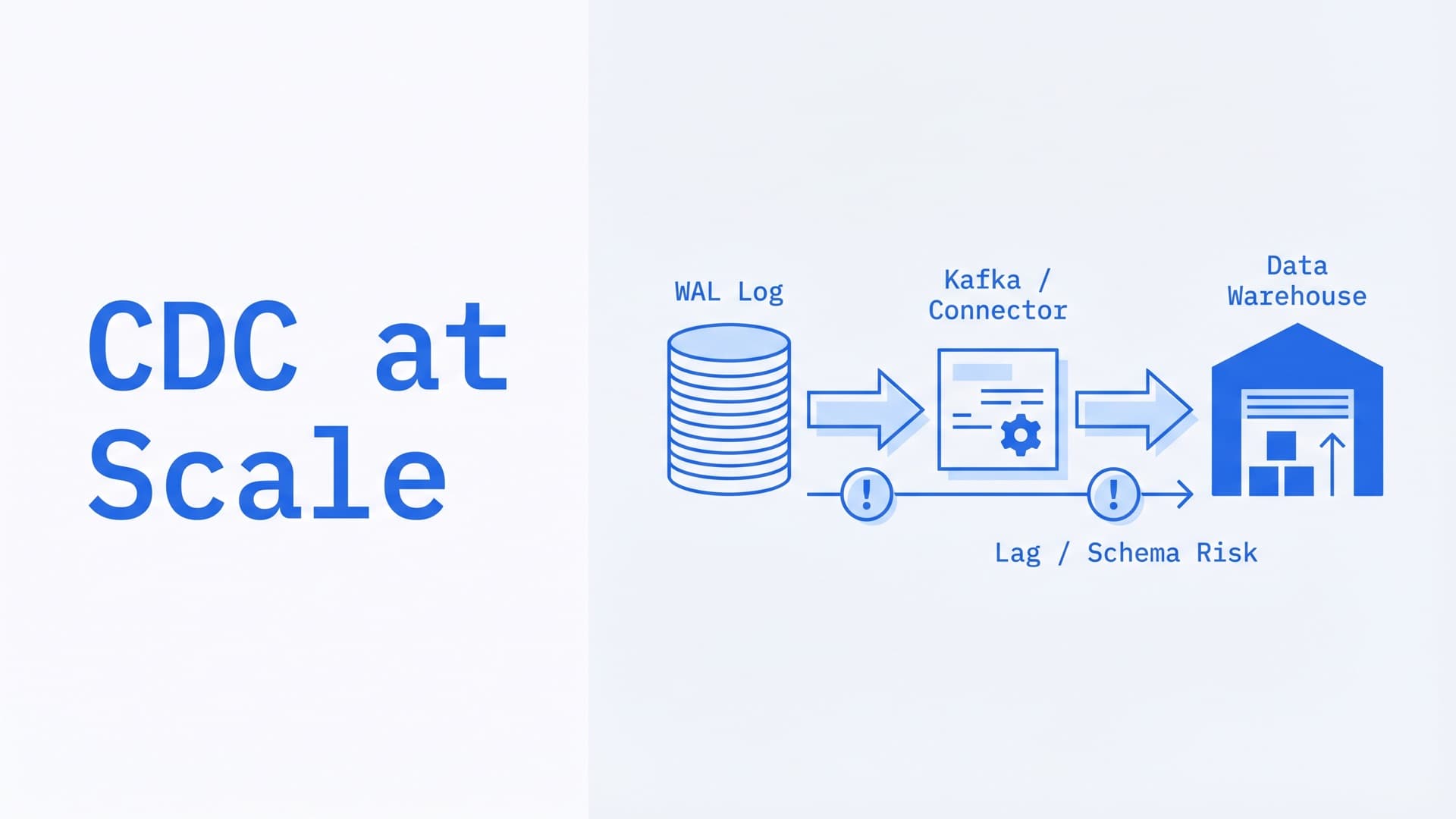
CDC at Scale: Debezium, Flink CDC, and the Real-Time Replication Problem
CDC looks simple — stream row-level changes from database to warehouse. In production it's schema drift, replication slot management, and full resyncs every time DDL runs. The honest guide.
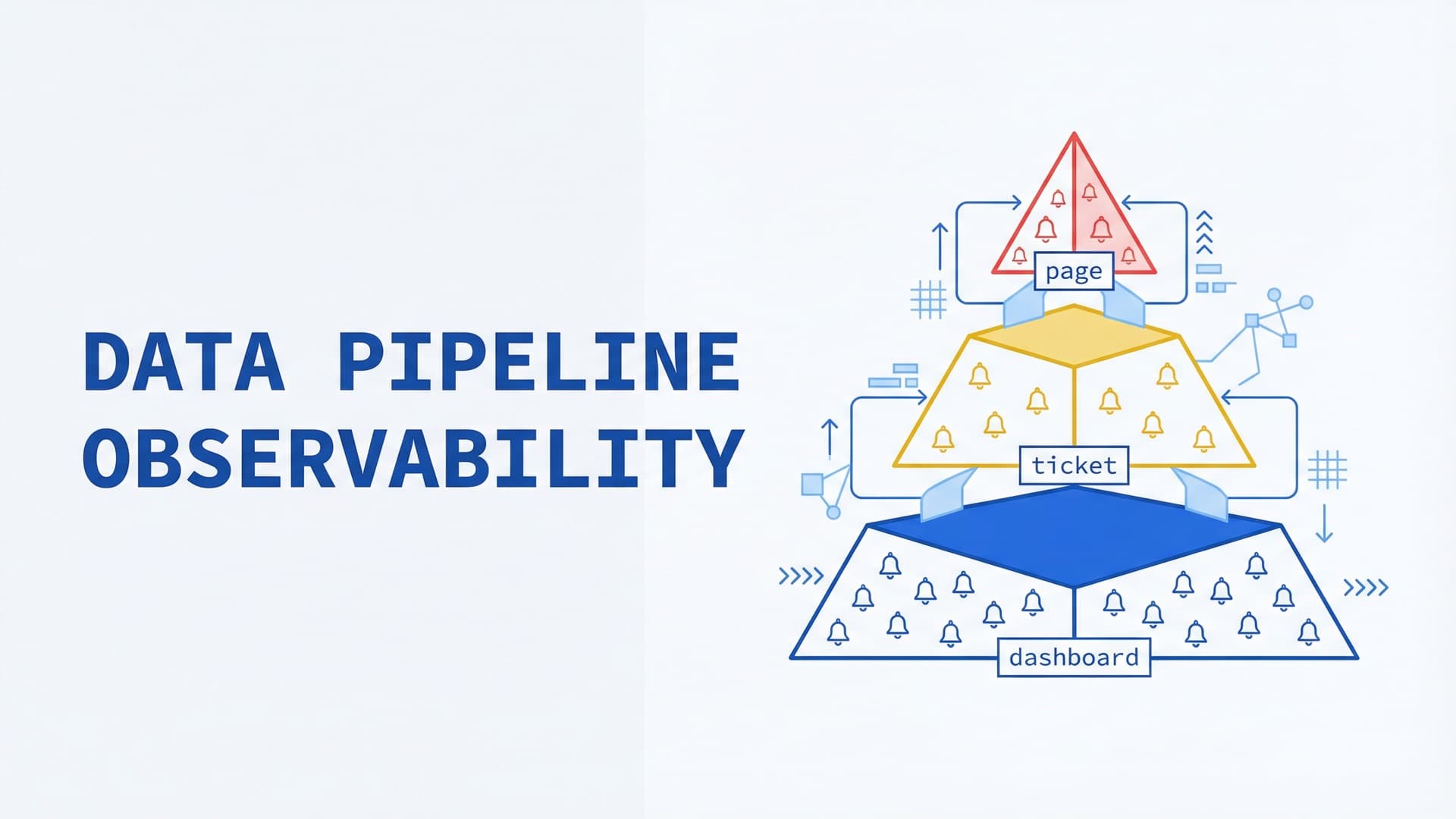
Data Pipeline Observability: Monitoring Airflow + dbt Without Drowning in Alerts
200 tests, 80 weekly alerts, and a Slack channel nobody reads. That's alert debt. The monitoring stack that catches real failures without burying your team.
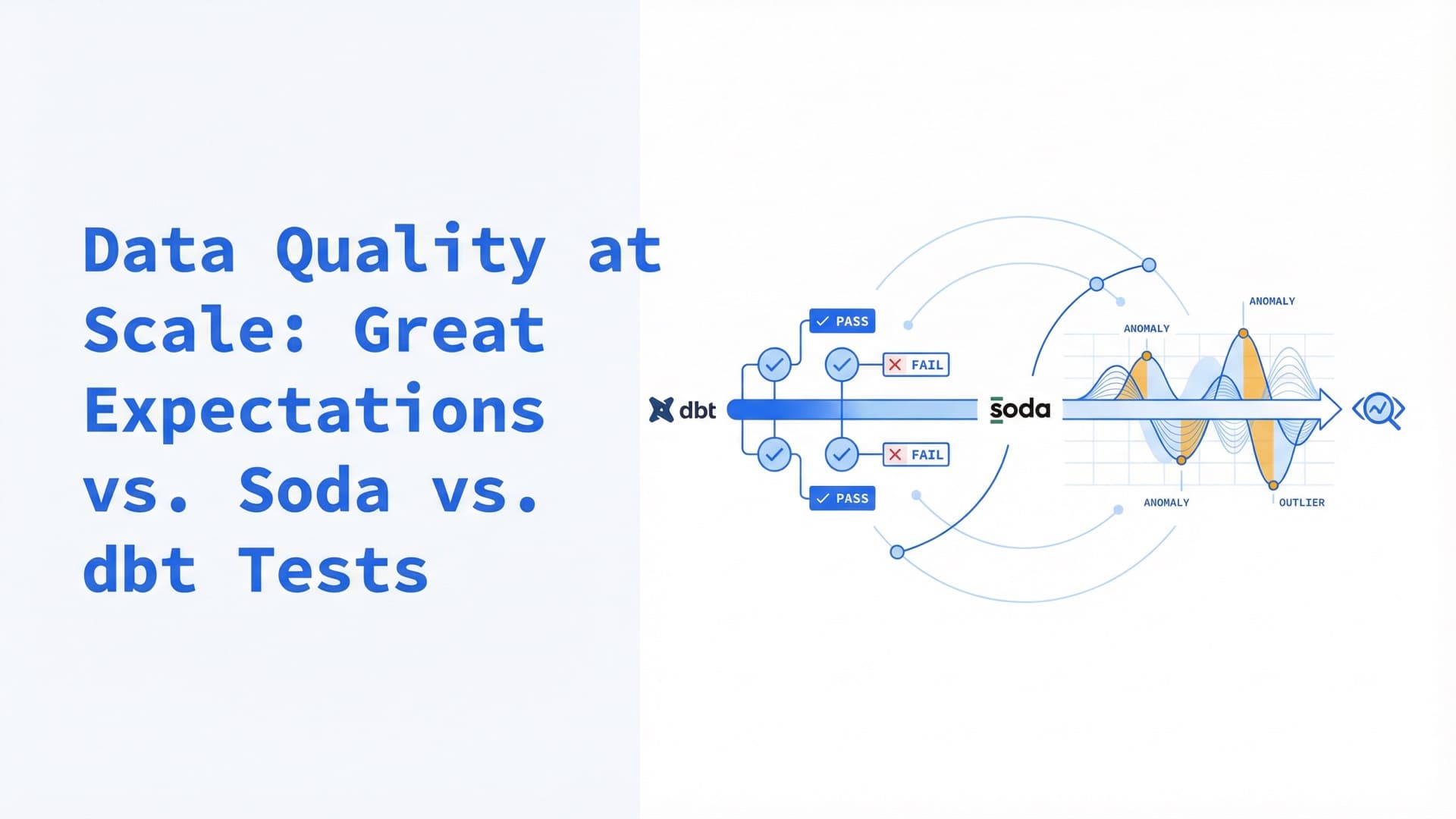
Data Quality at Scale: Great Expectations vs. Soda vs. dbt Tests
dbt tests catch transformation bugs. Great Expectations catches source corruption. Soda monitors everything between. A decision framework for choosing data quality tools in 2026.