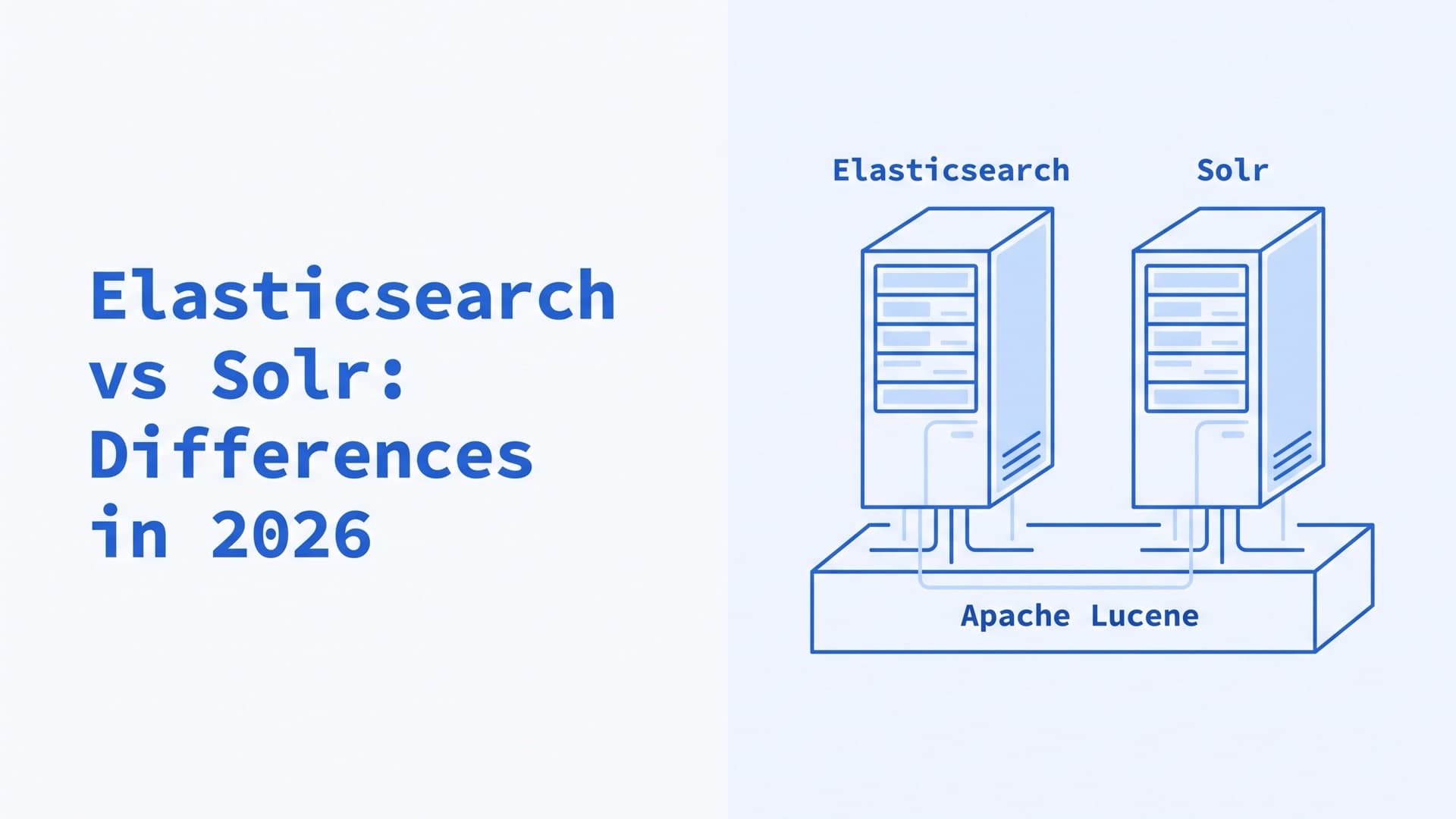
Elasticsearch vs Solr: Differences in 2026
What is the difference between Elasticsearch and Solr?
Elasticsearch and Apache Solr are both search servers built on Apache Lucene. Solr is an Apache Software Foundation project under the Apache 2.0 license. Elastic develops Elasticsearch and offers its source code under AGPLv3, SSPL or the Elastic License 2.0. Elasticsearch coordinates its own cluster, and SolrCloud uses ZooKeeper. Their query APIs, free features and tools differ too.
Ivinco has built search since 2009. All sources were checked in October 2026.
Elasticsearch vs Solr at a glance
The table compares self-managed installs as of October 2026.
| Aspect | Elasticsearch | Solr |
|---|---|---|
| Latest version | 9.5.5, Oct 6, 2026 | 10.0.0, Mar 3, 2026 |
| Lucene | 10.5.1 | 10.3.2 |
| Source license | AGPLv3, SSPL, ELv2 | Apache 2.0 |
| Download license | ELv2 | Apache 2.0 |
| Governance | Elastic | Apache Software Foundation |
| Cluster coordination | Built in | ZooKeeper for SolrCloud |
| Query languages | Query DSL, ES|QL, SQL | Query parsers, JSON API, SQL |
| Schema | Dynamic mapping by default | Schemaless in default config |
| Vector search | Quantized by default | Quantized types since 10.0 |
| RRF hybrid search | Enterprise tier | Free in 9.11, not 10.0 |
| Dashboards and UI | Kibana | Admin UI |
| Main managed service | Elastic Cloud | Third-party hosts |
| Typical uses | Search, observability, security | Site, content and catalog search |
Solr vs Lucene vs Elasticsearch
Apache Lucene is a Java library for indexing and search. Solr and Elasticsearch turn it into servers with HTTP APIs, clustering and central configuration (Solr, Elastic).
- 2004. Yonik Seeley wrote the first version of Solr at CNET.
- 2006 to 2007. The Apache Incubator accepted Solr in January 2006. It graduated as a Lucene sub-project in January 2007.
- February 2010. Elasticsearch had its first release, version 0.4.0.
- March 2010. Solr and Lucene merged their development into one project, and from Solr 3.1 the two shared a code repository.
- Early 2021. Elastic moved Elasticsearch off Apache 2.0, and 7.11 shipped under SSPL and the Elastic License in February. That month the ASF board made Solr a top-level project, separate from Lucene.
- May 2022. Solr 9.0 was the first Solr built and released apart from Lucene.
- 2024. Elastic announced AGPLv3 as a third source license. The code carries it from 8.16.0, released in November.
After the 2021 change, AWS forked Elasticsearch 7.10.2 as OpenSearch. Like Solr, OpenSearch is built on Lucene and uses Apache 2.0. Our OpenSearch vs Elasticsearch comparison covers that fork. Our guide to Elasticsearch alternatives explains why companies move away from Elasticsearch.
Is Solr still relevant?
Yes. Solr 10.0.0 shipped on March 3, 2026, and 9.11.0 followed on October 4, 2026. Sitecore XP 10.5 supports only Solr 10, and SAP Commerce Cloud uses Solr for its index-based search. Solr's DB-Engines popularity score has fallen over the past year, and Liferay plans to deprecate Solr support.
The downloads page sets the support policy. New features go into 10.x, and 9.11.x may get critical fixes. Every older version is end of life, Solr 8 included. The last 8.x release, 8.11.4, came out in September 2024. Solr 11 is in development.
Solr's project committee has 62 members, and the project has 103 committers (Apache). The 9.11.0 announcement thanks 44 contributors. Elastic's annual report for fiscal 2026 names Apache Solr among its search competitors.
DB-Engines' search engine ranking for October 2026 puts Solr third of 30 systems, with a score of 32.41. Elasticsearch is first with 94.11, and Splunk second. Over the past year, Solr's score fell 2.90 points and Elasticsearch's fell 22.55. DB-Engines scores popularity from mentions, searches, jobs and similar signals. Its method page says it doesn't measure installations or use. Our OpenSearch comparison answers whether Elasticsearch is still relevant.
Elasticsearch vs Solr license and governance
Elasticsearch source code is under a triple license by default, AGPLv3, SSPL or the Elastic License 2.0 (ELv2). Code in the x-pack folder, a large part of the repository, is under ELv2 only. The default download ships under ELv2. Elastic's client libraries remain under Apache 2.0.
ELv2 lets you use, change and redistribute the software, with three limits. You may not offer it as a hosted or managed service that gives users a substantial set of its features. You may not bypass its license keys. You must keep Elastic's notices.
The other two source licenses work differently. SSPL section 13 requires anyone offering the software as a service to publish the source of the whole service stack. That includes management, monitoring, backup and hosting software. AGPLv3 section 13 requires you to offer your modified source to users who reach it over a network. The x-pack code stays under ELv2 whichever option you pick.
Solr has one license. Its own code is all under Apache 2.0, which asks you to keep the license and notices when you redistribute. Have counsel check your own case.
Elastic's free Basic tier covers TLS, role-based access control, vector search, aggregations, ES|QL, SQL, Kibana dashboards, index lifecycle management and data tiers. Learning to rank and RRF hybrid search need Enterprise. Solr's learning to rank module ships under Apache 2.0 with the rest of Solr, and so does its RRF handler in 9.11.
Elastic owns Elasticsearch and sets its license, as the 2021 and 2024 changes show. Solr is run by its project committee under the ASF. ASF roles belong to individuals and are "not tied to your job or current employer" (ASF).
Elasticsearch vs Solr architecture and scaling
Elasticsearch coordinates its own cluster. Master-eligible nodes elect a master and commit changes to the cluster state by quorum. With three or four master-eligible nodes, a cluster survives the loss of one.
SolrCloud gives that job to Apache ZooKeeper. ZooKeeper tracks every node and core, stores the configuration and routes around failures. Solr bundles ZooKeeper, but the reference guide says the embedded instance shouldn't run in production. It suggests an external ensemble of three nodes, or five for a larger cluster. Solr also runs without ZooKeeper in user-managed mode, where you create shards and route documents yourself.
Solr 10 keeps ZooKeeper for SolrCloud and changes three other things (major changes).
bin/solr startnow starts SolrCloud, and--user-managedstarts the other mode.- The Overseer, a node that processes cluster changes, can be turned off. The notes say it might disappear in Solr 11.
- Clients should connect through Solr URLs. The client constructor that takes ZooKeeper hosts is deprecated.
Shard counts change in different ways. An Elasticsearch index fixes its number of primary shards at creation. The split API copies a read-only index into a new one with more shards. Solr's SPLITSHARD divides an existing shard in two, and the original shard routes requests to the new ones.
For time-based data, Elasticsearch moves indexes through hot, warm, cold and frozen data tiers. Tiers and lifecycle management are free. The frozen tier holds only searchable snapshots, an Enterprise feature. Solr's time routed aliases create a new collection for each time period and can delete old ones. Its guide suggests them for logs and sensor data.
Elasticsearch bundles its own JDK, and Solr 10 needs Java 21 or later. A new Elasticsearch node sets up TLS and a superuser password on its first start. Solr enables authentication once a security.json file configures it, which bin/solr auth can create. On Kubernetes, the Apache Solr Operator runs Solr, and Elastic's ECK runs Elasticsearch, free under the Basic license.
Schema and indexing in Solr and Elasticsearch
Both engines can guess field types, and both advise against relying on that in production. Elasticsearch's dynamic mapping adds fields as new documents arrive. Elastic recommends explicit mappings for production, and most changes to an existing field need a reindex.
Solr keeps a managed schema that the Schema API can change at runtime. Its schemaless mode guesses types for unseen fields and is on in the default configset. When you create a collection from it, bin/solr warns that this is "NOT RECOMMENDED for production use". Once Solr adds a field, its type is fixed, and documents with conflicting values fail.
Elasticsearch's nested type indexes each object in an array as a hidden document. Solr indexes parent and child documents together and searches them with block joins. Its guide says this usually beats a query-time join on speed, at some cost in flexibility.
Ingestion tools differ most.
- Elasticsearch runs ingest pipelines inside the cluster, and Elastic offers Logstash, Beats and Elastic Agent outside it.
- Solr accepts XML, CSV and JSON over HTTP, and its update processors change documents on the way in.
- Solr 9.0 removed the Data Import Handler, which became an independent project.
- Solr 10 extracts text from rich documents only through a remote Tika Server.
Solr vs Elasticsearch queries and relevance
Solr offers several query parsers. The standard parser takes Lucene syntax and is strict about errors. DisMax takes plain user input and searches several weighted fields. eDisMax adds Lucene syntax to DisMax. You pass parameters in the URL or through the JSON Request API.
For analytics, Solr has the JSON Facet API and streaming expressions over SolrCloud collections. An optional SQL module uses Apache Calcite to turn SQL into streaming expressions.
Elasticsearch uses one JSON Query DSL for search, with aggregations for metrics and buckets. ES|QL is a piped language for filtering and analysis. Elasticsearch SQL accepts SQL through REST and a CLI in the free tier, and through JDBC in paid tiers (subscriptions).
Here is how to write the same search in each engine. Solr's eDisMax spreads the words across weighted fields listed in qf. Elasticsearch's multi_match takes boosted fields and wraps them in a dis_max query by default. Both put the stock check in a filter that doesn't affect scores (Solr, Elasticsearch).
POST /solr/products/query
{
  "query": "running shoes",
  "filter": "in_stock:true",
  "params": {
    "defType": "edismax",
    "qf": "name^2 description"
  }
}
POST /products/_search
{
  "query": {
    "bool": {
      "must": {
        "multi_match": {
          "query": "running shoes",
          "fields": [
            "name^2", "description"
          ]
        }
      },
      "filter": {
        "term": { "in_stock": true }
      }
    }
  }
}
Both engines score text with BM25 by default (Solr, Elasticsearch). Both can rerank the top results with a trained model. Solr's learning to rank module ships under Apache 2.0. Elasticsearch added learning to rank in 8.12, and it needs an Enterprise subscription.
Elasticsearch vs Solr vector and hybrid search
Elasticsearch stores embeddings in a dense_vector field and searches them with HNSW. It quantizes float vectors by default. Since 9.1, fields with 384 or more dimensions default to BBQ, a binary quantization that cuts vector memory by 96%. Smaller fields default to int8, which cuts it by 75%. From 9.4, the default becomes bbq_disk where the license allows. That type searches k-means clusters of vectors, and it needs an Enterprise subscription.
The semantic_text field generates embeddings and chunks long text at index time. It usually calls Elastic's inference API, which needs an Enterprise subscription on self-managed clusters. Elastic recommends RRF for hybrid search, which also needs Enterprise on self-managed clusters.
Solr added dense vector search in 9.0, on Lucene's HNSW graphs. Solr 10 added scalar and binary quantized vector fields and GPU search through NVIDIA's cuVS. Quantization is opt-in.
For semantic search, Solr's text-to-vector module sends text to an external embedding service through LangChain4j. The model doesn't run inside Solr. Solr 9.8 added it for queries, and 9.9 for indexing.
Hybrid search with RRF arrived in Solr 9.11.0. Its new combined query handler runs several queries and fuses their rankings. Solr 10.0 shipped earlier without it. The guide for the coming 10.1, still marked beta, documents it.
Elasticsearch vs Solr performance and benchmarks
No published benchmark settles which engine is faster. Sematext, a consultancy that works with both, says in its comparison, last updated in March 2025, that nobody has done "good, comprehensive and unbiased benchmarks". Two independent academic studies point in opposite directions.
| Who ran it | Versions | Headline result |
|---|---|---|
| Federal University of Paraná, 2020 | Not stated | ES indexed faster with less memory |
| Inonu University, 2023 | Solr 9.0.0, ES 8.4.2 | Solr faster at indexing and search |
Federal University of Paraná, 2020. Aluísio Gonçalves and Marcos Sunye tested both engines behind DSpace, a digital repository platform, on a virtual machine with 8 virtual cores and 19GiB of RAM. They used the university's digital archive from February 2019 and 30 query patterns from its search logs. Elasticsearch indexed in 53 minutes against Solr's 224, with less memory and disk. It answered most queries in under 500ms, against about a second for Solr. On queries returning many documents, Solr took up to 5 seconds and Elasticsearch almost 15. Result quality differed by less than 5%. The paper doesn't state versions. Solr ran inside the DSpace process, which the authors say explains its extra memory, though not its slower indexing.
Inonu University, 2023. Ayşenur Deniz, Muhammed Mehdi Elömer and Ahmet Arif Aydın compared Solr 9.0.0 and Elasticsearch 8.4.2 on three Windows PCs. Each engine ran as one node with default settings and security off, on datasets of 17MB to 300MB. In the default runs, Solr indexed faster on every machine and dataset. Those runs gave Solr a 512MB heap and Elasticsearch half the machine's memory. The search tests ran on one of the PCs. Solr's average time was lower on all ten queries when Elasticsearch counted every hit, as Solr does, and on nine of ten with that count off. The authors call two of the queries about equal, and their abstract says seven of ten. They loaded each dataset as one bulk file and timed searches from a desktop API client.
Neither study reports a multi-node cluster or tests vector search. Both predate Solr 10 and Elasticsearch 9, which now run different Lucene versions. Comparisons from before 2020 tested versions many releases older, so they say little about today's engines. Results depend on workload, versions and tuning.
Test both engines on your own data and queries. Elastic's Rally benchmarks Elasticsearch only, and Solr's repository has a JMH module for micro-benchmarks. For a fair test, drive both with the same load tool, data, queries and hardware.
Kibana, the Solr Admin UI and other tools
Kibana is Elastic's interface for search, dashboards and alerts, and dashboards are in the free tier. It must run the same version as Elasticsearch. Solr's Admin UI is an operations console, with screens for logging, collections, the schema and test queries. Solr 10 adds an experimental new UI at /solr/ui and serves Prometheus metrics natively (major changes).
Elastic maintains official clients for Python, Java, JavaScript, .NET, PHP, Go and Ruby, and an experimental one for Rust. Solr ships SolrJ for Java. For Python, Solr's docs show plain JSON over HTTP, and community libraries such as pysolr wrap it.
Drupal, Sitecore and other platforms
- Drupal. The Search API Solr module reports 58,478 sites. Its page says one organization actively supports it, which slowed Solr 10 and dense vector work. The Elasticsearch Connector reports 5,908 sites, and its line for Elasticsearch 9 is in development.
- Sitecore. Sitecore XP 10.5, released on August 5, 2026, supports Solr 10 only.
- SAP Commerce Cloud. Its index-based search uses Solr. An SAP knowledge base article names Solr 9.10 as the latest version it offers.
- Liferay DXP. Liferay recommends Elasticsearch and installs its connector by default. It says Solr is planned for deprecation.
- GitLab. From version 19.1, its advanced search runs on Elasticsearch 8.x or 9.x, or on OpenSearch. GitLab.com uses Elasticsearch 9.x.
Managed Elasticsearch and Solr hosting and pricing
Elastic sells Elastic Cloud in two forms. Hosted deployments run on AWS, Azure and Google Cloud. As of October 2026, the Standard tier starts at $99 a month, priced for 120GB of storage across two zones. Serverless projects bill compute in virtual compute units with 1GB of RAM, plus storage. Self-managed subscriptions are priced by node count and RAM. Bonsai also hosts Elasticsearch. On AWS, Amazon OpenSearch Service runs OpenSearch and legacy Elasticsearch up to 7.10, but not Solr (AWS).
Managed Solr comes from third parties.
- SearchStax lists a Development plan with clusters from $367 a month, billed annually and with no uptime SLA. Its Core plan starts at $2,499 a month with a 99.9% SLA. Dedicated plans run on AWS, Azure or Google Cloud.
- Opensolr sells shared plans from €17 a month, billed yearly, for one index with 100MB of disk.
Those prices are as of October 2026. Each entry price buys a different setup, so compare quotes for your own data size, traffic and SLA.
Solr to Elasticsearch migration (and back)
A move in either direction means a full reindex. Solr's guide calls a Lucene index "a lossy abstraction" and says the original data can't be assumed available once indexed (reindexing). Reload from your source of truth where you can.
From Solr to Elasticsearch
Map each Solr field type and analyzer to an explicit Elasticsearch mapping. Most concepts have a counterpart.
| Solr | Elasticsearch |
|---|---|
| copyField | copy_to |
| fq filter | bool filter |
| DisMax, eDisMax | multi_match |
| JSON facets | Aggregations |
| SolrJ | Elastic's Java client |
If the source data is gone, export it from Solr. A cursorMark walks a whole collection page by page, and the /export handler streams large sorted result sets. Solr returns only fields that are stored or have docValues, so other fields must come from the source. Then rewrite queries and clients, and retest relevance on real queries before you switch reads.
From Elasticsearch to Solr
Elasticsearch keeps each original document in _source by default, so you can export documents and load them into Solr. Mappings become a Solr schema. Query DSL becomes parser parameters or JSON Request API calls, and aggregations become JSON facets. Kibana dashboards and alerts need a new tool.
Upgrading from Solr 8
Solr 8 is end of life. Lucene reads indexes only one major version back, and it records which version created an index (reindexing). Solr 10.0 runs Lucene 10.3.2, which won't open an index first created by Solr 8. Solr 9 reads it, but the Solr 9 notes strongly recommend a full reindex.
If you're planning a move between Solr and Elasticsearch, tell us about it. We've built and maintained search systems for over 15 years.
Should you use Elasticsearch or Solr?
Neither is better everywhere. Elasticsearch suits teams that want one vendor's stack and a managed service from its maker. Solr suits teams that need Apache 2.0 throughout, ASF governance or a platform built on Solr.
| Situation | Fits | Why |
|---|---|---|
| You want the engine's maker to run it | Elasticsearch | Elastic Cloud |
| You run logs or observability | Elasticsearch | Kibana, Elastic Agent, free ILM |
| You run Liferay DXP | Elasticsearch | Its recommended engine |
| You want support from one vendor | Elasticsearch | Elastic builds and supports it |
| You need Apache 2.0 for all code | Solr | No ELv2-only code |
| You sell the engine as a managed service | Solr | ELv2 forbids it |
| You run Sitecore XP 10.5 or SAP Commerce | Solr | Their search back end |
| You want LTR or RRF without a subscription | Solr | Free; RRF in 9.11, not 10.0 |
| You run Drupal | Either | Modules for both |
| You need vector or hybrid search | Either | Test both on your data |
| Your team already runs one well | That one | A switch means reindexing |
If neither fits the job, our guide to Elasticsearch alternatives compares other engines by workload. For Elasticsearch's model under Apache 2.0, see OpenSearch vs Elasticsearch.
Help with your search engine
We have built search since 2009. Today we build it on Manticore Search, Elasticsearch or whichever engine fits the job. Manticore is our close partner, so a project gets fast support and custom features from its team when it needs them. Tell us about your search workload. The first conversation is free.
Frequently Asked Questions
Is Solr SQL or NoSQL?
NoSQL. Solr is a search engine that stores documents in collections defined by a schema, and DB-Engines classes it as a search engine. Solr's project committee called it an "open source NoSQL search platform" when it announced 9.0. Its optional SQL module still accepts SQL, which Apache Calcite turns into streaming expressions.
Is Elasticsearch based on Apache Lucene?
Yes. Elasticsearch 9.5.5 runs on Lucene 10.5.1, and Solr 10.0.0 runs on Lucene 10.3.2. Lucene is a Java library for indexing and search. Both engines add the server parts around it, such as HTTP APIs, clustering and query languages. Their APIs differ, so switching means rewriting queries and clients.
What is Apache Solr used for?
Apache Solr is an open-source search server, built on Lucene, that powers search on websites, online stores and content platforms. Its 9.11.0 announcement lists full-text, vector, analytics and geospatial search. Sitecore XP and SAP Commerce Cloud use it as their search back end, and 58,478 Drupal sites report using the Search API Solr module. Solr's time routed aliases suit logs.
What is better than Solr?
No engine is better for every job. Elasticsearch adds Kibana and Elastic's logging tools. OpenSearch keeps the Elasticsearch model under Apache 2.0. Typesense, Meilisearch and Algolia need less setup for a website's search box. Our guide to Elasticsearch alternatives compares these engines by workload, license and switching cost.
What does Solr stand for?
Nothing. The project's official FAQ says "Solr is not an acronym" and that it is pronounced like "solar". CNET Networks started it in late 2004 as an in-house search platform called Solar, with an A. In January 2006, CNET granted the code to the Apache Software Foundation, where it became Solr.
Related posts
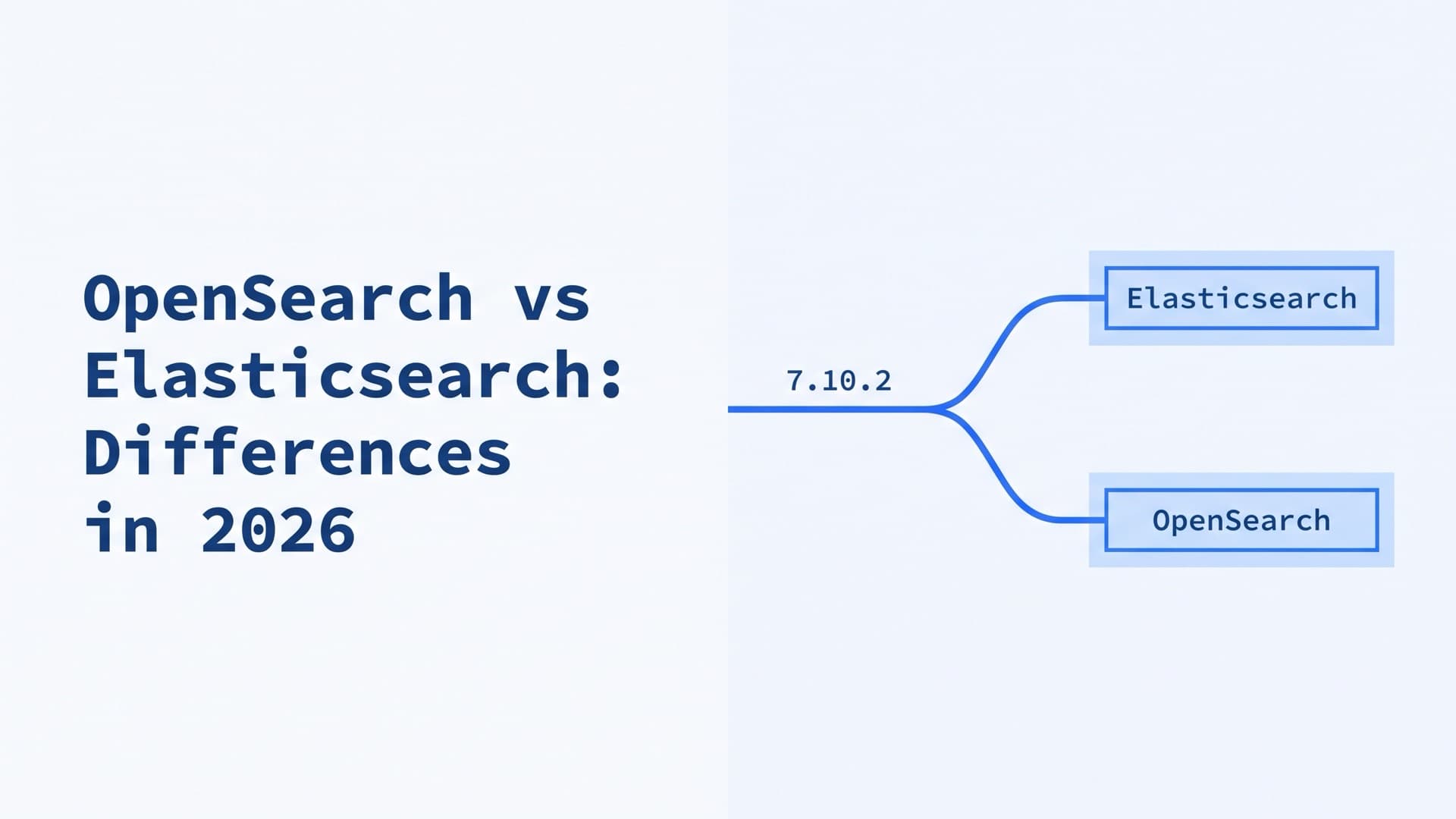
OpenSearch vs Elasticsearch: Differences in 2026
OpenSearch vs Elasticsearch as of October 2026: licenses, features, vector search, benchmarks, AWS and Elastic Cloud pricing, migration and which to pick.
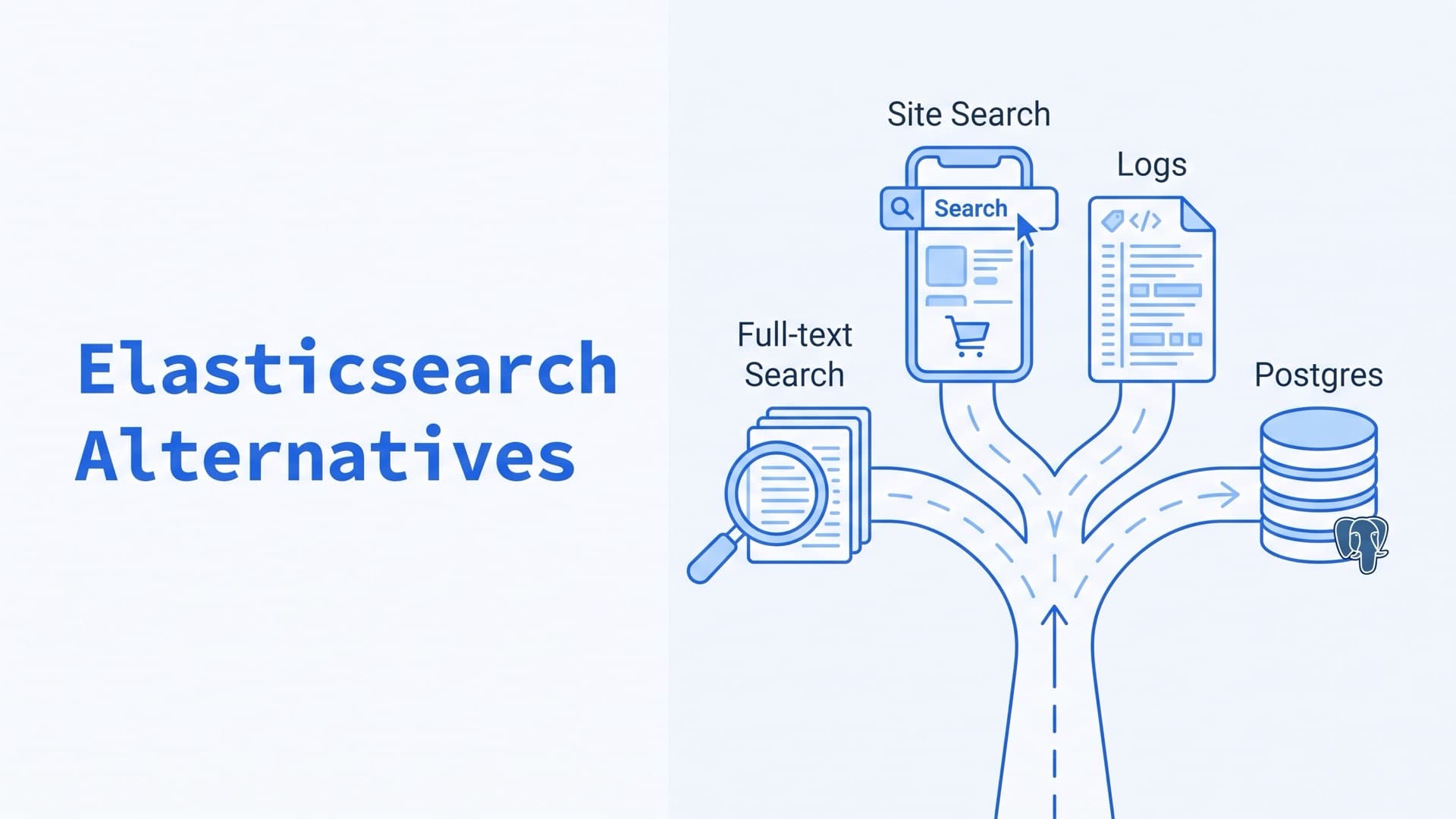
Elasticsearch Alternatives in 2026, by Workload
The best Elasticsearch alternative depends on the job. OpenSearch, Typesense, Meilisearch, Loki and more, compared by license, fit and switching cost.