OpenSearch vs Elasticsearch: Differences in 2026
What is the difference between OpenSearch and Elasticsearch?
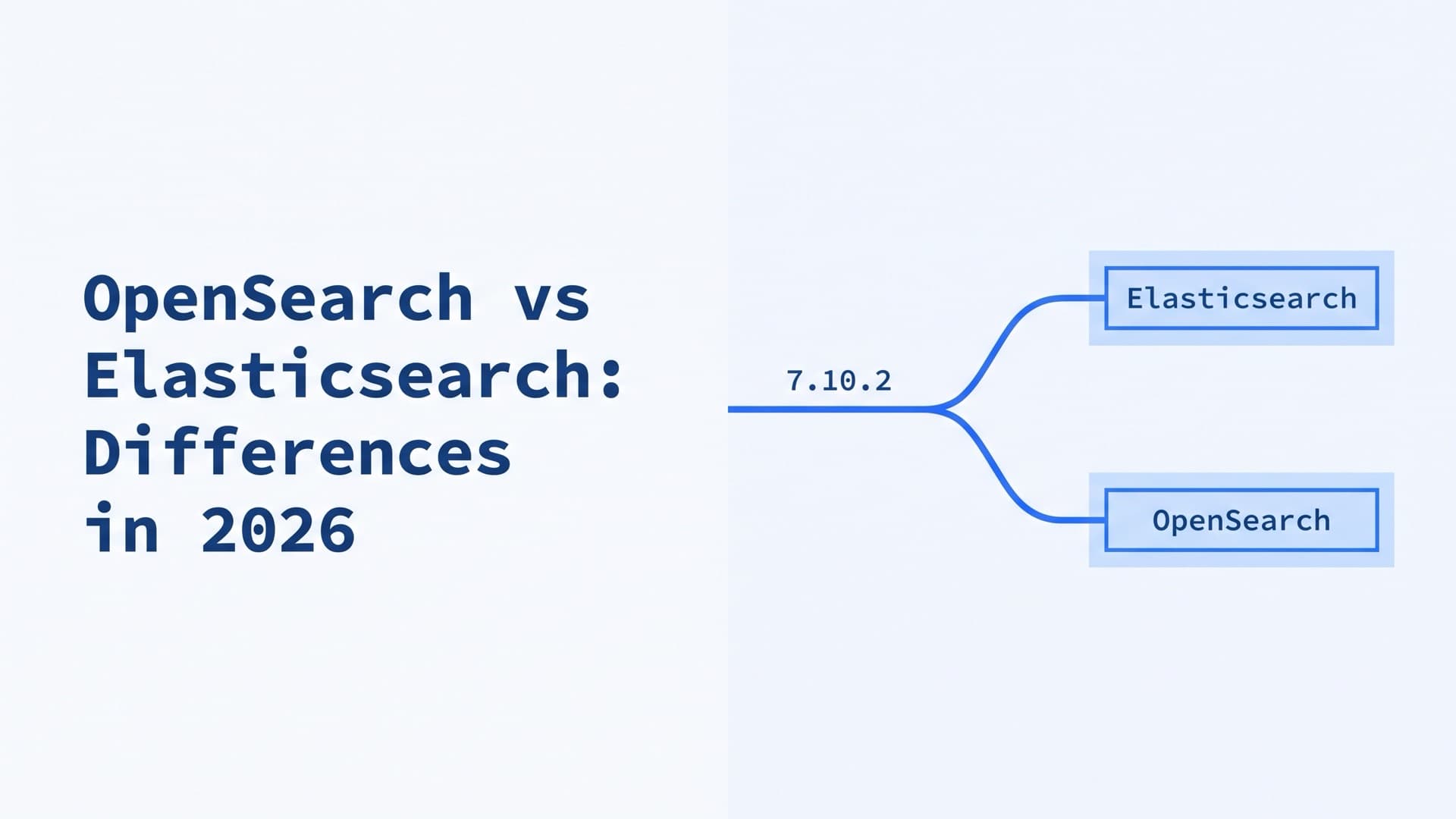
OpenSearch is a fork of Elasticsearch 7.10.2, the last Apache 2.0 release. AWS created it in 2021 after Elastic moved Elasticsearch off Apache 2.0. The engines now differ in license, governance, free features and tools. Elastic still develops Elasticsearch, now at 9.5.5. OpenSearch, now at 3.9.0, sits under the OpenSearch Software Foundation. AWS runs it as Amazon OpenSearch Service.
The two still share a core. Both are built on Apache Lucene 10.5.1 (Elasticsearch, OpenSearch) and search with a JSON Query DSL.
Ivinco has built search since 2009. All sources were checked in October 2026.
OpenSearch vs Elasticsearch at a glance
The table compares self-managed installs as of October 2026.
| Aspect | Elasticsearch | OpenSearch |
|---|---|---|
| Latest release | 9.5.5, Oct 6, 2026 | 3.9.0, Sep 29, 2026 |
| Source license | AGPLv3, SSPL, ELv2 | Apache 2.0 |
| Download license | ELv2 | Apache 2.0 |
| Project home | Elastic | OpenSearch Software Foundation |
| Lucene | 10.5.1 | 10.5.1 |
| Dashboards | Kibana | OpenSearch Dashboards |
| Free security | TLS, users, roles | Same, plus SSO, field-level |
| Vector search | Quantized by default | Faiss or Lucene engine |
| Piped language | ES|QL | PPL |
| Main managed service | Elastic Cloud | Amazon OpenSearch Service |
The sections below cover each row, with sources.
Why OpenSearch forked from Elasticsearch
- January 2021. Elastic announced that Elasticsearch and Kibana source code would move from Apache 2.0 to a dual SSPL and Elastic License. Its stated aim was to stop cloud providers from offering them as a service without contributing back. Version 7.11 shipped under the new terms in February.
- April 2021. AWS introduced OpenSearch, a fork of Elasticsearch 7.10.2 and Kibana 7.10.2. It also became the home of Open Distro for Elasticsearch, AWS's earlier Apache 2.0 distribution with security, alerting and SQL plugins. OpenSearch 1.0 was ready for production in July 2021.
- September 2021. AWS renamed Amazon Elasticsearch Service to Amazon OpenSearch Service.
- 2022 to 2025. Elasticsearch 8.0 and 9.0 shipped in February 2022 and April 2025. OpenSearch 2.0 and 3.0 shipped in May 2022 and May 2025.
- August 2024. Elastic announced AGPLv3 as a third license option. The source code carries it from version 8.16.0, released in November 2024.
- September 2024. AWS moved OpenSearch to the new OpenSearch Software Foundation under the Linux Foundation. AWS, SAP and Uber were its founding premier members.
The 2021 license change is why some companies moved away from Elasticsearch. Graylog, for one, switched to OpenSearch after Elastic's 7.11 changes. Our guide to Elasticsearch alternatives covers the other reasons teams leave, such as paid features and cluster upkeep.
Both projects still ship often. OpenSearch aims for a minor release about every eight weeks and maintains 2.19 until 4.0 ships. Elastic shipped 9.3.0, 9.4.0 and 9.5.0 in February, May and August 2026. Under its version policy, it still patches 9.4 and 8.19 next to 9.5.
OpenSearch vs Elasticsearch license and governance
Elasticsearch source code is under a triple license by default, AGPLv3, SSPL or the Elastic License 2.0 (ELv2). Code in the x-pack folder, a large part of the repository, is under ELv2 only. The default download ships under ELv2. Elastic's client libraries stay under Apache 2.0.
ELv2 lets you use, copy, change and redistribute the software, with three limits. You may not offer it as a hosted or managed service that gives users a substantial set of its features. You may not bypass its license keys. You must keep Elastic's notices. Elastic's ELv2 FAQ gives examples. A search box in your own SaaS product is fine, and so is a contractor setting it up for a client's internal use. A service whose customers directly use substantial parts of Elasticsearch's APIs or Kibana is not.
The other two source licenses work differently. SSPL section 13 requires anyone offering the software as a service to publish the source of the whole service stack. That includes management, monitoring, backup and hosting software. AGPLv3 section 13 requires you to offer your modified source to users who reach it over a network. The x-pack code stays under ELv2 whichever option you pick.
OpenSearch has one license. All OpenSearch software is under Apache 2.0, which asks you to keep its license and notices when you redistribute.
| Use | Elasticsearch download | OpenSearch |
|---|---|---|
| Run it for your own apps | Allowed | Allowed |
| Ship it inside your product | Allowed, within ELv2's three limits | Allowed, keep notices |
| Sell it as a managed service | Not allowed | Allowed |
The table summarizes the license texts. Have counsel check your own case.
Governance differs too. Elastic owns Elasticsearch and sets its license, as the 2021 and 2024 changes show. OpenSearch's foundation has a Governing Board of member representatives and the chair of the technical steering committee. The board oversees the foundation and its budget. The foundation stays out of technical oversight, which follows the project's technical charter. Its premier members, AWS, IBM, SAP and Uber, each appoint a board member.
OpenSearch vs Elasticsearch feature comparison
OpenSearch started with the Elasticsearch 7.10 REST APIs for ingest, search and management, and the same query syntax (FAQ). Since then, each project has added features under its own endpoints.
Query DSL and REST APIs
Both still search with a JSON Query DSL sent to _search (Elasticsearch, OpenSearch). OpenSearch plugins answer under _plugins/, such as _plugins/_ml for models and _plugins/_ppl for PPL. Elasticsearch runs ES|QL at _query. OpenSearch 2.0 removed mapping types from all endpoints, so requests from the 7.x era must drop any type name.
OpenSearch 3.0 removed the setting that let it report version 7.10.2 to older tools. OpenSearch's FAQ says it will try to keep APIs similar where features overlap. It also calls the two projects distinct.
Security, alerting and other built-in features
This is where the free versions differ most. OpenSearch bundles its plugins with every distribution except the minimal one. Self-managed Elasticsearch puts many of the same features in paid tiers.
| Feature | Elasticsearch | OpenSearch |
|---|---|---|
| TLS, users, roles | Free | Free |
| Vector search, SQL | Free | Free |
| SSO (SAML, OIDC) | Platinum, Enterprise | Free |
| Field- and document-level security | Platinum, Enterprise | Free |
| Email and webhook alerts | Paid tiers | Free |
| Anomaly detection | Platinum, Enterprise | Free |
| Cross-cluster replication | Platinum, Enterprise | Free |
| Searchable snapshots | Enterprise | Free |
| Learning to Rank | Enterprise | Free |
| RRF hybrid search | Enterprise | Free |
Elastic made TLS, users and role-based access free in versions 6.8.0 and 7.1.0 in 2019. Today a new node sets up TLS and a superuser password when it first starts. Elastic no longer sells Gold or Platinum to new self-managed customers, so for them every paid row means Enterprise. Paid tiers also add Elastic's own models and AI tools, such as the ELSER sparse encoder and Agent Builder.
The OpenSearch column comes from its security, notifications, anomaly detection, replication and searchable snapshot docs.
Elasticsearch vs OpenSearch vector and hybrid search
Elasticsearch stores embeddings in a dense_vector field, up to 4,096 dimensions, and searches them with HNSW. It quantizes float vectors by default. Since 9.1, fields with 384 or more dimensions default to BBQ, a binary quantization that cuts vector memory by 96%. Smaller fields default to int8, which cuts it by 75%. From 9.4, the default becomes bbq_disk where the license allows. That type searches k-means clusters of vectors, and it needs an Enterprise subscription. Elastic recommends RRF for hybrid search, which also needs Enterprise on self-managed clusters.
OpenSearch stores embeddings in a knn_vector field. Its k-NN plugin offers the Faiss and Lucene engines, and Faiss became the default in 2.18. NMSLIB is deprecated since 3.0. Built-in quantization covers scalar, product and binary types. Hybrid search runs in a search pipeline that normalizes and combines scores or fuses rankings with RRF. AI search adds semantic, sparse and multimodal search, plus RAG.
Both can generate embeddings inside the cluster (Elasticsearch, OpenSearch). On self-managed Elasticsearch this needs a paid subscription, and the inference API needs Enterprise.
ES|QL vs PPL
Both projects added a piped query language for filtering and analyzing data. ES|QL runs at POST /_query and is in Elastic's free tier. PPL runs at POST /_plugins/_ppl and comes with OpenSearch's bundled SQL plugin. Both engines also accept SQL. The syntax differs, so queries need a rewrite when you switch.
POST /_query
{
  "query": "FROM employees | STATS count = COUNT(emp_no) BY languages"
}
POST /_plugins/_ppl
{
  "query": "source=employees | stats count() by languages"
}
OpenSearch vs Elasticsearch performance
Both engines now run the same Lucene version. Published benchmarks still disagree, because each answers a narrow question with its own setup.
| Who ran it | Versions | Headline result |
|---|---|---|
| Elastic, 2023 | ES 8.7, OS 2.7 | ES 40% to 140% faster |
| Elastic, 2024 | ES 8.14, OS 2.14 | ES up to 12x faster on vectors |
| Trail of Bits for AWS, 2025 | OS 2.17.1, ES 8.15.4 | OS 1.6x faster on Big5, 11% on vectors |
| Yonik Seeley, 2026 | ES 9.5.4, OS 3.8.0 | ES 22% to 40% more throughput |
Elastic, August 2023. Elastic compared Elasticsearch 8.7 and OpenSearch 2.7 on two five-node clusters with 32GB of memory and 8 cores per node. It loaded a generated 1TB log dataset and measured 90th-percentile latency for text queries, sorting, date histograms, ranges and terms. Elastic says TechTarget's Enterprise Strategy Group validated its method, and it published a summary PDF. Anton Hägerstrand of Blunders, a JVM profiling company, reran the test on one desktop machine with versions 8.11 and 2.11. He concluded that the original says little about relative speed. Some queries matched no documents, most aggregations seemed to come from cache, and for many queries network latency likely outweighed query execution.
Elastic, June 2024. Elastic tested vector search in Elasticsearch 8.14 and OpenSearch 2.14, on datasets of 2 million to 10 million vectors. It reported Elasticsearch 2 to 12 times faster.
Trail of Bits, March 2025. Trail of Bits ran this study at AWS's request, with OpenSearch Benchmark on fresh AWS instances each day for 11 to 15 days. On the Big5 workload, OpenSearch 2.17.1 was 1.6 times faster than Elasticsearch 8.15.4, by the geometric mean of median 90th-percentile service times. In the study's results by category, Elasticsearch was faster on text queries, while OpenSearch was faster on date histograms and term aggregations. On a 10-million-vector workload with default engines, OpenSearch was 11% faster. The study also found more extreme outliers in OpenSearch, and more tasks with outliers in Elasticsearch. The OpenSearch project pointed readers to the study.
Yonik Seeley, September 2026. Seeley wrote the first version of Solr and now develops Luxir, a separate engine. He ran 60 query types on 10 million Wikipedia documents, on one node with one shard. By geometric mean, Elasticsearch had 22% to 40% more throughput, rising with concurrency. OpenSearch was about 1.8 times as fast on some top-10 OR queries. Seeley later traced the largest gaps to three bugs in OpenSearch's query cancellation, two of them in code added in 3.7.0. OpenSearch merged his fix on September 28, 2026, but the 3.9.0 release of the next day doesn't include it. On a 3.10.0 development build with the fix, Seeley measured exact counts of two frequent terms within about 3% of Elasticsearch's throughput at 32 connections. Prefix and wildcard top-10 queries still trailed by about 1.6x at that load.
Each study chose its own data, cluster shape and versions, and newer releases have replaced every version tested. Both projects have also changed their vector defaults since the 2024 and 2025 tests. Seeley's own limits note that his test skips indexing, relevance, aggregations and distributed search. Run OpenSearch Benchmark or Elastic's Rally on your own data and queries before you decide.
Kibana, OpenSearch Dashboards and other tools
OpenSearch Dashboards is a fork of Kibana 7.10.2, and OpenSearch's FAQ says Kibana won't work on top of OpenSearch 1.0. Elastic also requires Kibana and Elasticsearch to run the same version.
Data shippers split the same way. Beats 7.13 and later don't support OpenSearch. Beats OSS up to 7.12.1 worked with OpenSearch 1.x and 2.x only through a setting that reports version 7.10.2, and OpenSearch 3.0 removed it. Logstash works through the OpenSearch output plugin, which OpenSearch 3.x requires. OpenSearch's documented workaround for unsupported Beats is to send their data through Logstash. Elastic Agent sends data to Elasticsearch, Kafka or Logstash. OpenSearch points users to Fluent Bit, the OpenTelemetry Collector and its own Data Prepper.
Graylog and OpenSearch
In 2022, Graylog said it would not support Elasticsearch past 7.10, citing Elastic's 7.11 changes. Its current stack recommends Data Node, a Graylog component that runs and manages OpenSearch. With self-managed OpenSearch, Graylog 7.2 supports versions up to 3.7 (matrix).
Magento 2 and Adobe Commerce
Adobe Commerce 2.4.9 lists OpenSearch 3 as its only search engine, on Adobe's cloud and on premises (system requirements). Adobe's migration guide says its cloud infrastructure no longer supports Elasticsearch. Older on-premises lines still list Elasticsearch 7.17 or 8.
Is OpenSearch compatible with Elasticsearch?
Partly. OpenSearch started with the Elasticsearch 7.10 APIs, and its features, clients and tools have diverged since. Official Elasticsearch clients check what they connect to. From version 7.14, they run a product check before the first request. The Python client, for example, raises UnsupportedProductError when the server isn't a supported Elasticsearch. OpenSearch's client docs recommend Elasticsearch clients 7.13 for OpenSearch 1.x. For OpenSearch 2.0 and later, they say no Elasticsearch client is fully compatible.
OpenSearch has its own clients for Python, Java, JavaScript, Go, Ruby, PHP, .NET and Rust. Moving between engines means swapping the client library, so retest every call. On AWS, OpenSearch Serverless requires clients compatible with OpenSearch 3.x.
How do I know my OpenSearch version?
Send GET / to the cluster. OpenSearch answers with its version in version.number and sets version.distribution to opensearch. This abridged example comes from OpenSearch's docs.
{
  "version" : {
    "distribution" : "opensearch",
    "number" : "3.2.0"
  },
  "tagline" : "The OpenSearch Project: https://opensearch.org/"
}
Elasticsearch answers the same request with build_flavor and the tagline "You Know, for Search". Its response has no distribution field.
OpenSearch version numbers don't map to Elasticsearch's. Every OpenSearch release descends from Elasticsearch 7.10.2, and OpenSearch's FAQ promised backwards compatibility with Elasticsearch 7.10 for all 1.x releases.
AWS OpenSearch vs Elasticsearch pricing and managed services
Amazon OpenSearch Service runs OpenSearch versions up to 3.5, behind the project's 3.9.0, and legacy Elasticsearch versions up to 7.10. Managed clusters have no minimum fee and bill for instance hours, storage and data transfer, with on-demand, Reserved Instance and Savings Plan pricing.
On Amazon OpenSearch Service, old Elasticsearch versions move to paid Extended Support. AWS ends standard support for Elasticsearch 6.8, 7.9 and 7.10 on November 7, 2027. After that, Extended Support adds $0.0065 per normalized instance hour in US East (N. Virginia). For Elasticsearch 7.1 to 7.8 and most older versions, Extended Support from November 7, 2026 costs as much as the instance itself.
OpenSearch Serverless bills compute in OpenSearch Compute Units (OCUs), each about 6GB of memory with matching vCPU, plus storage per GB-month. Indexing and search OCUs bill separately. Classic collections bill at least 2 OCUs for the first collection, or 1 in dev-test mode. NextGen collections have no minimum and scale to zero after 10 minutes without activity.
Elastic sells Elastic Cloud in two forms. Hosted deployments run on AWS, Azure and Google Cloud, with resource-based pricing in four tiers. As of October 2026, the Standard tier starts at $99 a month. Serverless projects bill compute in virtual compute units with 1GB of RAM, split into ingest, search and machine learning, plus storage per GB. Elastic Cloud is also sold through the AWS, Azure and Google Cloud marketplaces. Self-managed subscriptions are priced by node count and RAM.
Other companies host them too. Aiven and NetApp Instaclustr offer managed OpenSearch, and Bonsai runs both OpenSearch and Elasticsearch.
Elasticsearch to OpenSearch migration (and back)
Your source version decides the path. OpenSearch's migration overview lists rolling upgrades, snapshot and restore, remote reindexing and Migration Assistant.
From Elasticsearch 7.10 or earlier
OpenSearch 1.x reads indexes created by Elasticsearch 6.0 to 7.10 (FAQ). From 7.0 to 7.10, you can do a rolling upgrade to OpenSearch 1.x, one node at a time. From 6.8, you need a full cluster restart, and earlier 6.x versions upgrade to 6.8 first. You can also restore a snapshot, as AWS's migration tutorial shows. Every Elasticsearch domain on Amazon OpenSearch Service is in this group, since the service runs Elasticsearch only up to 7.10. A 7.x domain there upgrades in place to OpenSearch 1.x.
Plan for more steps. AWS's upgrade guide says indexes created in Elasticsearch 6.8 don't work in OpenSearch 2.3, and OpenSearch 3.x doesn't read any index created before OpenSearch 2.0. Reindex them before each of those upgrades. Snapshots taken on Elasticsearch 7.10 and earlier don't restore on 3.x either. Features missing from the Elasticsearch OSS build don't carry over, paid or free (FAQ), because AWS removed Elastic's commercially licensed code from the fork. That includes the free security in Elastic's default download, so you set up OpenSearch's own security plugin instead.
From Elasticsearch 7.11 or later
OpenSearch doesn't support upgrades from versions released after the fork, and their indexes need reindexing (FAQ). OpenSearch's Migration Assistant is the documented tool. It reads a snapshot of the source and reindexes the documents into OpenSearch 2.x or 3.x. It can also capture live writes through a proxy and replay them, so the cutover needs little downtime. Its support matrix covers Elasticsearch 1.x to 8.x, with live capture from 5.x, and doesn't list 9.x.
Plan for these limits.
- It runs on Kubernetes, with Amazon EKS as the recommended AWS path.
- It doesn't migrate data streams, ILM policies, security settings, Kibana objects, ingest pipelines or cluster settings.
- Replay doesn't keep auto-generated document IDs, and live capture suits less than 4TB of writes a day.
- It can convert
dense_vectorfields toknn_vector, though vector queries may still need changes.
Remote reindexing is the other route on OpenSearch's list. Its overview says it needs no downtime, but it runs slower and loads the source cluster. OpenSearch's docs don't say which Elasticsearch versions it can read, so test it on your exact source version first.
From OpenSearch to Elasticsearch
Elastic's own guide says snapshot restore and reindex-from-remote don't work from OpenSearch. It streams documents with Logstash and the OpenSearch input plugin, reading by scroll and writing to Elasticsearch. It sets up index templates and lifecycle policies first, and keeps each source document ID to avoid duplicates. The guide moves data only, so plan dashboards, alerts and security separately.
If you're planning a move between the two, tell us about it. We've built and maintained search systems for over 15 years.
Should you use OpenSearch or Elasticsearch?
Neither is better everywhere. Elasticsearch suits teams that want Elastic's tools and support, or need features only Elastic ships. OpenSearch suits teams that need Apache 2.0, want AWS to run it, or want security and replication without a subscription.
| Situation | Fits | Why |
|---|---|---|
| You want AWS to run it | OpenSearch | Amazon OpenSearch Service |
| You want Elastic to run it | Elasticsearch | Elastic Cloud, also on AWS |
| You need Kibana, ES|QL or Elastic Agent | Elasticsearch | Built for Elasticsearch |
| You run Elasticsearch 7.11 or later | Elasticsearch | Moving means reindexing |
| You sell the engine as a managed service | OpenSearch | ELv2 forbids it |
| You want SSO or field-level security free | OpenSearch | Bundled plugins |
| You run Graylog or Adobe Commerce 2.4.9 | OpenSearch | Their supported back end |
| You need vector or hybrid search | Either | Test both on your data |
| You run log analytics at scale | Either | Test both on your data |
If neither fits the job, our guide to Elasticsearch alternatives compares other engines by workload. It covers Apache Solr, which is also built on Lucene but has its own schemas, APIs and clients.
Help with your search engine
We have built search since 2009. Today we build it on Manticore Search, Elasticsearch or whichever engine fits the job. Manticore is our close partner, so a project gets fast support and custom features from its team when it needs them. Tell us about your search workload. The first conversation is free.
Frequently Asked Questions
Is Elasticsearch now called OpenSearch?
No. OpenSearch and Elasticsearch are separate products. Elasticsearch is still Elastic's engine, at version 9.5.5 since October 6, 2026. The confusion comes from AWS, which renamed Amazon Elasticsearch Service to Amazon OpenSearch Service on September 8, 2021. That service runs OpenSearch, plus legacy Elasticsearch versions up to 7.10.
Does Amazon use OpenSearch?
Yes. AWS created OpenSearch in 2021 and sells it as Amazon OpenSearch Service, with a serverless option. The project itself is no longer part of AWS. In September 2024, AWS moved it to the OpenSearch Software Foundation under the Linux Foundation. AWS is one of the foundation's premier members, with IBM, SAP and Uber.
Can I use Kibana with OpenSearch?
No. OpenSearch's FAQ says Kibana won't work on top of OpenSearch 1.0, and Elastic requires Kibana to match the Elasticsearch version. Use OpenSearch Dashboards, the project's own fork of Kibana 7.10.2. Saved objects such as dashboards move by manual export and import, so test each one after the move.
What are the downsides of using OpenSearch?
Most are about compatibility. Elasticsearch clients aren't fully compatible with OpenSearch 2.0 and later, Beats 7.13 and later don't support it, and Kibana doesn't run on it. Features Elastic built after 2021, such as ES|QL, have no exact match. Amazon OpenSearch Service also trails the project, offering up to 3.5 while 3.9.0 is current.
Is Elasticsearch outdated?
No. Elastic released Elasticsearch 9.5.5 on October 6, 2026, and patches the 9.5, 9.4 and 8.19 lines. It runs on Lucene 10.5.1, the same version as OpenSearch 3.9.0. Its free tier includes vector search and ES|QL. What changed in 2021 is the license, and that change is why OpenSearch exists.