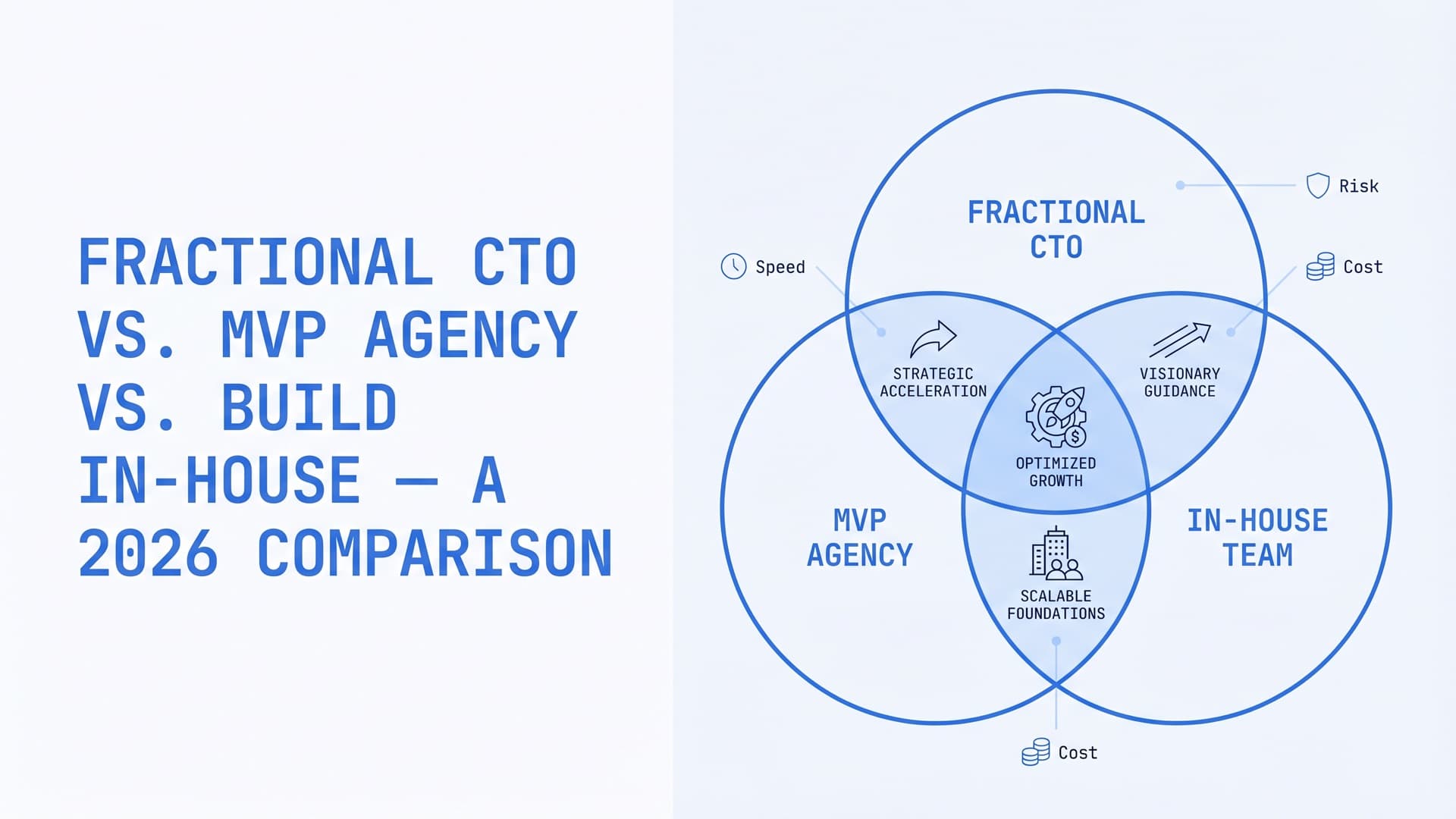
Fractional CTO vs. MVP Agency vs. Build In-House — A 2026 Comparison
A founder asked us this Tuesday. "Should I hire a fractional CTO, work with an MVP agency, or build with in-house engineers?" We hear the same framing most weeks, and the question is the problem. It assumes the three options are substitutes for each other. They aren't. They solve different problems, and the right answer for most founders is a combination, not a pick.
This post compares the three models across six dimensions — cost, speed, strategic depth, execution quality, continuity, and risk — then names the combinations that actually work. The framework was assembled from fractional CTO pricing data, MVP agency cost surveys, and the patterns we've watched play out across the engagements we've sat on the agency side of.
What Each Option Actually Delivers
Fractional CTO. A senior technical leader working 10–25 hours per week at $8K–$15K/month retainer, with effective hourly rates around $200–$350. What you get: architecture decisions, stack selection, hiring decisions, vendor evaluations, code review for critical systems, technical representation in fundraising. What you don't get: someone writing your production features.
MVP agency. A team of 2–5 engineers plus a project manager and designer, working for 8–14 weeks on a fixed-scope build. Cost $50K–$150K at US rates, $30K–$80K at Eastern European rates per Raftlabs's 2026 breakdown. What you get: a shipped product. What you don't get (from most agencies): strategic decisions about your stack choice, a plan for what happens after the build, or production engineering that survives diligence.
In-house engineers. Two to four full-time employees. US fully-loaded cost $140K–$240K per engineer per year, or about $280K–$960K/year for a small team. What you get: durable capacity, institutional knowledge, the team that scales with the company. What you don't get: speed — hiring good engineers takes 3–6 months, and a team of two won't outship a team of five on a fixed timeline.
The Six-Dimension Comparison
| Dimension | Fractional CTO | MVP Agency | In-House | |-----------|---------------|------------|----------| | Cost (6 months) | $48K–$90K | $50K–$150K | $140K–$480K | | Time to first production ship | N/A (no execution) | 8–14 weeks | 4–8 months (hiring + build) | | Strategic depth | High | Variable | Low initially, grows | | Execution quality | N/A | Variable | Depends on hires | | Continuity post-launch | Ongoing | Usually ends | Permanent | | Risk concentration | Low | Medium (handoff) | High (single hires) |
The table reveals what the three-option framing hides. Fractional CTO and in-house are comparable on continuity but not on cost or speed. MVP agency and in-house are comparable on execution but not on continuity. No single option dominates the others — each is strongest on different dimensions, and picking one means accepting its weaknesses.
Where Each Option Wins Alone
Fractional CTO wins when the founder is technical enough to execute with guidance, or when there's already an in-house engineer who needs architectural backup. A founder who can write Python well enough to ship a v1, but can't evaluate whether to use Postgres or MongoDB, gets $120K of value from a $12K/month fractional CTO advising on the calls that matter. A founder with zero technical judgment gets less value, because fractional CTOs don't write production code — the execution gap remains.
MVP agency wins for non-technical founders with a funded runway, a defined product scope, and a target timeline under four months. The agency delivers a product in the window where in-house hiring wouldn't even complete the first hire, at a fraction of the total cost of a full-time team. The trade-off is the handoff discontinuity — the team that built your product is not the team that maintains it.
In-house wins when the product is the business. Long-term durable capacity, institutional knowledge, and full-time focus are worth the cost and time premium for companies whose entire value is the software they ship. Most successful tech companies end up here eventually; the question is whether starting here makes sense given the founder's budget, hiring ability, and time pressure.
What Goes Wrong When You Pick Wrong
A fractional CTO without an execution team writes architecture decisions and roadmaps. Nothing ships because nobody is coding. The founder pays $72K over 6 months for advice that couldn't be executed. This is the common failure mode for non-technical founders who mistake strategic guidance for team capacity — the advice is correct, but the product doesn't ship because the gap between advice and code is staffed with nobody.
An MVP agency without technical oversight ships a product. At handoff, the founder has no way to evaluate whether what was built is good. Six months later, the same questions we cover in the Series A diligence checklist surface as problems — missing observability, no load test, secrets in .env files — and the founder is back in the market for an operator-grade agency to clean up what the first one didn't do.
No single option covers all six dimensions. Picking one without understanding its gaps leads to the gap biting at the worst time.
The Three Combinations That Work
Fractional CTO + MVP agency. The most common successful pattern for non-technical founders in 2026. Fractional CTO provides the architecture and evaluation layer the founder can't; agency provides the execution capacity the fractional CTO can't. Combined cost: $100K–$200K for the first six months. Fractional CTO stays on after launch for ongoing strategy; agency delivers a clean handoff. This is what we recommend to most founders who approach us — not because we're the agency in the equation, but because the two roles are genuinely complementary.
Fractional CTO + first in-house hire. For founders who want long-term capacity but can't yet hire a full CTO. The fractional CTO runs the interview process, makes the architecture decisions the new hire will execute against, and mentors the first engineer until they're operating independently. Combined cost: $14K–$17K/month for 6–12 months. Transitions cleanly to the in-house hire running the team once they're senior enough.
MVP agency → in-house team. The pattern for founders with a clear product and funded runway. Agency ships the MVP in 3–4 months. During the build, the founder hires the first 1–2 in-house engineers who shadow the agency team. At handoff, the in-house team takes ownership and the agency rotates off. The handoff is the critical moment — it either works cleanly (documented codebase, infrastructure in founder's account, runbook delivered) or it turns into a cleanup, which is what the vibe-coding cleanup playbook exists to solve.
What the Comparison Misses
The trade-offs above are real, but this framework ignores two things that matter in practice.
Team chemistry. A founder who clicks with a specific fractional CTO gets more value than the same founder forced into a different relationship. Same with agencies — the agency that returns your call on Saturday night during a launch is worth more than a larger, better-credentialed agency that doesn't. The dimension tables can't capture chemistry, and it decides more engagements than any objective metric.
The product's state. A pre-PMF product needs a different team than a post-PMF product. Pre-PMF wants speed and the ability to change direction. Post-PMF wants reliability and scale. Fractional CTO works well pre-PMF (cheap, flexible); in-house works well post-PMF (durable, focused). Agencies split the difference and work in both phases, depending on scope.
If the framework ignores chemistry and product state, use it to narrow options, not to pick one. The final pick is about fit.
The Honest Answer
The question isn't "which one." It's "which two work together for my next 12 months."
Need help? Talk to an engineer.
Frequently Asked Questions
Should I hire a fractional CTO or an MVP agency first?
Neither, separately. The effective pattern for non-technical founders is both in sequence: fractional CTO first to evaluate agencies, scope the project, and select the stack; then the agency for execution with the fractional CTO staying on as technical oversight during the build. Combined cost runs $100K–$200K for six months and avoids the failure modes of either alone. Retaining a fractional CTO before picking an agency can save $30K–$50K on the agency engagement alone by scoping out unnecessary work.
What's the cheapest path to a shipped MVP?
AI coding tools plus one part-time engineer, at roughly $200/month for Cursor and $10K–$30K for an engineer to harden the output. This works only if the engineer can identify and fix the 45% of AI-generated code that fails OWASP Top 10 tests per Veracode's 2026 testing. Without that engineer, the cleanup costs documented at $50K–$250K eliminate the savings. The cheap path requires technical judgment the founder typically needs to buy as a fractional CTO arrangement.
When is in-house building the right call for an MVP?
When the founder is technical enough to lead the build themselves, has 9–12 months of runway, and treats the first hires as the core of a durable engineering org. Cost runs $140K–$240K per engineer fully loaded, so a two-engineer team is $280K–$480K/year. This is 2–3x the cost of an agency engagement but delivers durable team capacity. The right answer for product-led companies post-PMF and the wrong answer for pre-PMF founders who need to validate quickly.
How much does a fractional CTO cost in 2026?
$8K–$15K/month for most engagements, or $200–$350/hour effective rate for engagements billed hourly per fractional CTO pricing research. Typical engagement is 10–25 hours per week for 6–12 months. Project-based engagements run $5K–$50K for specific scope (technical due diligence, stack migration, hiring process setup). The retainer model is more common and usually better value per hour.
What's the single biggest mistake founders make choosing between these three?
Assuming they're substitutes for the same problem. Fractional CTO solves "who decides?"; MVP agency solves "who builds?"; in-house solves "who stays?" Choosing one without a plan for the other two leaves a gap that shows up at the worst time — usually right after the first build ships and the strategic or continuity gap becomes a blocker.
Related posts

What Does $80K Actually Buy From an MVP Development Company in 2026?
At $150/hour, $80K buys 533 engineering hours. At $70/hour, 1,143. Same visible scope, 2x labor spread. Here's the math most founders never see — and the Invisible Line Item that tells the difference.
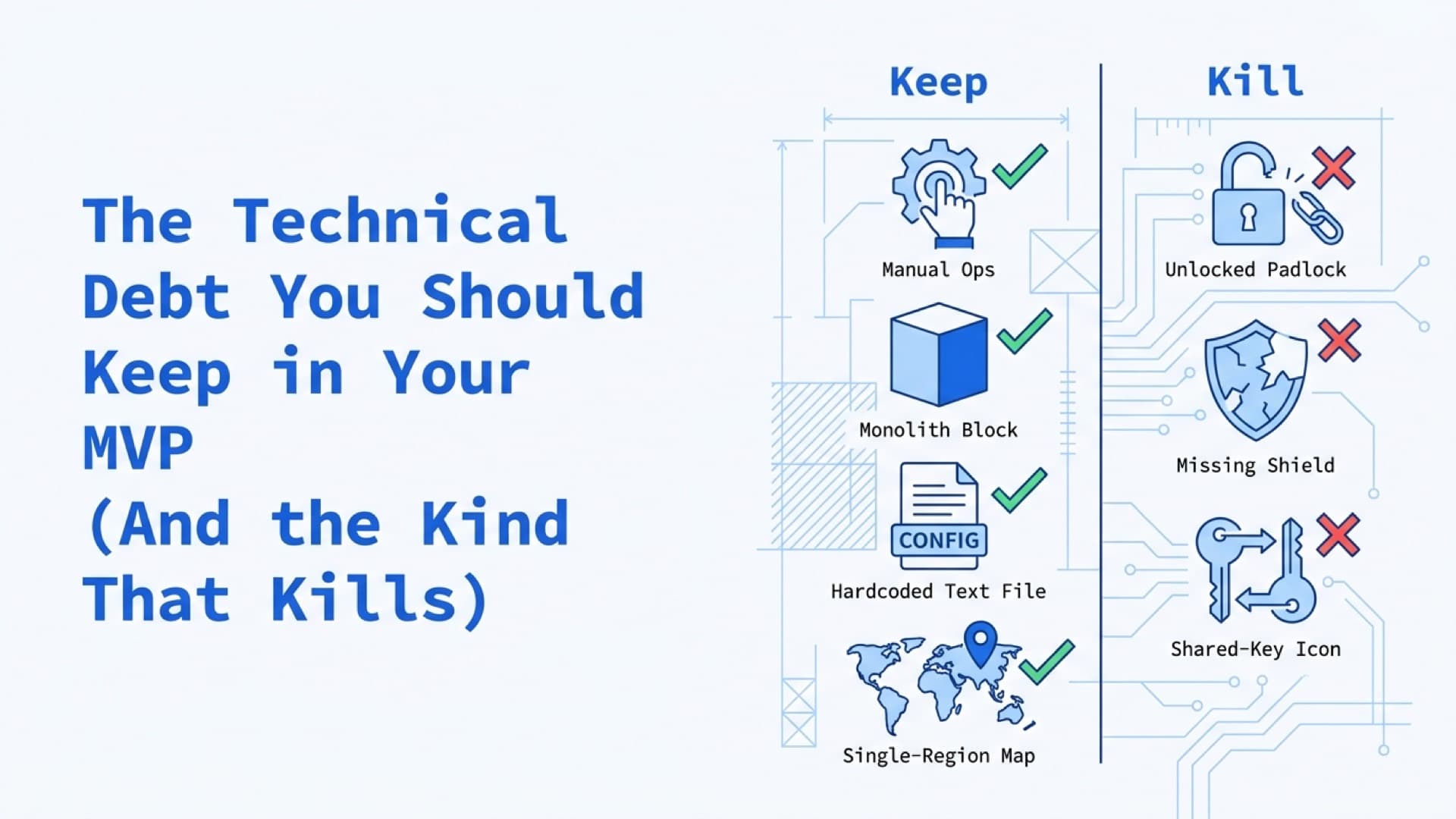
The Technical Debt You Should Keep in Your MVP (And the Kind That Kills)
Good debt trades speed now for bounded cost later. Bad debt hides a step function that fires at the worst moment. Five shortcuts to keep forever, five that compound silently, and a better rule than the 20% sprint tax.
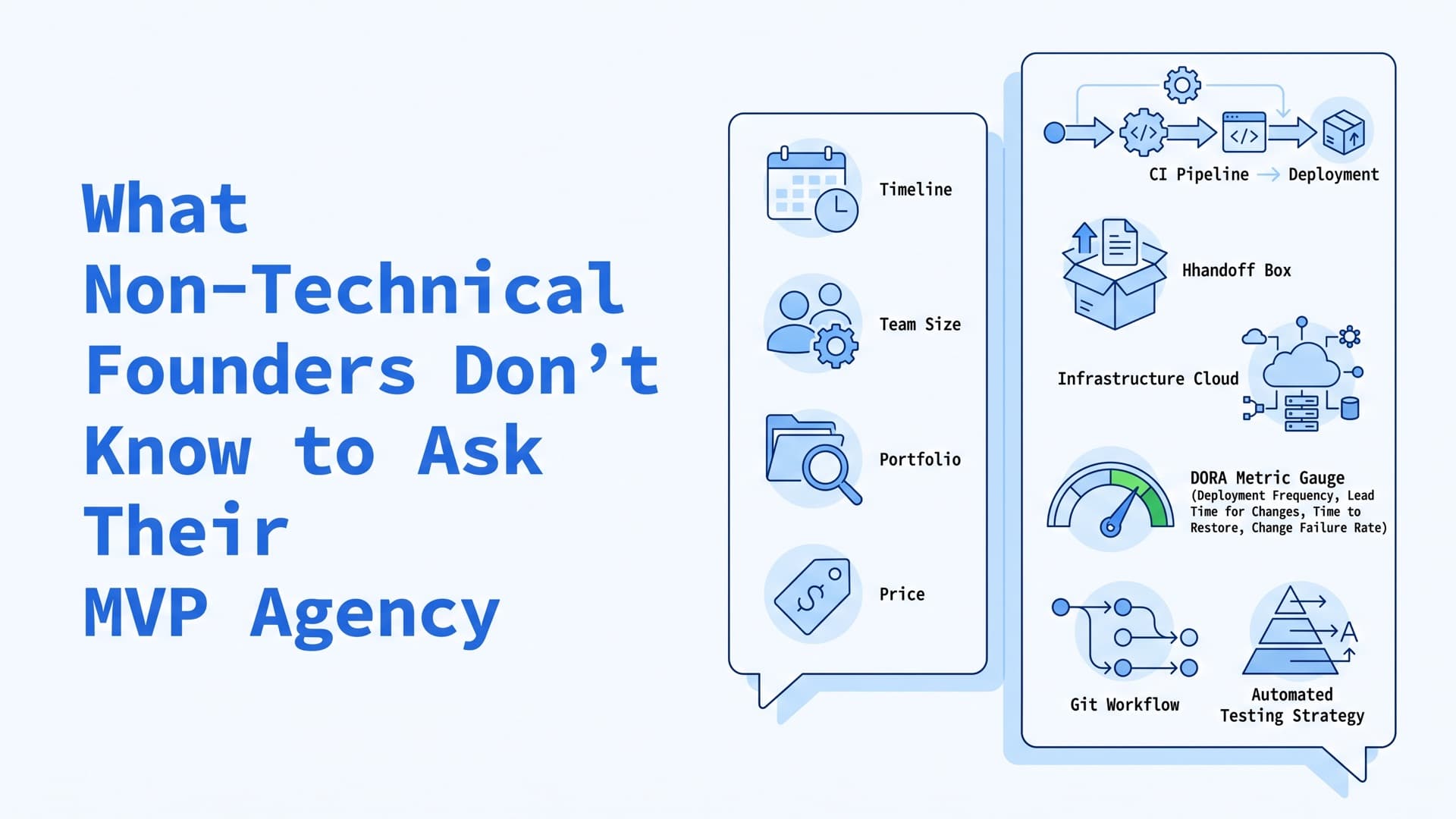
What Non-Technical Founders Don't Know to Ask Their MVP Agency
Timeline, team size, portfolio, price — the four questions every intro call runs through. Six different questions surface whether the agency will deliver production, not a demo. Here are the good answers and the red flag answers for each.