What Does $80K Actually Buy From an MVP Development Company in 2026?
Two MVP quotes land on a founder's desk. One says $50K, the other $90K. The feature lists are nearly identical. One of them is lying — and it's rarely the expensive one.
Founders bring us this pair of quotes almost every month. The question is always the same: "If I have $80,000 to spend, what do I actually get?" The answer is math, and most of the competing proposals are doing the math wrong.
At a US rate of $150/hour, $80,000 buys 533 hours of engineering. At an Eastern European rate of $70/hour, it buys 1,143 hours — a 2x spread in labor for near-identical visible scope. Either the US shop is charging 2x for the same work, or the offshore shop is removing the work that takes hours but doesn't show in a demo.
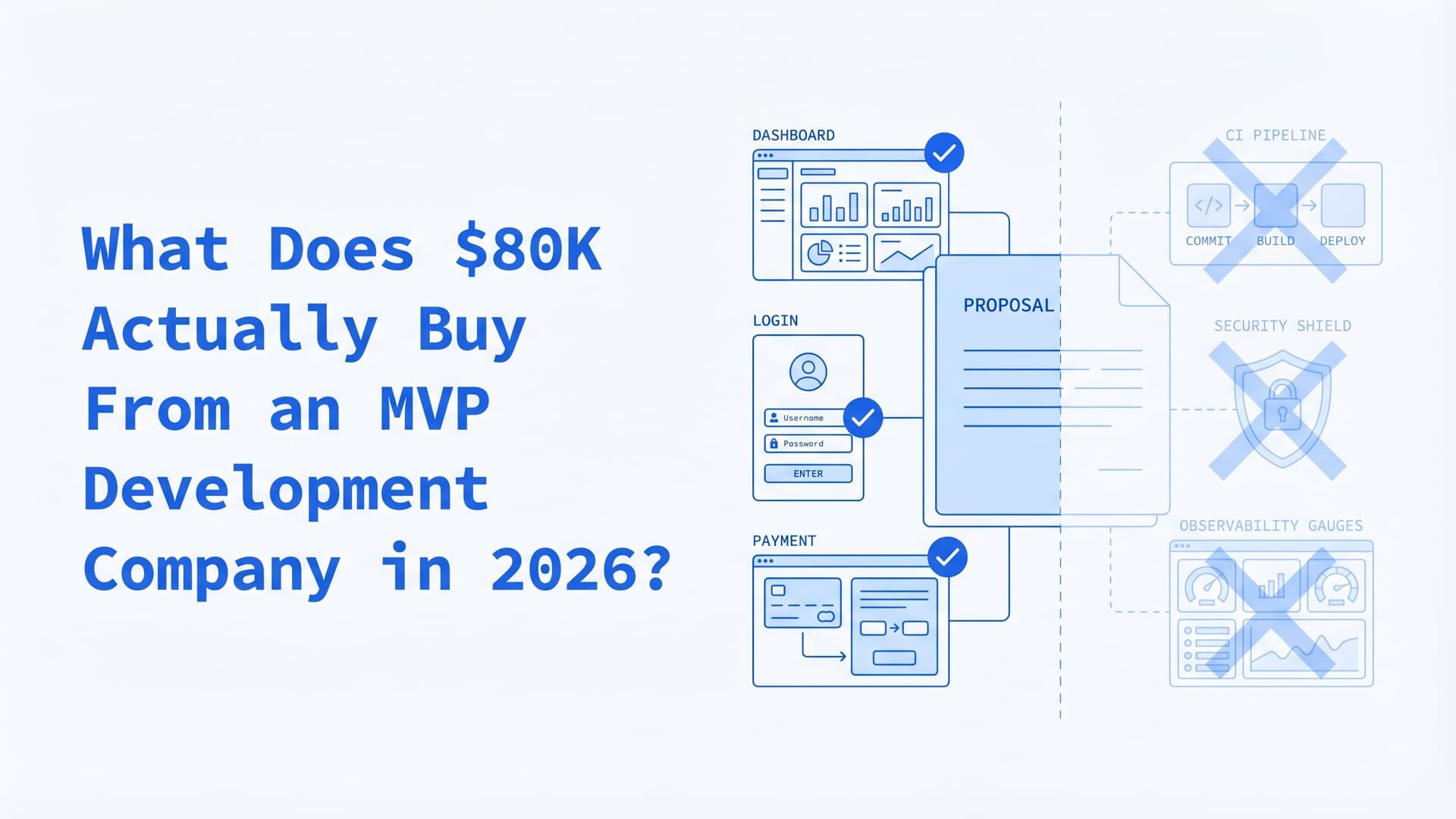
We call that removed work the Invisible Line Item — the production engineering slice that separates a scope that ships a demo from a scope that survives real users. It's what an agency removes from the proposal when it's competing on price.
What $80K Actually Buys
The 2026 market data is consistent across sources. Raftlabs and Softermii both price a "medium complexity" MVP — the tier where $80K lands — between $50K and $100K for 8–14 weeks of work. At US rates ($120–$200/hour per multiple agency surveys), that budget buys 400–670 engineering hours. At Eastern European rates ($40–$80/hour), 1,000–2,000 hours. Spent well, the scope looks like this:
| Component | Hours | Cost range | |-----------|-------|------------| | Discovery & architecture | 40–80 | $4K–$12K | | UI/UX design (5–10 screens) | 60–120 | $6K–$18K | | Frontend development | 120–200 | $12K–$30K | | Backend + API | 150–240 | $15K–$36K | | Third-party integrations (auth, payments, email) | 40–80 | $4K–$12K | | QA & testing | 40–60 | $4K–$9K | | Deployment + DevOps setup | 20–60 | $2K–$9K | | Total | 470–840 | $47K–$126K |
At $80K, a well-structured MVP gets you: a user-facing web app with authentication, a payment flow, a primary user journey with 5–10 screens, an admin dashboard, a database with 10–20 tables, integrations with two or three external services (Stripe, email, maybe a third-party API), basic automated tests, and deployment to a cloud platform.
That's the visible scope — the part that shows up in the demo and the proposal. It's not what makes the product survive contact with real users.
The Invisible Line Item
Walk into a $50K offshore quote and a $90K mid-market US quote side by side. Both describe the same features. Both promise delivery in 10 weeks. The visible scope is identical. The gap is in what Softermii's market breakdown calls "production readiness" and what we call the Invisible Line Item:
- CI/CD pipeline. Not
git pushand hope. Automated test runs, type checks, security scans (Semgrep,npm audit), and deployment gates. Budget: 20–40 hours. - Observability. Structured logging (Axiom, BetterStack), error tracking (Sentry), and at minimum a
/healthendpoint that verifies database connectivity. Budget: 16–30 hours. - Secrets management. Environment variables in a real secrets store (AWS Secrets Manager, Doppler, Infisical) — not
.envfiles in Git. Budget: 8–16 hours. - Rate limiting. Especially on auth endpoints and any route that calls a paid API (LLM, SMS). Budget: 8–12 hours.
- Input validation. Zod schemas at every API boundary. Veracode tested over 100 LLMs across 80 coding tasks and found 45% of AI-generated code fails OWASP Top 10 tests — the gap is almost entirely in validation. Budget: 20–40 hours.
- Load test. K6 or Artillery script hitting the critical paths at 10x expected peak traffic. Reveals connection pool limits before users do. Budget: 12–24 hours.
- Runbook. A written document for the founder and any future engineer: how to deploy, how to roll back, what the alerts mean, where the secrets are stored, what external services cost. Budget: 8–16 hours.
Add it up: 92–178 hours of production engineering. At US rates, that's $14K–$27K. At EU rates, $6K–$14K. This is the slice that separates a $65K quote from a $90K quote for the same visible features.
This is the slice that gets cut first when an agency is competing on price. The demo still passes, the app still deploys, the founder still ships on schedule. The bill arrives later. An unthrottled endpoint running up an LLM invoice nobody watches. Or an admin route with no auth middleware. Or the database pool saturating the first time marketing runs a campaign.
What "In-Scope" Hides
The word "included" on an MVP proposal is doing more work than it should. Three specific scopes get listed as "included" when they are not:
"Deployment to production." This can mean "we set up GitHub Actions to push to Vercel on every commit" or "we provisioned a Kubernetes cluster with blue-green deploys, automated rollbacks, and zero-downtime schema migrations." Two hours of work versus forty — same line item on the proposal.
"Security best practices." Usually translates to: Cloudflare in front, HTTPS on, done. A real security review — threat model, OWASP check, dependency audit, secrets scan, penetration test — takes 30–50 hours. If the proposal lists "security" but doesn't name specific tools (Semgrep, OWASP ZAP, TruffleHog), the line is decorative.
"Testing." Unit tests alone don't catch the bugs MVPs ship with. You need at least one end-to-end test per critical user journey (Playwright, Cypress) that runs on every PR. Without a stated coverage target and without E2E scripts, "testing" means whoever wrote the last line of code decided what to test — which is usually nothing.
The Regional Rate Trap
Offshore isn't the problem. Offshore without structure is.
The Gartner figure puts 67% of offshore MVP projects as requiring substantial rework. A Deloitte study found 59% of companies dissatisfied with offshore development outcomes. These aren't geography problems — they're governance problems. The cost model that looks clean on paper (offshore $50/hour × 1,600 hours = $80K) collapses when the real equation is:
cost = base_rate × hours × rework_multiplier
With a 1.67 multiplier (Gartner's number), that $80K offshore quote becomes a $133K actual spend. When it goes worse than average — the founder pays $80K for a build, hits production, and writes a second check for rewrite eight to twelve months in — the effective cost lands near $140K.
Direct-employment teams in Eastern Europe with a named engineering lead and code review by someone who has operated production ship comparable quality to US shops at half the rate. That's the exception pattern. Structural markers that tell you whether a quote falls inside it: fixed engineer assignments for the full engagement, an English-speaking lead available on video, a written code review policy, and shared access to the deployment environment from day one. Without those markers, you're buying a lottery ticket, not a team.
What $80K Does Not Buy
Three things an $80K engagement cannot produce, no matter who you hire:
HIPAA or PCI compliance. Regulated industries bust $80K fast. Raftlabs's industry-specific breakdown puts healthcare MVPs at $25K–$50K above baseline for HIPAA compliance work alone, and fintech at $25K–$60K above baseline for PCI-DSS. A $80K budget for a healthcare MVP means the compliance piece is being skipped or deferred.
Mobile apps on two platforms. A cross-platform React Native build squeezes into $80K; two native apps (iOS + Android) does not. Mobile MVPs at reputable agencies run $45K–$90K for a single platform with shared codebase logic.
Multi-region or high-availability architecture. One region, one replica, one database. That's what $80K buys for infrastructure. Anything requiring multi-region failover, active-active database replication, or 99.99% uptime SLA is a separate engagement at $40K–$100K on top.
An $80K MVP proves an unregulated-industry product and survives early users on a single region. It is not a Series A-ready platform — that's a different budget.
The Alternatives at the Same Price Point
For a founder with $80K, the MVP agency is one of four real options:
Fractional CTO only. Six months at $8K–$15K/month lands at $48K–$90K. Fractional CTOs charge $200–$350 per hour effective rate and spend most of that time on architecture, hiring, and technical decisions — not writing production features. The model works if you're technical enough to execute with guidance, or if you're separately paying for engineers.
Two mid-level engineers in-house. At a US fully-loaded cost around $140K–$180K/year, half a year runs $70K–$90K. You get labor without architectural authority. Without a senior engineer or technical co-founder making decisions, two mid-levels produce a build that shows the product but carries the same Invisible Line Item gaps as a cheap agency.
AI coding tools plus a part-time engineer. Roughly $200/month on Cursor and $10K–$30K for an engineer to harden the output. Y Combinator reported that 25% of its Winter 2025 cohort shipped codebases approximately 95% AI-generated. The cost model works if the engineer you hire understands what the AI generates and can fix the 45% that fails OWASP Top 10 tests. Without that engineer, the $30K you saved on build becomes $100K on cleanup.
Operator-grade MVP agency. Ten to fourteen weeks, $70K–$120K — the hybrid. Strategic decisions made by senior engineers, execution by the same team, production engineering included in scope rather than removed when the price gets tight. We sit in this fourth category. The founders who come to us have usually received three other quotes, and the gap between them is exactly the Invisible Line Item.
Post-Launch Math
Launch is not the last payment. That's the piece every first MVP budget leaves out.
Raftlabs's breakdown recommends budgeting 15–25% of the build cost per year for maintenance. On an $80K MVP, that's $12K–$20K/year to cover cloud costs, dependency updates, security patches, and bug fixes. The Softermii figure puts post-launch engineering at $2,650–$14,500/month depending on complexity.
The realistic first-year spend on a $80K MVP:
- Build: $80K
- Post-launch engineering (6 months at $3K–$8K/month): $18K–$48K
- Cloud, monitoring, email, payments processing: $6K–$15K
- Total first-year cost: $104K–$143K
If the proposal you're evaluating doesn't discuss post-launch, you're being quoted 55–65% of the actual spend.
The Line That Matters
The honest difference between a $60K MVP and a $100K MVP is not the features. It's what happens on the first day after launch. The $100K build catches its first production error at 30 seconds. The $60K build has a demo that works. The difference becomes visible at 2 AM.
Need help? Talk to an engineer.
Frequently Asked Questions
What's the difference between a $50K MVP and a $100K MVP?
At $50K you get the visible features: UI, backend, authentication, payments, deployment. At $100K you get the same features plus the production engineering layer — CI/CD pipeline, observability, load testing, rate limiting, input validation, and a runbook. Both apps work in a demo; only the second one survives a bad weekend of production traffic or a Series A technical due diligence.
How many hours of engineering does $80K actually buy?
At US rates of $120–$200/hour, $80K buys 400–670 engineering hours — about 10–17 weeks of one senior engineer's time. At Eastern European rates of $40–$80/hour, the same budget buys 1,000–2,000 hours. The quality gap depends less on region and more on whether the team has production operations experience or just development experience.
What gets cut when an MVP agency competes on price?
The production engineering layer. Specifically: the CI/CD pipeline, structured logging, error tracking, rate limiting, secrets management, load testing, and a written runbook. All of these take 90–180 hours combined and rarely appear on an MVP proposal. Their absence is only visible after launch, when the app fails in production and nobody knows why.
Is it cheaper to use AI coding tools and hire an engineer to fix the output?
Sometimes. Cursor plus a $10K–$30K engagement for hardening works if the engineer can identify and fix the 45% of AI-generated code that fails OWASP Top 10 security tests (Veracode, 2026). Without that engineer, the cleanup costs run $50K–$500K based on vibe coding rescue data. The savings are real only with technical evaluation built in.
What should I ask every MVP agency before signing?
Six questions: Who specifically will write my code day-to-day? What does your CI/CD pipeline look like on my project? How are secrets stored, and which service? What's your approach to observability — which tools? What's the load test target? What gets handed off in week 12 — source code, infra, documentation, runbook? Vague answers on any of these means the work isn't in scope.
Related posts
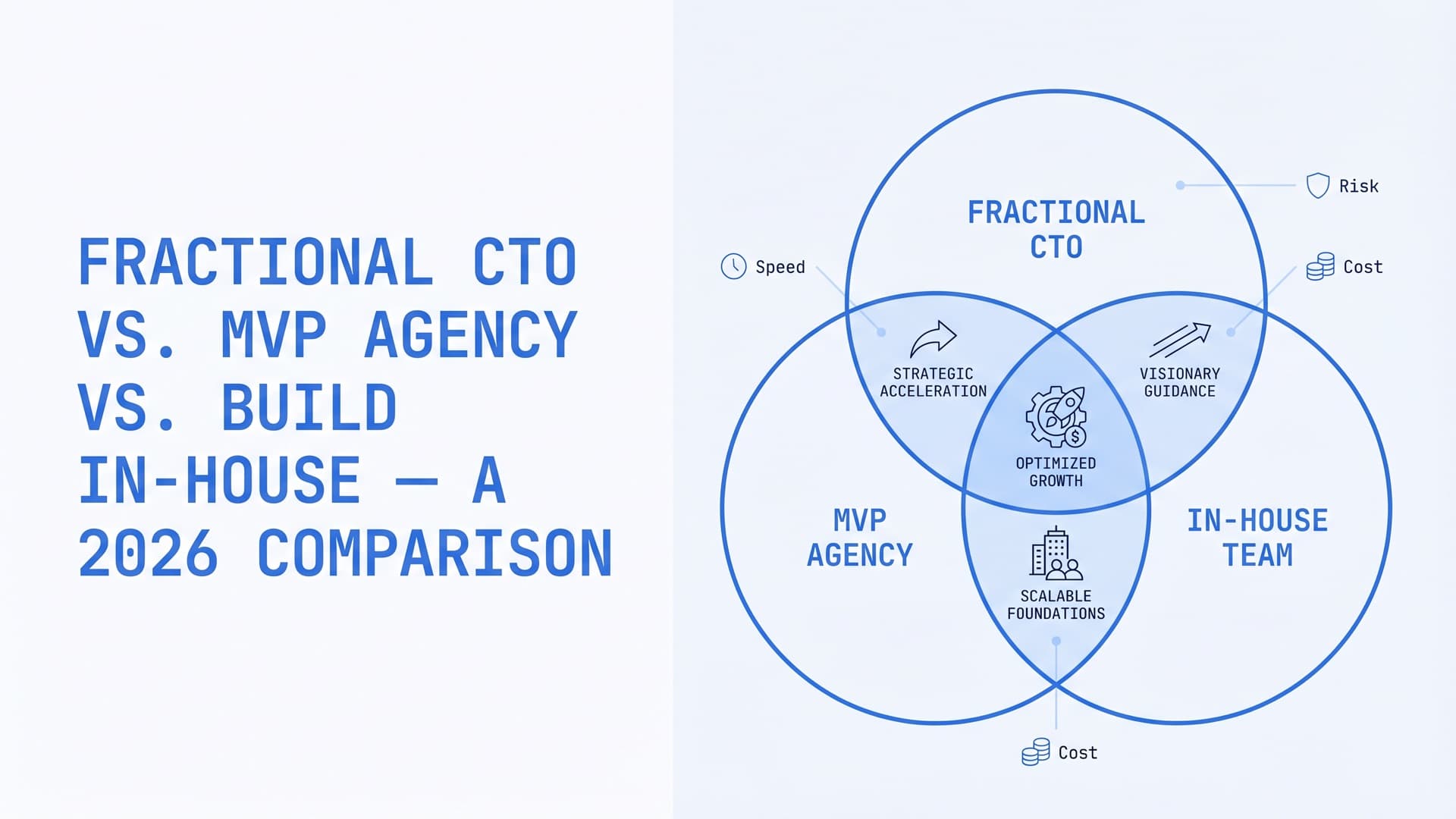
Fractional CTO vs. MVP Agency vs. Build In-House — A 2026 Comparison
Fractional CTO solves "who decides?" MVP agency solves "who builds?" In-house solves "who stays?" Three options, six dimensions, and the combinations that actually work. The single-option pick is the wrong default.
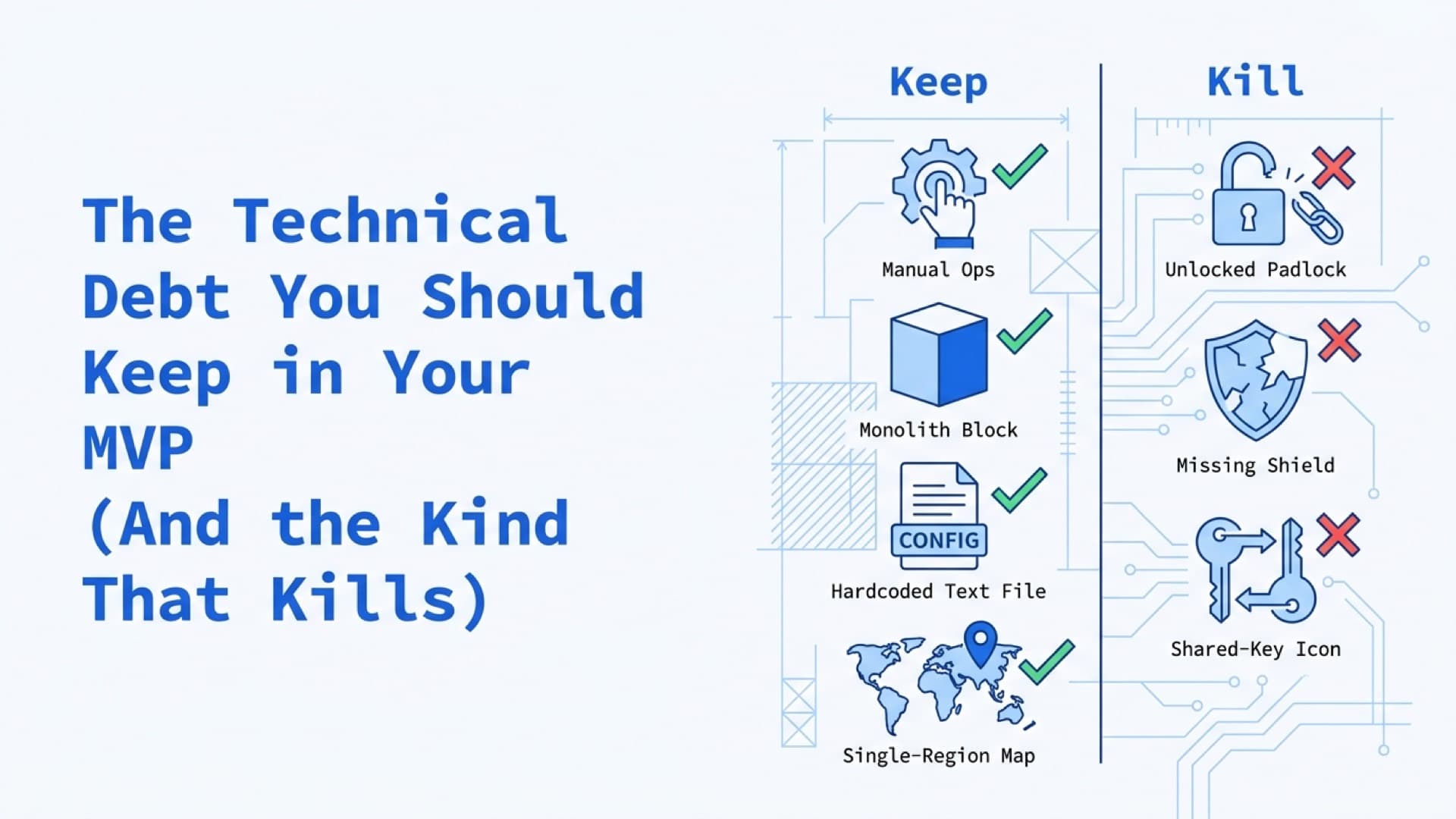
The Technical Debt You Should Keep in Your MVP (And the Kind That Kills)
Good debt trades speed now for bounded cost later. Bad debt hides a step function that fires at the worst moment. Five shortcuts to keep forever, five that compound silently, and a better rule than the 20% sprint tax.
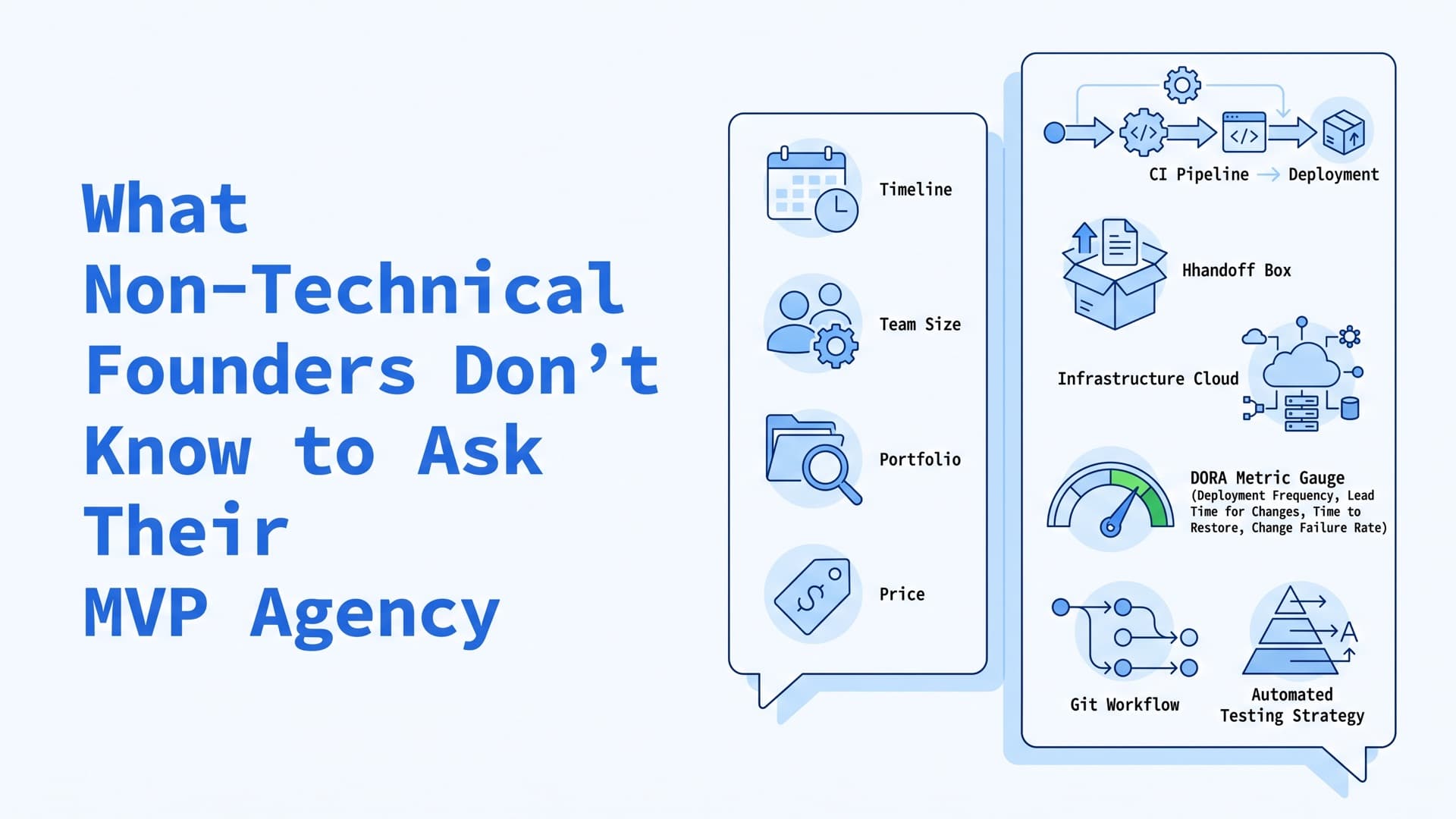
What Non-Technical Founders Don't Know to Ask Their MVP Agency
Timeline, team size, portfolio, price — the four questions every intro call runs through. Six different questions surface whether the agency will deliver production, not a demo. Here are the good answers and the red flag answers for each.