What Non-Technical Founders Don't Know to Ask Their MVP Agency
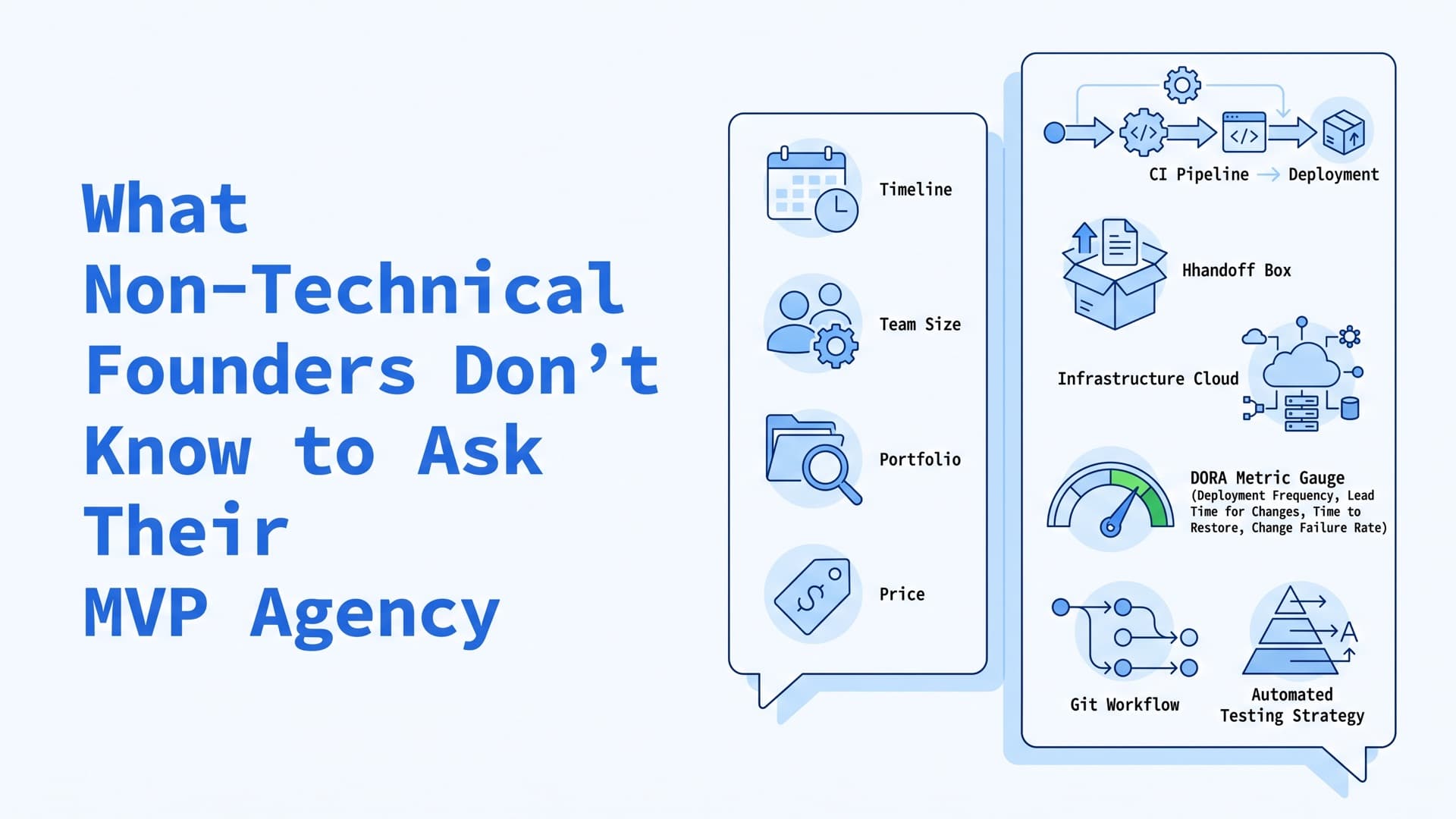
Non-technical founders walk into intro calls with the same four questions. Timeline. Team size. Portfolio. Price. We hear them every time. Each is reasonable. Together, they miss the part that decides whether the product survives its first month in production.
The six questions below are the ones that actually matter. Each has a "good answer" tell and a "red flag" tell. This is the Translation Gap — the distance between what a non-technical founder knows to ask and what an engineer would ask if they sat on the other side of the table. Closing the gap costs nothing during sales conversations and saves tens of thousands at handoff.
Question 1: "Who Specifically Will Write My Code, Day to Day?"
Why it matters: Most agencies quote the senior engineer on the sales call. Then they staff the project with a different team — often a more junior one, sometimes subcontracted. The person you liked in the pitch isn't the person you get.
Good answer: Named engineers. "Anna and Dmitri, 5 and 7 years experience, both staying on your project for the full engagement." A willingness to introduce you to them before signing. LinkedIn profiles you can verify.
Red flag answer: "Our project manager will assign a team based on availability" or "We have a pool of senior engineers across our company." These phrases mean nothing is named, nothing is guaranteed, and the actual coders will be whoever's on the bench when your contract starts. Valtorian's guide for non-technical founders flags this bait-and-switch pattern as the most common failure mode.
Question 2: "What Happens to My Codebase After Launch?"
Why it matters: The build ends. The product doesn't. The question is whether you're on your own after week 12 or whether the agency has a structured handoff that makes ongoing maintenance possible for you or the next team.
Good answer: A handoff package with source code in your GitHub organization, infrastructure in your cloud account (your AWS/GCP/Azure, not theirs), a written runbook covering deploy/rollback/incident response, documented external service accounts (Stripe, SendGrid, etc. all in your name), and a 30-day warranty period for bugs. Pricing for ongoing maintenance spelled out at $3K–$8K/month.
Red flag answer: "We hand over the code at launch." Without infrastructure ownership, without credentials in your name, without a runbook, the code is a pile of files that nobody — including you — can deploy. VeryCreatives lists "Limited Post-Launch Support" as one of ten dealbreakers for good reason.
Question 3: "Does CI/CD Come With This, And What Does It Include?"
Why it matters: CI/CD (continuous integration / continuous deployment) is the automated pipeline that tests and deploys your code. Without it, every deploy is manual, every bug is caught after users see it, and Series A due diligence will flag the omission. Many agencies list "CI/CD setup" as a line item without specifying what it includes.
Good answer: A specific pipeline description. "GitHub Actions running on every PR: TypeScript compile check, Vitest unit tests, Semgrep security scan, npm audit for dependency vulnerabilities, Playwright end-to-end tests on the critical user path. Automated preview environment per PR. Production deploy requires PR approval and a green build."
Red flag answer: "Yes, we set up CI/CD." No tools named. That usually translates to a GitHub Actions workflow running npm test on push — the word "pipeline" without the work.
Question 4: "Who Owns the Infrastructure?"
Why it matters: Some agencies deploy to their own AWS account for speed. Your app runs on their credit card. When the relationship ends, you either pay to migrate or you don't have a product anymore.
Good answer: "Infrastructure provisioned in your cloud account (AWS, GCP, Azure, or whatever you prefer). Every resource tagged with your project. Every credential stored in your secrets manager. We have a read-only role for support during the engagement, which is revoked at handoff."
Red flag answer: "We'll handle the infrastructure — you don't need to worry about it." You do need to worry about it. Your product exists on their account, their credentials, their relationships with cloud vendors. Losing that at the wrong moment costs weeks.
Question 5: "What Does Handoff Look Like in Week 12?"
Why it matters: A vague answer here predicts a chaotic handoff. A specific answer predicts a handoff that actually works. The quality of the answer correlates directly with whether the team has done this before.
Good answer: A deliverables list. Source code in your Git organization, reviewed and squashed. Infrastructure as code (Terraform, Pulumi). A runbook that covers deploy, rollback, the top 5 failure modes, and on-call contact. An architecture diagram. A transferred inventory of external services — Stripe, Sentry, email provider, all in your name. Database credentials in your secrets store. A known-issues list. A 30-day bug warranty.
Red flag answer: "We'll do a knowledge transfer call at the end." One call is not a handoff. A call doesn't produce the document you hand to the next engineer. If the agency can't list the artifacts they'll produce, they don't have a repeatable handoff process.
Question 6: "Will This Pass Series A Technical Due Diligence?"
Why it matters: Most MVPs are built with Series A in mind. Most MVP agencies don't build to pass diligence. The gap is expensive to discover at the diligence stage — 8 to 16 weeks of platform engineering and tens of thousands in delayed funding cost.
Good answer: Confidence, with specifics. "Yes. We build to the standard diligence checklist from day one: DORA metrics measured, infrastructure as code, structured logging with Sentry, secrets in AWS Secrets Manager, runbook written, backup restores tested, pentest-ready. The gap between 'good MVP' and 'diligence-ready MVP' is mostly process. We include the process."
Red flag answer: "That's a separate engagement after you raise." That's the right answer for an agency that doesn't do it. It's not the right answer for you. Retrofitting diligence readiness after the round costs $60K–$150K of engineering time in the window where you need to be shipping features, not filling checklist gaps.
The Golden Test Question
Beyond the six: Valtorian recommends asking, "Can you show me an MVP you built that's live and still running after two years?" This is the question that separates shops that build to ship from shops that build to last. Portfolios are full of screenshots; live products are full of evidence.
If the agency's best-maintained work is still online with the original architecture holding, that tells you what their work looks like 24 months out. If every link goes to "This site can't be reached" or a rebuilt version, you know the real shelf life of what they deliver.
How Pricing Answers Reveal Process
Agencies that can't name specifics on the six questions above usually can't justify their price beyond the sticker number. Watch what happens when you ask "how did you arrive at $85K?" A good answer breaks down hours by role and phase. A bad answer is "that's our standard rate for this type of project."
VeryCreatives flags "suspiciously low pricing" as a dealbreaker for the obvious reason: US/Canada teams charge $120–$200/hour, Eastern European teams charge $40–$80/hour. A $25K quote for a 400-hour build means the hourly rate is below market in every region, which means the team is junior, inexperienced, or both.
What the Six Questions Assume
These questions assume the agency you're evaluating has operated production before. An agency that has only ever delivered demos will find the questions awkward because the answers don't exist in their process. That's not a failure of the questions — it's the information the questions are designed to surface.
The limit of the framework: the six questions don't tell you whether the agency understands your market, your users, or your business. That's a separate evaluation — references, portfolio depth, product taste — that a technical founder would also have to do. What the six questions catch is the production engineering layer that's invisible until the product ships.
The Punchline
The four sales-call questions surface the agency's marketing. The six questions above surface their operations. Demos are free. Production isn't.
Frequently Asked Questions
What questions should a non-technical founder ask an MVP agency?
Six specific questions: Who writes my code day-to-day? What happens to the codebase after launch? Does CI/CD come with this, and what does it include? Who owns the infrastructure? What does handoff look like in week 12? Will this pass Series A technical due diligence? Each question has a "named tool/named person/named artifact" good answer and a vague red-flag answer. Vague answers mean the work isn't in scope.
How do I know if an MVP agency will deliver production-ready code?
Three tests: they can name the specific tools they'll use (Sentry for errors, Semgrep for security, GitHub Actions for CI, Zod for validation), they can show an MVP they built that's still running after two years, and they include a written runbook and infrastructure-as-code in the handoff package. If any of these three is missing, the build will likely need retrofit work before the product survives production.
What's the biggest mistake non-technical founders make when hiring an MVP agency?
Optimizing for sticker price. A $40K offshore quote that delivers a demo without CI/CD, observability, or a handoff runbook is more expensive than a $90K quote that includes all three — the gap becomes visible when the founder tries to run the product independently after launch and can't. Market rates for MVP work in 2026 run $40K–$150K depending on scope; anything meaningfully below that means production engineering has been removed from the scope.
Should I sign an NDA before discussing my idea with an MVP agency?
Standard practice, though the protective value is limited. Most reputable agencies will sign one on request and have a boilerplate template ready. Refusal to sign is a red flag. However, the NDA does not protect your idea from being copied — the execution, relationships, and team you build around it are what actually defend the business. Treat the NDA as a professionalism signal, not a trade-secret shield.
How long should an MVP development engagement take?
Standard SaaS MVP: 8 to 14 weeks of development plus 2 to 4 weeks of discovery. Simple CRUD apps: 5 to 8 weeks. Complex AI-integrated MVPs: 3 to 6 months. Agencies quoting significantly less than these ranges are either cutting production scope or overpromising; agencies quoting significantly more are adding features you don't need for validation. The quoted timeline should be justified with a week-by-week sprint plan, not stated as a single number.
Need help? Talk to an engineer.
Related posts
Fractional CTO vs. MVP Agency vs. Build In-House — A 2026 Comparison
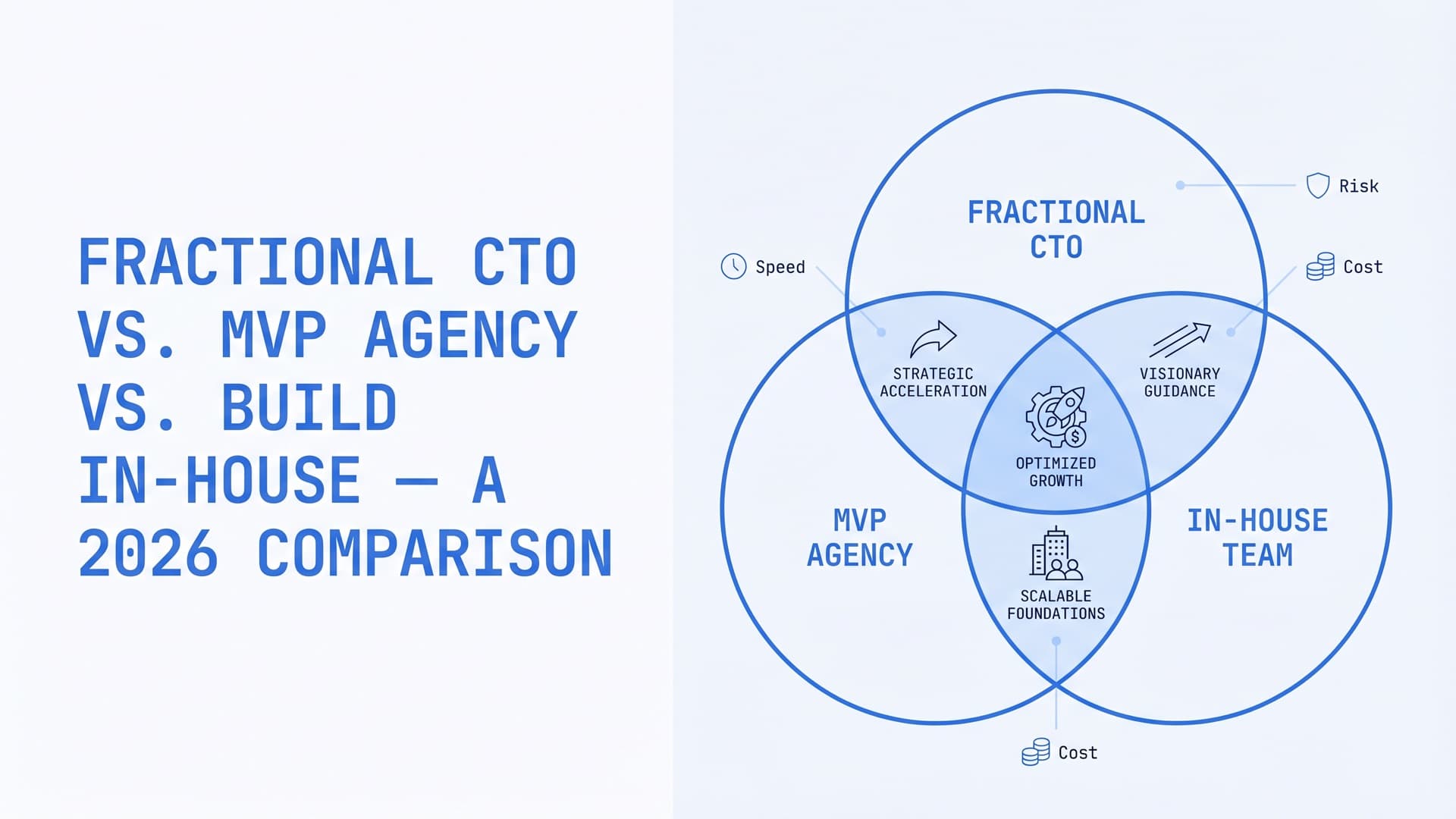
Fractional CTO solves "who decides?" MVP agency solves "who builds?" In-house solves "who stays?" Three options, six dimensions, and the combinations that actually work. The single-option pick is the wrong default.
What Does $80K Actually Buy From an MVP Development Company in 2026?
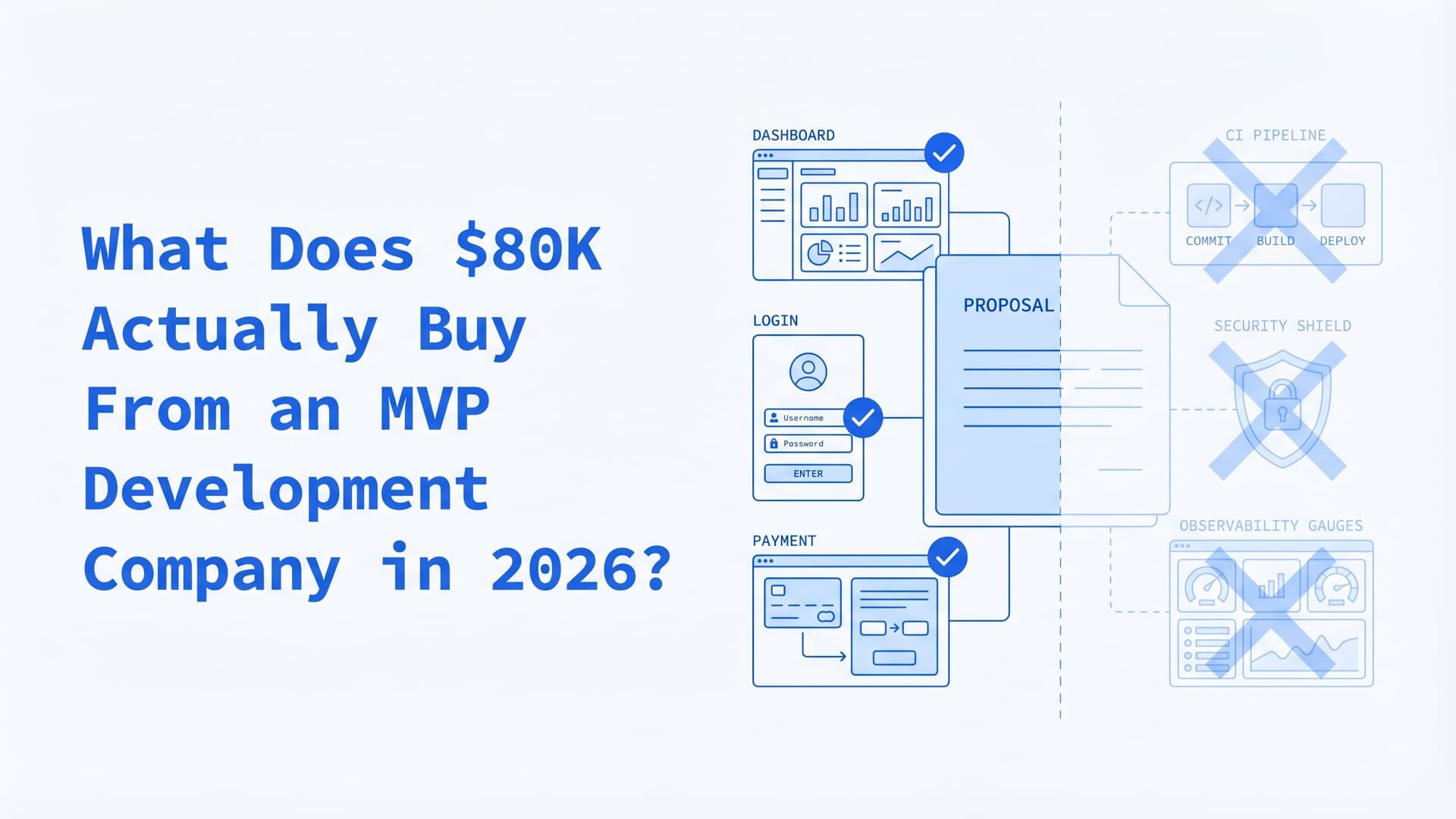
At $150/hour, $80K buys 533 engineering hours. At $70/hour, 1,143. Same visible scope, 2x labor spread. Here's the math most founders never see — and the Invisible Line Item that tells the difference.
The Technical Debt You Should Keep in Your MVP (And the Kind That Kills)
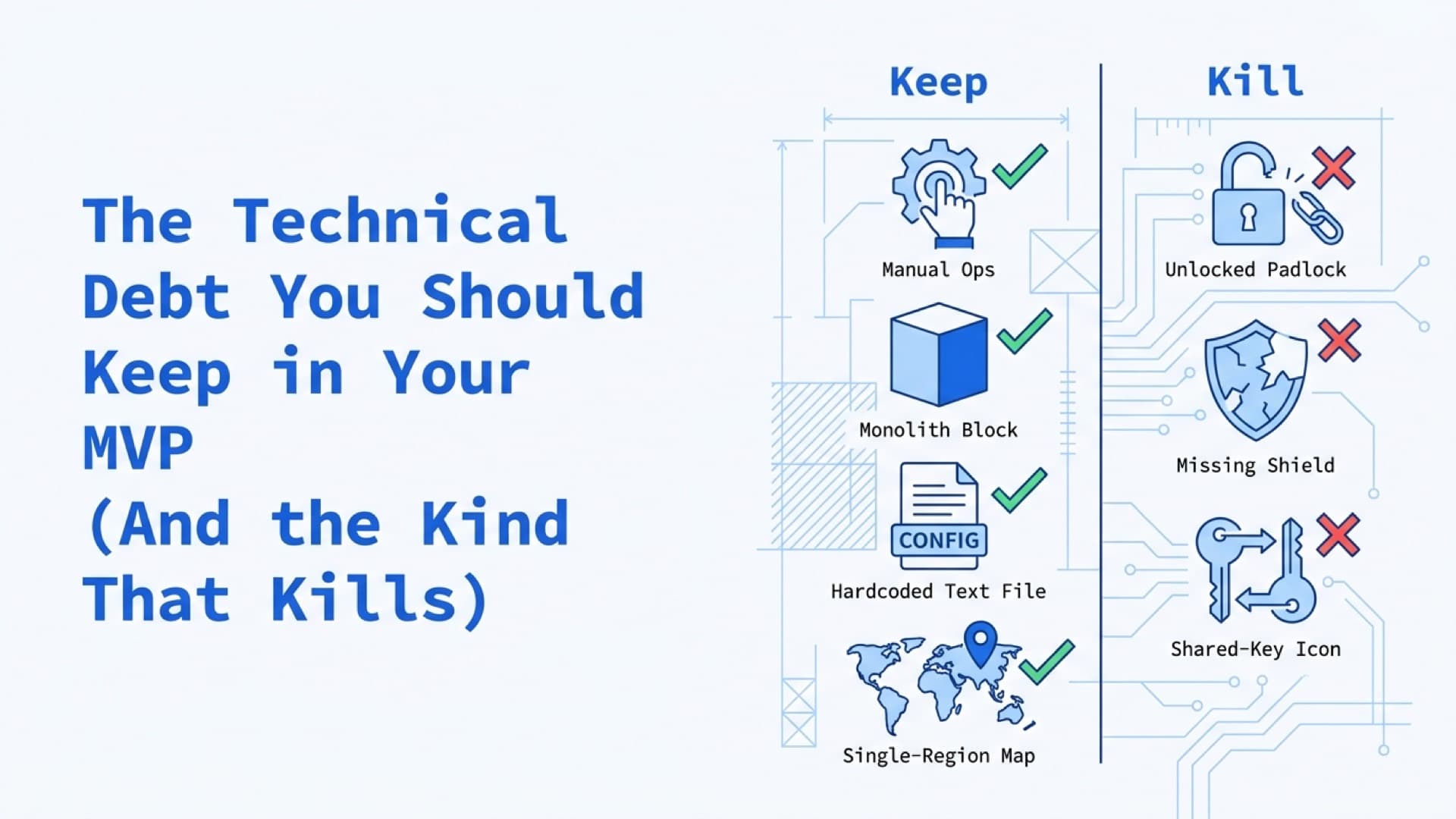
Good debt trades speed now for bounded cost later. Bad debt hides a step function that fires at the worst moment. Five shortcuts to keep forever, five that compound silently, and a better rule than the 20% sprint tax.