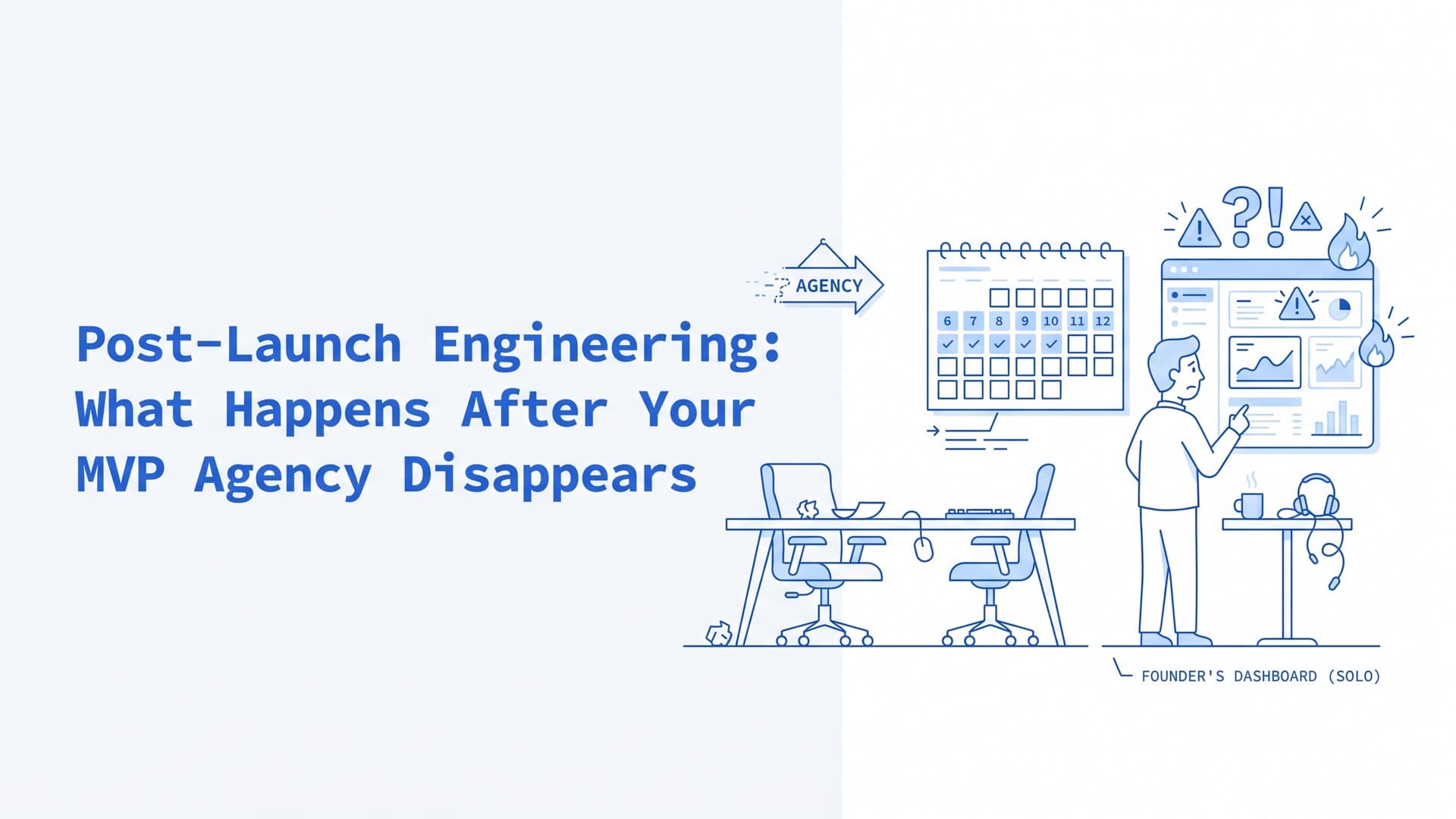
Post-Launch Engineering — What Happens After Your MVP Agency Disappears
The agency celebrates launch. The founder celebrates launch. Six weeks later, the founder discovers that the engineers who knew why the payment retry logic had three seconds of jitter are not returning calls, the AWS bill arrived with a charge nobody can attribute, and the first real production bug just dropped the checkout page for an hour. This is the Post-Launch Gap — the distance between "we shipped an MVP" and "we have a product that survives operating."
This is the default outcome. The build works. The launch works. Then the team rotates off and the founder inherits a system nobody documented. This post covers what actually happens in the months after launch, what it costs to run, and what the realistic paths are for the founder who inherits an MVP and needs it to keep working.
Month 1: The Things That Weren't Configured
Every MVP ships with a set of known-good-for-launch settings that need to change within the first 30 days. Most of them aren't configured by default; most agencies don't configure them because the product worked without them during development.
Alerting thresholds. Sentry is installed, but alerting is configured to notify on every error. At 100 users, that's fine. At 1,000 users, it's 400 Slack pings a day, which becomes noise, which becomes ignored. Re-tune to alert only on error rate increases relative to baseline, or only on specific error classes (payment failures, auth failures). This is a 2–4 hour task that has to happen once traffic shows what normal looks like.
Log retention and cost. Axiom, BetterStack, or Datadog ship with 7–30 day default retention. For a product with real users, 30 days isn't enough for debugging — expand to 90 days. For a product trying to minimize burn, 14 days is enough. Either way, the default needs a conscious decision or the log ingest bill grows faster than the user count.
AWS/cloud tagging. The infrastructure is provisioned but nothing is tagged. The monthly bill is a single number nobody can decompose. Before month 2, every resource needs tags (product, environment, cost center) so the bill can be rolled up by surface. We covered this in the Series A diligence checklist — it's the Mystery Cloud Bill failure mode.
Secrets rotation schedule. The API keys that were set up for launch need a rotation policy. Stripe, OpenAI, database credentials — every one gets a rotation cadence (90 days is standard) and an owner. Without this, the first breach response becomes a scramble because nobody has rotated anything since the build.
Month 1 cost to execute well: about 20–40 engineering hours. Cost to skip: 6-18 months before the shortcuts turn into incidents.
Month 2–3: The First Incident
Every MVP has its first production incident between week 6 and week 12. The pattern is predictable:
- Traffic hits a new level the build wasn't tested for.
- A dependency somewhere in the stack fails in a way that wasn't handled.
- The app returns 500s or becomes unresponsive.
- Nobody knows what happened because the logs weren't structured well enough to reconstruct the request.
- The fix takes 4–8 hours of engineering time plus the customer-facing downtime.
Common first-incident causes, ranked by frequency:
- Database connection exhaustion. Documented in From 10 Users to 10,000. The most common first-incident cause.
- External API rate limit. OpenAI, Stripe, SendGrid — hit a per-minute limit during a traffic spike and the retry storm cascades.
- Disk full on a server instance. Logs, build artifacts, or upload attachments filling a disk without monitoring.
- Memory leak in a long-running process. Node services running for 3 weeks develop issues Node services restarting every 15 minutes don't.
The first incident is information. If you have observability in place, you can diagnose it in an hour. If you don't, you're flying blind until the next one. This is why observability belongs in Month 0, not Month 3. Installing Sentry, Axiom, and a /health endpoint after the first incident costs 3x what it costs to install them before.
Months 3–6: The Features That Were Deferred
By month 3, the real feature requests from actual users are coming in. Most of them are the features the agency explicitly scoped out of the MVP build — the "we'll do that in v2" list. Three patterns to expect:
1. Admin tooling. The product works for users. It doesn't work for the founder trying to run the business. Support lookups, manual refunds, account resets, user impersonation for debugging — all missing. The first 3–4 weeks of post-launch engineering usually go here.
2. Exports and integrations. Real users want to export their data (CSV, PDF). Real B2B customers want SSO (SAML, OIDC). Real enterprise customers want webhooks, a public API, and Zapier support. None of this was in the MVP scope.
3. Mobile experience. The MVP was responsive on a phone. It was not designed for a phone. Users complain. Depending on usage pattern, this is either a low-priority refinement or the #1 issue.
Engineering cost for this phase: 80–160 hours/month of focused work, or about $10K–$30K/month at senior rates. This is the permanent engineering spend the founder is now on the hook for.
The Three Paths Post-Launch
Every founder inherits the same question at this point. Who does this engineering work? Three realistic answers:
Path 1: Retain the agency. Most agencies offer a post-launch retainer at $3K–$8K/month for ~30 hours of engineering time. This is the continuity option. It works if the agency was senior enough to be worth retaining and structured enough to have a handoff that wasn't total. Costs $36K–$96K/year.
Path 2: Hire a single engineer. One full-time engineer on the product. Fully loaded US cost $140K–$240K/year; fully loaded EU cost $80K–$130K/year; hybrid remote contractor $80K–$120K/year. This works if the product has clear forward momentum and the hire is senior enough to own the system. The risk is the Bus Factor — one person leaves, the product goes with them.
Path 3: Accept slower cadence. The founder doesn't hire anyone. The agency goes away. Small bugs get patched by the founder themselves, by a friend, or by a fractional engineer on a $200/hour ad hoc basis. This is the cheapest path and the most common when budgets are tight. It works for products that aren't growing — and stops working the moment the product starts growing and needs active engineering.
The right choice depends on a question most founders don't think to ask: how much forward engineering does the product actually need, not how much the founder wishes it needed. Products with steady 10-20%/month growth need Path 1 or Path 2. Pre-PMF products can often get by on Path 3 until the product stops being pre-PMF.
What the Agency Should Have Left Behind
The post-launch phase is shaped by what was delivered at handoff. If the handoff was complete, any of the three paths above works. If the handoff was incomplete, none of them work without a cleanup first.
A complete handoff includes the source code in the founder's Git organization, infrastructure as code (Terraform or Pulumi) in the same repository, a runbook covering deploy/rollback/top-5 failure modes, an architecture diagram, external service account access transferred to the founder's name, a known-issues list, and a 30-day warranty period. We covered the full handoff checklist in what non-technical founders should ask their MVP agency.
Without those artifacts, the founder's engineering capacity for the first two months goes to recreating what should have been delivered. That's six to twelve weeks of engineering effort the founder is paying for a second time, usually while also trying to ship features that were in the original product scope.
What We Keep Seeing
The pattern repeats. Three Month-0 decisions decide the next six months:
- Whether the infrastructure is in the founder's cloud account or the agency's (decides whether Path 3 is even possible).
- Whether a runbook was written during the build or deferred to "we'll document it later" (decides whether a new engineer can onboard in two weeks or two months).
- Whether observability was installed before launch or after the first incident (decides how hard the first 90 days of operation will be).
Get these three right in Month 0 and the post-launch phase is a maintenance question. Get them wrong and it's a rescue question.
The Compressed Version
The agency leaves. The product doesn't. Handoff decides whether that matters.
Need help? Talk to an engineer.
Frequently Asked Questions
How much does it cost to maintain an MVP after launch?
$4K–$8K/month for a standard SaaS MVP with 1,000–5,000 users, per Softermii's 2026 breakdown (range extends $2,650–$14,500/month across complexity). Split the spend three ways: ongoing engineering, cloud and third-party services (Stripe, email, observability at $500–$2K/month), and monitoring tools ($200–$500/month). Total first-year maintenance runs 15–25% of the original build cost.
What should I expect in the first production incident?
A 4–8 hour debugging session plus customer-visible downtime, usually caused by database connection exhaustion, an external API rate limit, a full disk, or a memory leak. The cost of the incident is bounded if observability is installed (Sentry, structured logs, health endpoint); the cost is unbounded if not, because you can't diagnose what you can't see. Expect the first incident between week 6 and week 12 post-launch.
Should I keep the same MVP agency for post-launch maintenance?
Only if they're senior enough to be worth the retainer and the handoff was complete. Most agencies offer $3K–$8K/month maintenance retainers for 20–40 hours of engineering. This is the continuity option. The alternative — hire a full-time engineer or work ad hoc — is often better economically after month 6, when the monthly retainer passes the fully-loaded cost of a mid-level engineer.
What are the most common bugs in post-launch MVPs?
Database connection exhaustion (most common), external API rate limits (Stripe, OpenAI, SendGrid), disk-full errors on server instances, memory leaks in long-running Node processes, and unhandled timeouts on third-party calls. All five have the same root cause: the MVP was tested with one user and shipped without a load test or observability layer to catch the patterns before users did.
How do I know if my MVP is ready to scale?
Run a load test at 10x expected peak concurrent users against staging. If it holds, you're ready. If it breaks, whatever broke is the next thing to fix — and scaling without fixing it means the break happens with real users instead. Tools: k6, Artillery, Locust. The full architecture progression at each scale boundary is covered in From 10 Users to 10,000.
Related posts
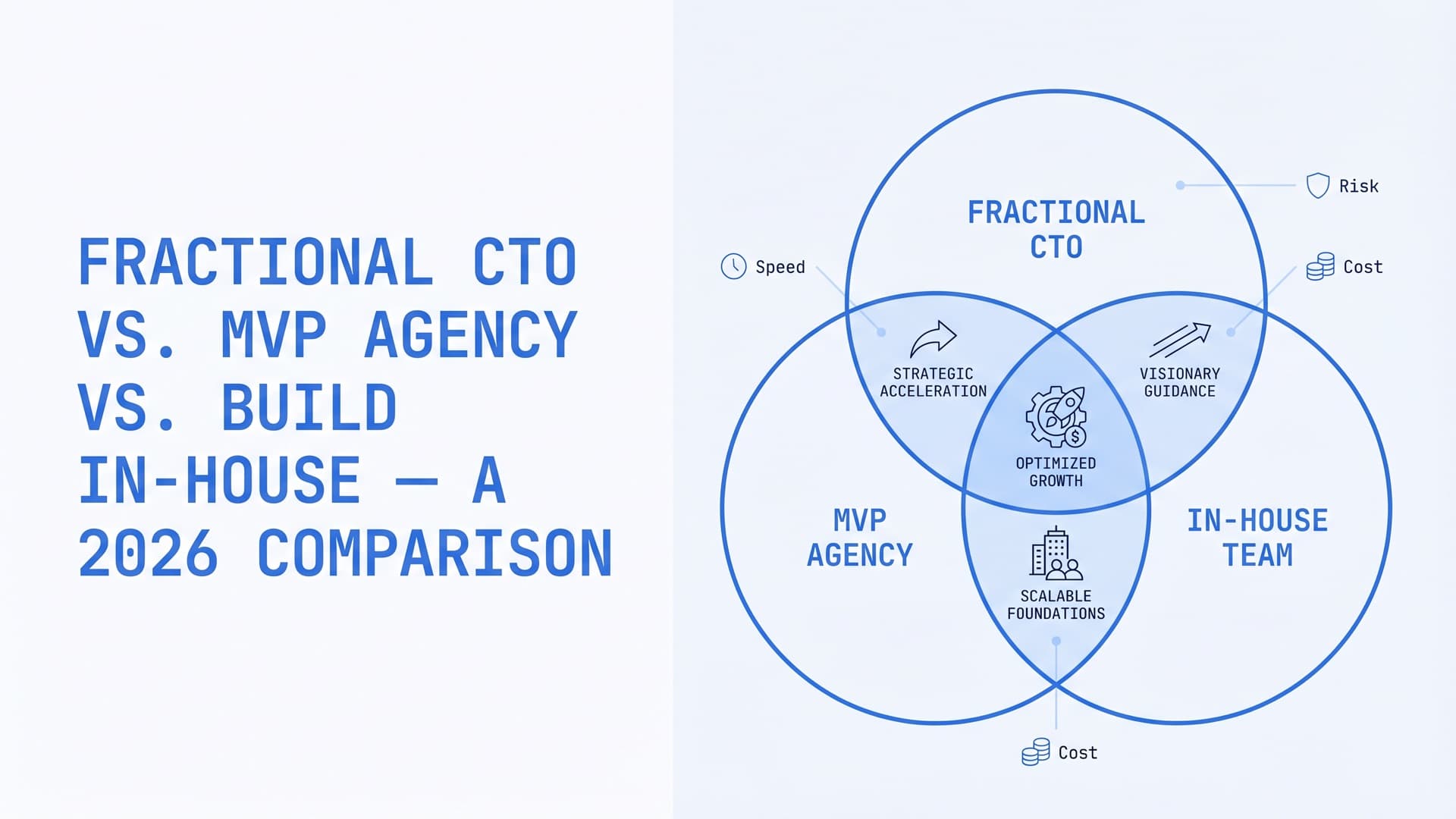
Fractional CTO vs. MVP Agency vs. Build In-House — A 2026 Comparison
Fractional CTO solves "who decides?" MVP agency solves "who builds?" In-house solves "who stays?" Three options, six dimensions, and the combinations that actually work. The single-option pick is the wrong default.
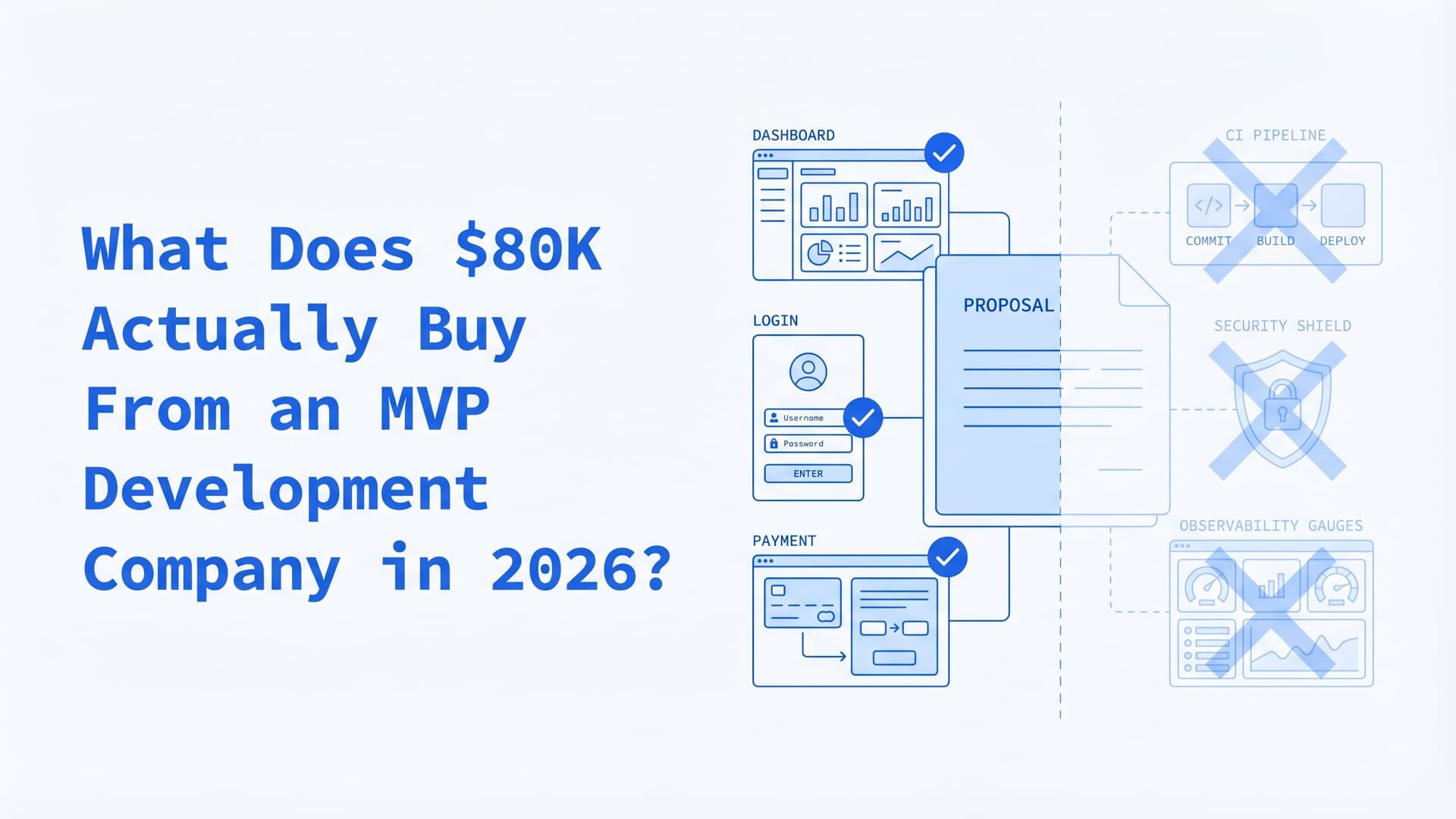
What Does $80K Actually Buy From an MVP Development Company in 2026?
At $150/hour, $80K buys 533 engineering hours. At $70/hour, 1,143. Same visible scope, 2x labor spread. Here's the math most founders never see — and the Invisible Line Item that tells the difference.
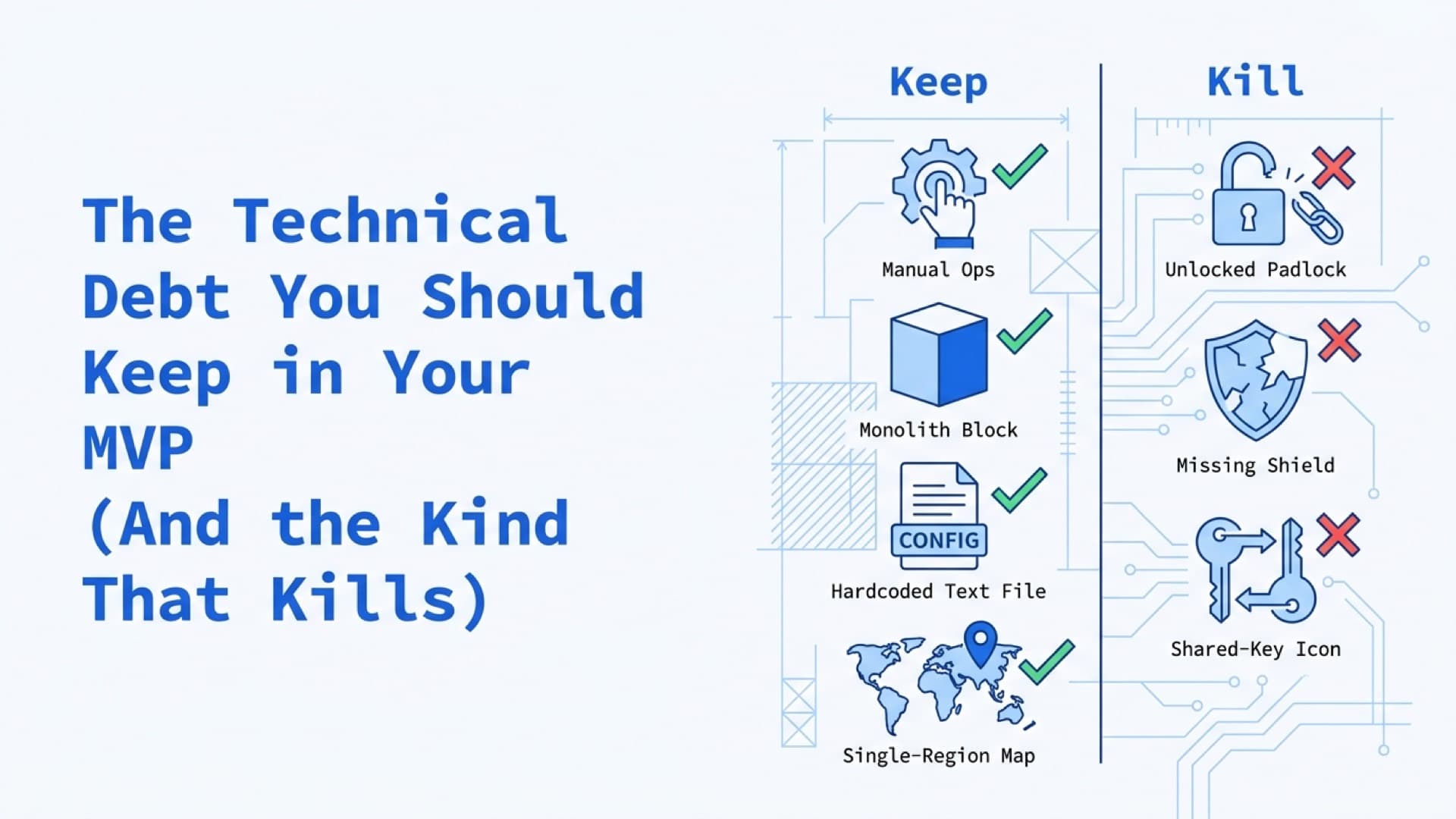
The Technical Debt You Should Keep in Your MVP (And the Kind That Kills)
Good debt trades speed now for bounded cost later. Bad debt hides a step function that fires at the worst moment. Five shortcuts to keep forever, five that compound silently, and a better rule than the 20% sprint tax.