The True Cost of a Dedicated Development Team: Beyond the Hourly Rate
A buyer gets a quote: $65/hour for a senior Eastern European developer in a dedicated team. They run the arithmetic — 160 hours × $65 × 4 engineers = $41,600/month. Budget approved.
Twelve months in, the actual cost to the business is closer to $58,000-$65,000 per month. Nobody was dishonest. Per Oski's 2026 cost analysis, hidden cost categories inflate the actual spend 20-40% above the quoted headline rate, and most buyers don't price them in because nobody names them together.
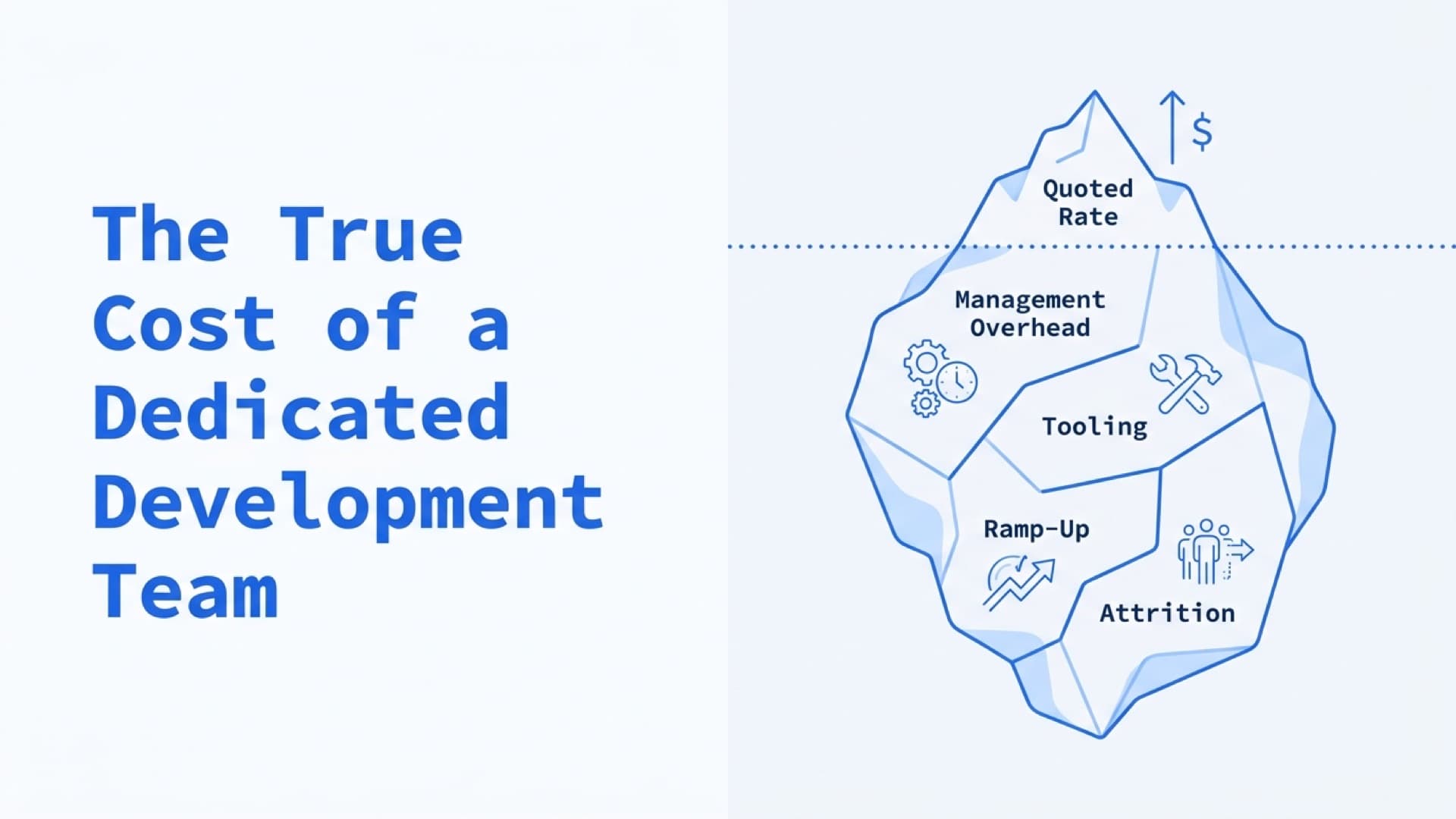
Call this The Iceberg Rate: the hourly number a vendor quotes for a dedicated team represents roughly 55-70% of the total cost the buyer will actually incur over a 12-month engagement. The rest sits below the waterline. Some of it is in the contract if you read carefully. Some of it isn't.
What's Above the Waterline
Senior developers in Eastern Europe run $65-$90/hour in Poland, $45-$75 in Romania, and $40-$65 in Bulgaria, according to Devico's 2026 rate breakdown. LATAM senior rates fall into similar bands — $50-$80/hour in Mexico and Colombia, $35-$55 in Argentina. US in-house equivalents run $100-$160/hour blended, or $170,000-$240,000/year fully-loaded per ScaleUpAlly's 2026 benchmarks.
Dedicated team retainers compress the per-hour math into per-team-per-month pricing. Debut Infotech's 2026 cost breakdown puts typical retainers at $15,000-$60,000/month for a 3-6 person team; Acquaintsoft's survey widens the range to $45,000-$80,000/month for teams of 6-10.
These numbers are honest and incomplete. The iceberg starts below them.
What's Below the Waterline
Five cost categories sit under the headline rate.
1. Management Overhead (15-30% of base)
A dedicated team comes with a tech lead or project manager. A sensible contract prices that role into the retainer. A less-sensible one bills it as a separate line at 15-30% of the team's base cost, according to Acquaintsoft's 2026 cost guide. On a $40K/month base, that's an additional $6,000-$12,000 per month that some buyers assumed was bundled and wasn't.
The rougher version: "light-touch" contracts where the vendor provides engineers plus "occasional" PM attention. What "occasional" means in practice — and how much of it is priced into the retainer — is frequently unclear until month two, when the client tech lead notices they've been running the standups. This is staff augmentation with a dedicated-team price tag, and it's the spec-to-reality gap that drives most of Oski's 20-40% inflation finding above.
2. Infrastructure and Tooling Pass-Through ($240-$1,050/dev/month)
Per Oski's 2026 pricing survey, infrastructure and tooling costs run $240-$1,050 per developer per month. The range is wide because it depends on the stack: a simple web product team may land at the bottom; a team running ML workloads or compliance-heavy infra at the top.
What lives inside this line: IDE licenses, monitoring and observability stack, CI runner capacity, issue tracking, design tools, test environments, security scanners, VPN and identity infrastructure, compliance tooling (SOC 2 audit prep, penetration testing), and any cloud allocation for dev/staging.
Some vendors bundle all of this into the retainer. Others itemize it separately. That's why a $42K and $54K quote for the same nominal team are often for quantitatively different engagements — the "same team" across two vendor quotes isn't actually the same team until you've asked what's included.
3. Ramp-Up Opportunity Cost (3-9 months to full velocity)
The IEEE ramp-up study across 80 engineering organizations found 3-9 months to full productivity as the industry norm. The same study found that cutting ramp time in half saves the equivalent of 17 developer-years per year across new hires at a typical org.
Translating those ranges onto a new four-person team: months one and two deliver partial velocity, month three is where sprint output starts to stabilize, and full productivity lands somewhere in the month-four-to-six window — assuming nothing else resets the curve.
Whether you pay for that ramp depends on the contract. Some vendors discount the first 30-60 days. Most don't. You're invoiced at the full rate while velocity is a fraction of projection. On a $40K/month engagement, that's tens of thousands of dollars of productivity deficit in the ramp quarter — money spent against output that arrives later.
Compressing ramp is real work — documentation, an internal point person, a well-defined first-month plan. The vendor can execute structured onboarding; the client has to have the artifacts for the vendor to onboard against. Without them, the vendor's "fast ramp" pitch collapses into the same 3-9 month curve everybody else runs.
4. Attrition Buffer (15-25% annual replacement churn)
Oski's data on dedicated team attrition: 15-25% annually at reputable providers, 40% at low-quality ones. Staff augmentation attrition is lower (8-12%) because the vendor isn't carrying the seat — they pull the engineer and give you someone new. Dedicated team attrition is absorbed as vendor cost in the retainer, but the client still pays the ramp cost on the replacement.
If one of four engineers turns over at month eight, you get a replacement at week 10 or 12 who needs three months to reach the level of the predecessor. That's roughly a quarter of team velocity running at half capacity. Priced against a $40K/month retainer, that's $10,000-$15,000 of lost productive output that didn't hit your invoice but did hit your sprint.
5. Contract Fees That Aren't in the Rate
Budget providers itemize costs separately, and Oski's analysis puts the total of these at 20-40% above the quoted headline rate. The common categories:
- Setup fees. One-time charges for environment provisioning, security review, and access setup. Observed range across mid-market vendor contracts: low single-digit thousands for a 4-person team, higher for compliance-heavy work.
- Buyout clauses. If you decide an engineer is worth hiring directly, the fee runs $14,000-$20,000 or 18-25% of annual salary, per HighCircl's benchmarks. The vendor also controls the minimum engagement duration before conversion is permitted.
- Early termination. Standard notice periods run 30-60 days across most dedicated-team MSAs; contracts with 90-day notice or partial-retainer penalties are common enough to look for explicitly before signing.
- Compliance certifications. If you need SOC 2 Type II artifacts, a DPA under GDPR Article 28, or a HIPAA BAA, many mid-market providers charge extra for the overhead. Secureframe puts the vendor-side cost of a Type II attestation at $30,000-$150,000 annually — a cost smaller providers amortize across the clients who request it.
- IP escrow. For engagements exceeding 6 months, source code escrow via a service like Escode (NCC Group) is standard practice for business-continuity protection, typically billed separately from the team retainer.
The Actual Math on a $25,000/Month Team
Start with a four-person team quoted at $25,000/month — a standard mid-market dedicated team pitch.
Nominal 12-month cost: $300,000.
Now add the iceberg.
| Component | Cost | Source | |-----------|------|--------| | Base retainer | $300,000 | Quote | | Management overhead (20%) | $60,000 | If unbundled | | Tooling and infrastructure (mid-range) | $30,000 | $600/dev/month × 4 × 12 | | Setup fees (one-time) | $5,000 | Environment, access | | Ramp-up deficit (first 3 months at 60% avg) | $30,000 | Calculated against target velocity | | Attrition ramp cost (assume 1 turnover) | $12,000 | Quarter of team × 3 months × half velocity | | Compliance artifacts (SOC 2 client overhead) | $8,000 | If required | | Buyout/early termination risk buffer | $0-$20,000 | Contingent |
Realistic 12-month cost: $425,000-$465,000.
That's a multiplier of 1.4x-1.55x against the headline quote before anything goes wrong. Higher turnover and aggressive itemization push the multiplier up; premium vendors with fully-bundled retainers push it down but raise the headline rate to compensate. In either direction, the thing moving the number isn't dishonesty.
It's naming. The Iceberg Rate is a real pricing category, and buyers leave it out of vendor-to-vendor comparisons because there's no standard line item for it.
What to Ask Before You Sign
Four questions resolve most of The Iceberg Rate variance.
What's included in the per-team retainer, line by line? Ask for the split: engineer base cost, PM/tech lead cost, tooling pass-through, and any compliance overhead. If the vendor won't give you that split, they're planning to move costs between categories post-signature.
Minimum engagement length and early termination penalty. If the answer is "we're flexible," get it in writing. Notice periods over 60 days or penalties above 20% of unexpired retainer should be flagged as clock risk, not treated as standard.
What's the ramp-up discount structure? Reasonable answers include a 15-30% discount for the first month, or a structured onboarding plan with shared KPIs. "We don't discount ramp-up" is honest; it just means you need to price three months of partial velocity into your projection.
What's the vendor's annual attrition rate, and what's the replacement SLA? Reputable providers answer with a number (10-18% is good, 15-25% is industry norm, 30%+ is a flag) and a replacement commitment measured in weeks, per Oski's benchmarking. Budget providers answer with "we'll find someone." That answer is the cost you're going to pay twice.
Honest Boundary
The multiplier math in this post is directional, not precise. The 1.4x-1.55x range assumes a mid-market vendor, a moderately complex stack, and a competent client-side PM. Variance drivers:
- Stack complexity. ML infrastructure teams sit near the top of the tooling range; simple web teams near the bottom. Compliance-heavy work (fintech, healthcare) adds 10-20% in audit-related costs that simpler work doesn't face.
- Client-side maturity. A client with existing documentation, a mature backlog, and a clear internal product owner shortens ramp and reduces the ramp-deficit component significantly. A client who treats onboarding as the vendor's problem pays for it anyway.
- Vendor market position. Enterprise vendors like EPAM charge 1.5-2x the mid-market rate and tend to bundle more aggressively — higher headline number, fewer below-the-waterline surprises. Budget providers compete on the opposite side: a lower headline rate with more line items that surface after signature. The total cost of ownership across these market segments converges more than the quoted rates suggest.
- Currency and timing. USD/EUR/PLN fluctuations across a 12-24 month contract can move the effective rate 5-15%. Some vendors lock in USD at signature; others bill in local currency and let exchange rate variance land on the client.
This post also assumes a software engineering dedicated team. Data engineering and ML teams trend higher on tooling costs. Pure DevOps/SRE engagements trend higher on on-call and incident-response line items, which this framework doesn't fully cover.
Need help pricing a dedicated team realistically? Talk to an engineer.
The quoted rate is the tip. The bill is the iceberg. Price the whole thing before you sign the retainer.
Frequently Asked Questions
What does a dedicated development team actually cost per month?
Nominal monthly retainers run $15,000-$25,000 for a 3-4 person startup-scale team, $25,000-$45,000 for 4-6 engineers, and $45,000-$80,000 for 6-10 engineer product teams. Add 40-55% above the headline rate for management overhead, tooling pass-through, ramp-up deficit, and attrition replacement to get realistic 12-month total cost of ownership per Oski's 2026 pricing analysis.
What is the fully-loaded cost multiplier for a dedicated team?
For a mid-market vendor with a standard retainer, the total 12-month cost runs roughly 1.4x-1.55x the headline quote once management overhead (15-30%), tooling pass-through ($240-$1,050/dev/month), ramp-up productivity deficit, attrition replacement cost, and contract-specific fees are included. Budget providers can push the multiplier to 1.7x-1.9x through aggressive cost itemization.
How much should I budget for onboarding a new dedicated team?
Budget three to six months for ramp to full velocity based on IEEE research across 80 engineering organizations showing 3-9 months as the industry norm. Concretely, expect 30-50% effective output in month one, 60-75% by month three, and near-full velocity by month four to six. On a $40,000/month engagement, that's $30,000-$60,000 of productivity deficit across the ramp window.
What hidden costs do dedicated team contracts typically have?
Common hidden-cost categories: management overhead billed separately (15-30% of base if unbundled), tooling and infrastructure pass-through ($240-$1,050 per developer per month), setup fees ($3,000-$8,000), buyout clauses to convert engineers to direct hires ($14,000-$20,000), early termination penalties (up to 25% of unexpired retainer), and compliance artifact overhead (SOC 2, HIPAA, GDPR DPA) adding $5,000-$15,000 annually.
How do I compare dedicated team vendor quotes fairly?
Request a line-item split: engineer base cost, PM/tech lead cost, tooling pass-through, and compliance overhead. Ask for the ramp-up discount structure and termination penalty. Get the vendor's annual attrition rate and replacement SLA. Vendors who refuse to itemize are planning to shift costs between categories after signature, which makes apples-to-apples comparison impossible.
Related posts
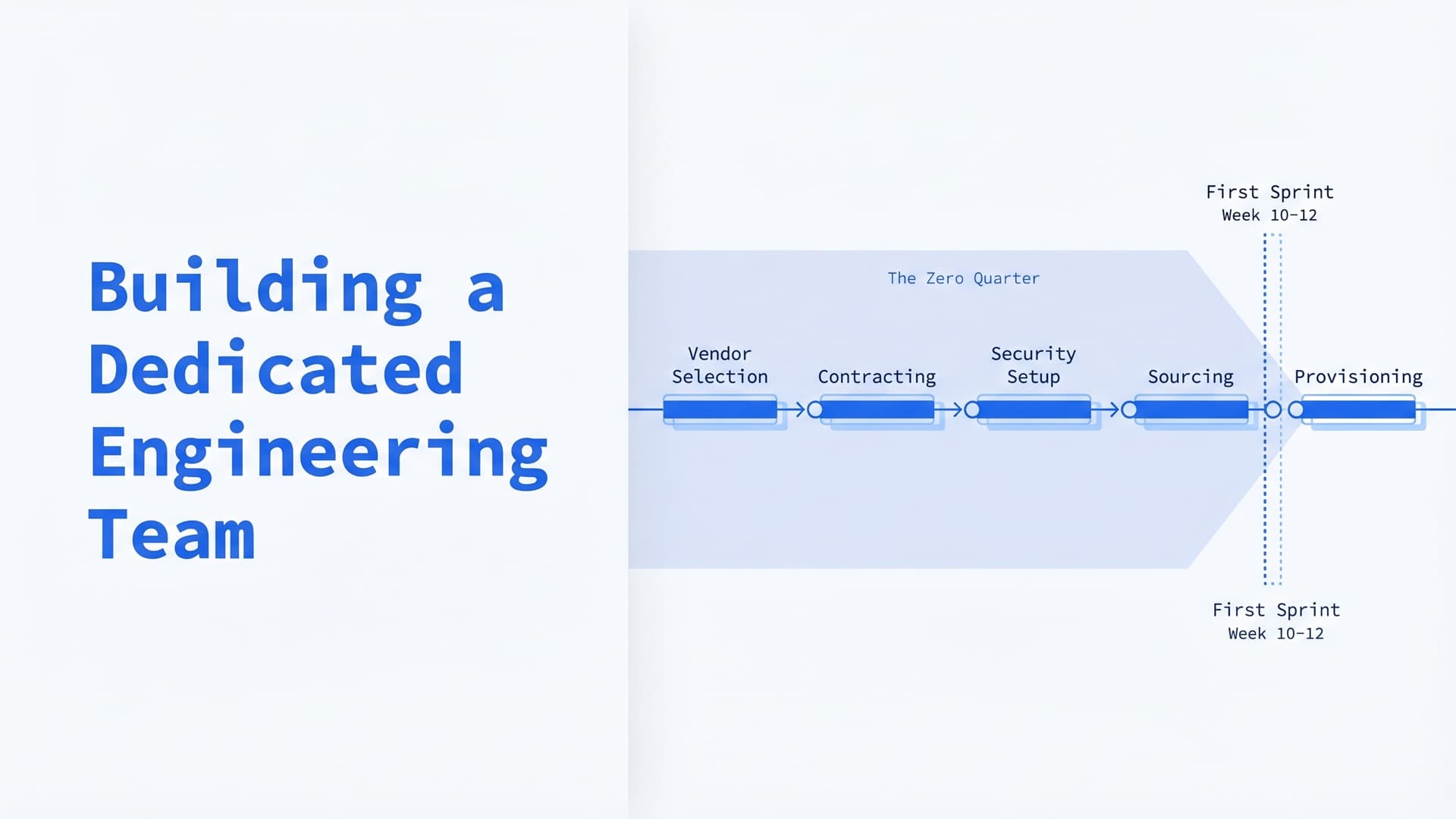
Building a Dedicated Engineering Team from Scratch: Timeline, Cost, and Mistakes
Vendor decks show 2 weeks. The real timeline is 10-16 weeks. Call it The Zero Quarter — everything between decision and first sprint. Cost model, worked example, and the five setup mistakes that compound.
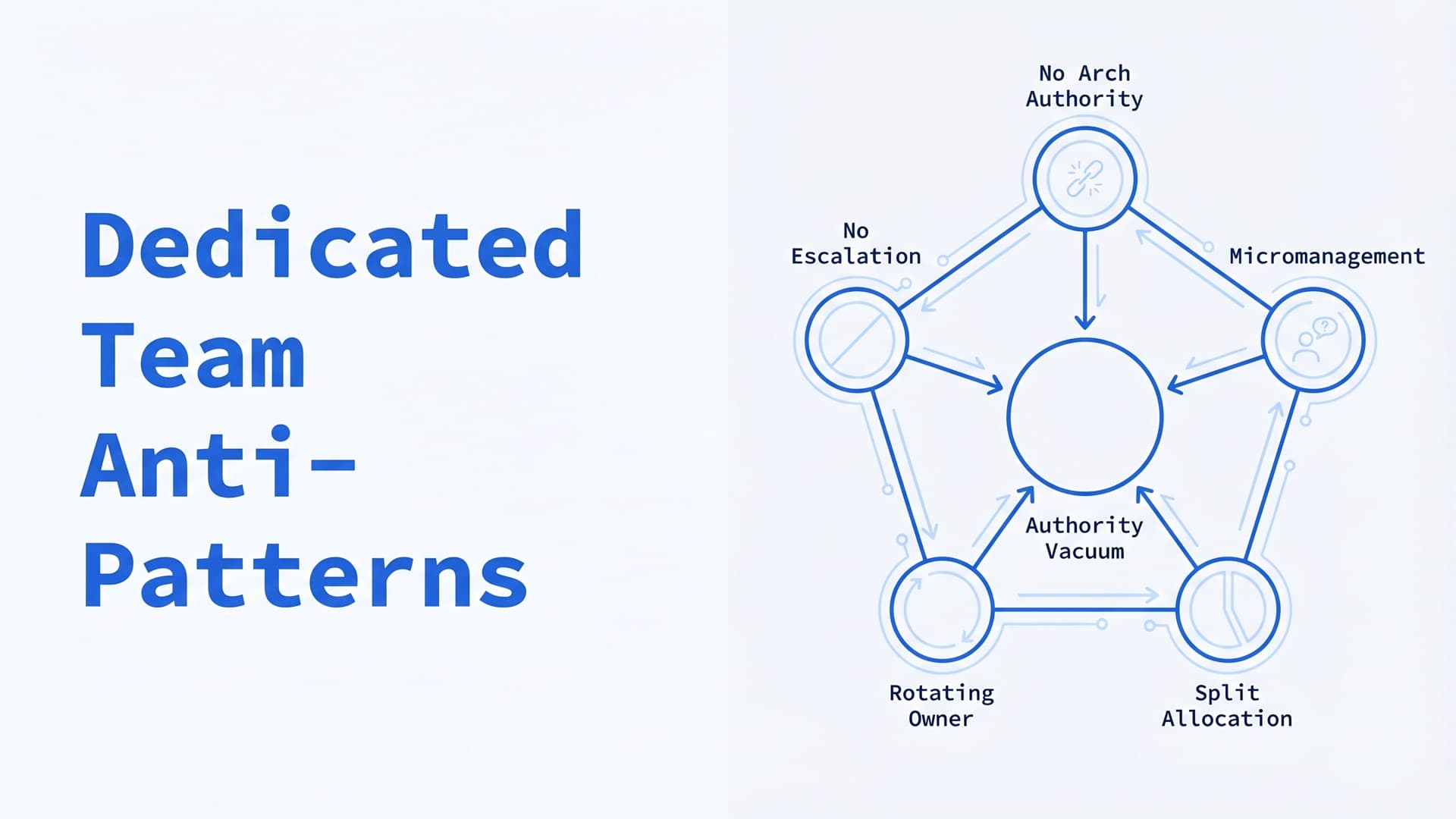
Dedicated Team Anti-Patterns: 5 Governance Failures That Kill Productivity
Five governance failures account for most dedicated team engagement failures — and none of them are about engineer quality. The Authority Vacuum, the five patterns it creates, and how to diagnose which one you have.
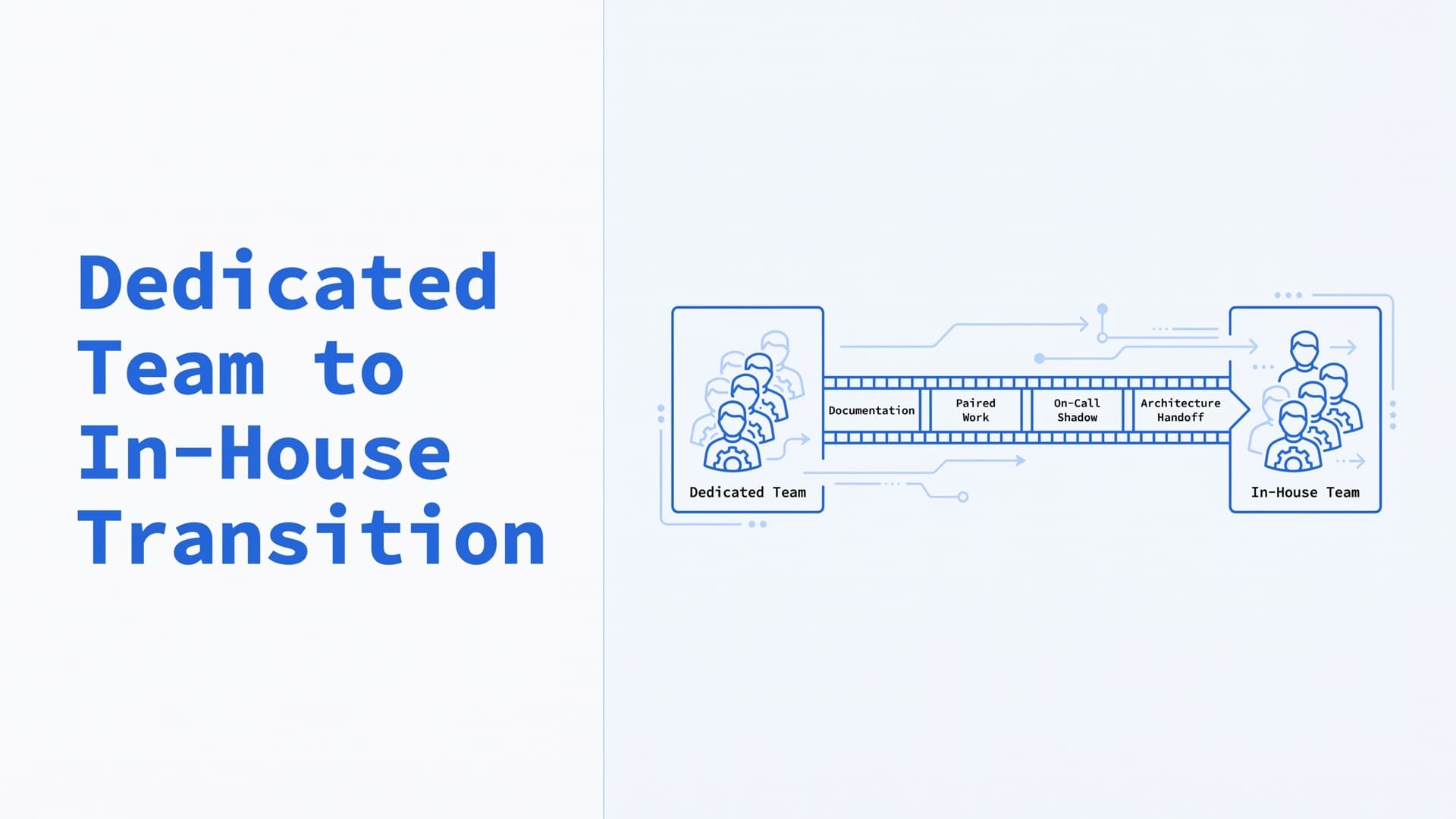
When to Bring a Dedicated Team In-House (And How to Do the Transition)
70% of executives have selectively insourced. The Knowledge Bridge is what separates successful transitions from expensive restarts. Signals, playbook, and the four failure modes that sabotage in-housing.