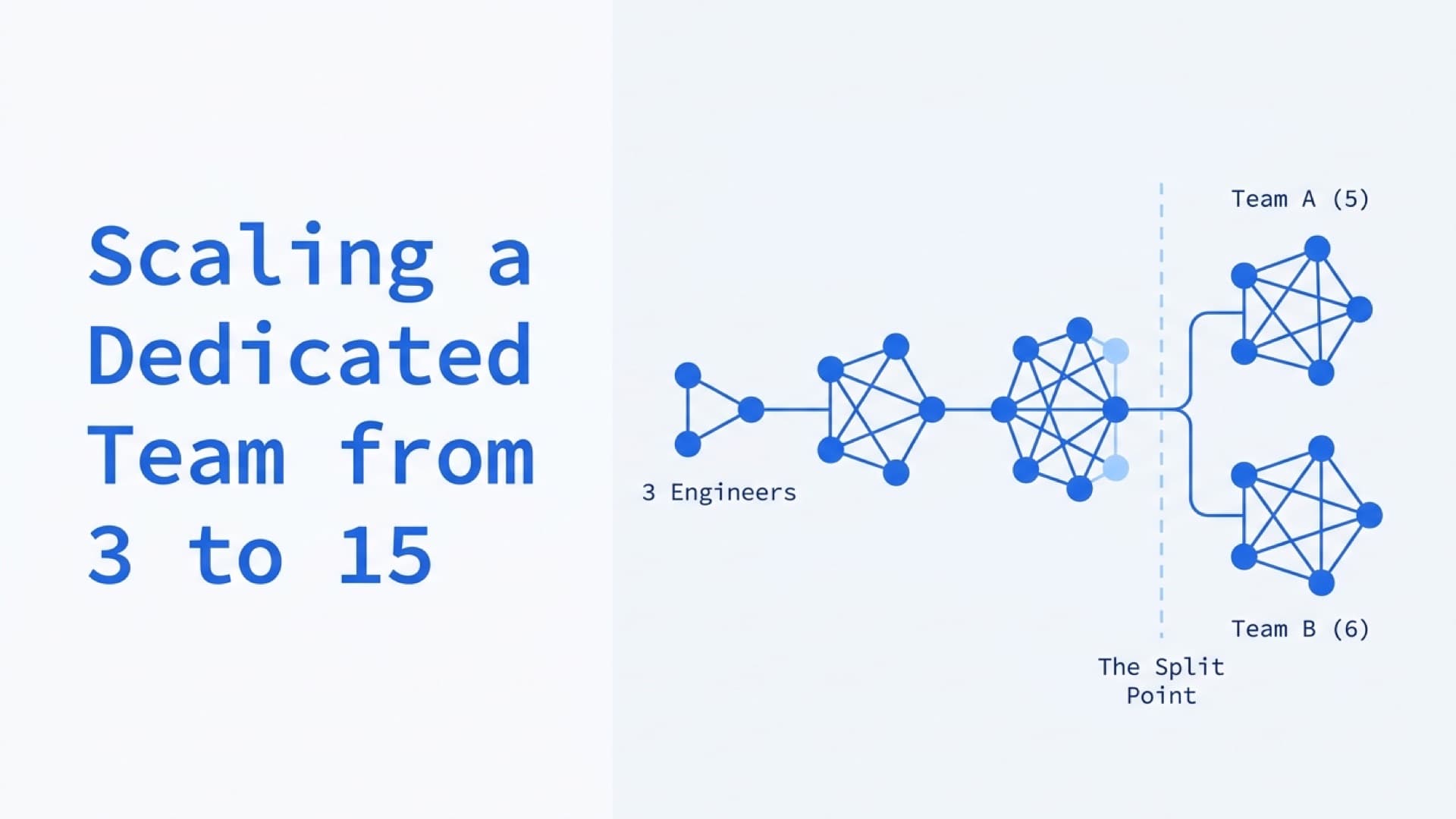
Scaling a Dedicated Team from 3 to 15 Engineers Without Losing Quality
A client starts a dedicated team with three engineers. Twelve months later, they want fifteen. The instinct is to keep the team intact and just add people — same Slack channels, same standup, same product owner, same codebase. It's the fastest way to turn a well-functioning team into a slow-moving one.
The engineering team scaling math is not linear. Adding one engineer to a team of three roughly doubles communication channels but adds substantial capacity. Adding one to a team of nine adds modest capacity and dramatically multiplies coordination overhead. At some point between those two numbers, the team's coordination cost exceeds the output gain from adding people. Call this The Split Point: the team size where adding a tenth or eleventh engineer to a single team produces net-negative velocity unless the team is restructured into two.
The Split Point is observable, predictable, and mostly ignored during scaling. Teams that hit it without noticing spend months wondering why their 12-person team ships less than their 7-person team did. Teams that plan for it split early, stay fast, and scale past 15 without the quality drop that typically comes with growth.
The Math of Coordination Overhead
The foundation is Fred Brooks' 1975 observation: adding people to a late project makes it later. The mechanism is communication overhead — specifically, the n(n-1)/2 formula for communication channels on a team of n people.
| Team Size | Communication Channels | |-----------|------------------------| | 3 | 3 | | 5 | 10 | | 7 | 21 | | 9 | 36 | | 11 | 55 | | 15 | 105 |
A 9-person team has 36 pairwise channels through which coordination can either happen or break down. A 15-person team has 105. The additional capacity from doubling the team is largely consumed by the nearly-3x increase in coordination surface.
Empirical research on software team size consistently finds 5-7 members as the productivity peak for a cohesive team. Above that, coordination cost starts to dominate. Between 7 and 9 is the zone where a team is still functioning but showing strain. Past 9, something has to give — and it's usually quality, because velocity pressure makes review corners cut before headcount gets reduced.
The Split Point isn't a single number — it's a function of the work's cognitive load. IT Revolution's work on team cognitive load distinguishes three types: intrinsic (problem complexity), extraneous (environmental friction), and germane (learning). A team working on a conceptually simple product with stable tooling can absorb more engineers before splitting. A team working on a complex distributed system with heavy compliance requirements hits its Split Point much earlier.
The math is public. The planning isn't.
The Three Transitions
Scaling from 3 to 15 traverses three distinct structural transitions. Each requires different interventions, and missing any one produces compounding drag.
Transition 1: 3 → 5 engineers
This transition is largely about formalizing process. A three-person team communicates almost entirely informally — quick pairing, Slack DMs, shared context from being small enough that everyone knows everything. At five, that breaks. Process artifacts that didn't matter before become load-bearing: ticket descriptions need to be complete enough that an engineer can work from them without asking, PR descriptions need to explain intent because not everyone was in the design conversation, standup shifts from discussion to status.
The teams that handle this transition well introduce async documentation habits early. The teams that stall treat the transition as a staffing problem — "we just hired two people" — and miss the process shift. Six months later, the five-person team is still functioning like a three-person team that's missing two people.
Transition 2: 5 → 9 engineers
This is where tech leadership becomes a distinct role. Below 5, the most senior engineer can be "the tech lead" part-time while still shipping 70%+ of their own code. Between 5 and 9, that breaks structurally — the tech lead has to spend material time on code review, architectural questions, cross-engineer coordination, and hiring. Their individual contribution time drops to 30-40%, and the team should be structured around that reality, not against it.
Teams that don't make the transition keep the tech lead in a full IC role and starve the coordination function. Symptoms are observable: code review backlog, inconsistent architectural choices across engineers, onboarding slowness when new hires join. The underlying mechanism is that coordination work is fungible with IC work only up to a point — past the transition, those hours get allocated to one or the other, not both.
Transition 3: 9 → 15 engineers
This is where The Split Point becomes unavoidable. A single team of 12 can technically exist, but the overhead cost makes it structurally worse than two teams of 6 on most metrics. The question is not whether to split, but how.
The standard split patterns come from Team Topologies — the foundational text on engineering team structure by Matthew Skelton and Manuel Pais. Three patterns are relevant:
- Stream-aligned split. Two product areas become two teams, each owning a product stream end-to-end. Minimal cross-team dependencies. Works when the product has natural seams.
- Stream-aligned plus platform. One team builds the product, another builds the internal platform they ship on. Works when the platform work is substantial enough to justify dedicated ownership.
- Stream-aligned plus enabling. One team builds the product, another helps multiple product teams level up on specific capabilities (security, observability, testing). Works at larger scales; premature at 15 engineers.
For a dedicated team scaling from 9 to 15, the stream-aligned split or stream-aligned-plus-platform pattern is usually the right choice. The decision hinges on whether there's enough platform work to occupy a dedicated team — if the answer is no, the "platform team" becomes a service team that interrupts its own work to support the product team, and the split hasn't actually helped.
Hiring Cadence: Avoiding the Big-Bang Mistake
The worst way to scale a dedicated team from 3 to 15 is to hire the 12 new engineers in one quarter. The best way involves spreading the growth across 9-18 months and pacing hires to ramp capacity.
The mechanism is in the IEEE ramp-up research: new engineers take 3-9 months to reach full productivity. A team that hires six engineers in a single quarter adds six simultaneous ramp-up curves — six engineers at 25% velocity in month one, all demanding documentation and guidance from the existing three engineers. The existing team stops shipping because they're running onboarding full-time.
Stagger the hiring. A realistic cadence for 3-to-15 across a year:
- Months 0-3: Add engineers 4 and 5. Team operates as 3 effective + 2 ramping.
- Months 3-6: Add engineers 6 and 7. Team is now 5 effective + 2 ramping.
- Months 6-9: Add engineers 8, 9, and a dedicated tech lead role. Team is now 7 effective + 3 ramping. Begin planning the split.
- Months 9-12: Split into two teams of 5, each adding one more engineer to reach two teams of 6. Hire a second tech lead.
- Months 12-18: Each team grows to 7-8 engineers. Total: 15.
This cadence keeps most of the team at full productivity at any given time, which is what makes the business case for scaling work. A big-bang hire of 12 engineers might reach the same 15 headcount in 6 months, but the team operates at a fraction of its nominal capacity until most of the ramp finishes — by which time the business case has eroded.
The split is not a crisis. It's a scheduled event.
Culture Across Growth
Dedicated team culture that survives 3-person scale and breaks at 15-person scale almost always breaks at the same place: the transition from informal trust to explicit structure.
At three people, culture is implicit. Everyone knows how decisions get made, who to ask about what, what "good enough" means. At fifteen, none of that is implicit anymore. The engineer who joins in month 14 cannot absorb culture by osmosis the way the engineer in month 2 did. If the culture isn't documented, they absorb whatever pattern they observe locally, which may or may not match what the team thinks it is.
The mechanisms that preserve culture through scale:
- Written engineering principles. Three to seven explicit principles that the team holds itself to. Basecamp's engineering principles or similar are public references. The principles exist to resolve specific disagreements, not to be inspirational.
- Onboarding rituals. Documented first-week, first-month, first-quarter milestones. Every new hire experiences the same ramp pattern.
- Decision logging. ADRs and team meeting notes kept as searchable history. New engineers can reconstruct how decisions were made before they joined.
- Retrospective rhythm. Sprint or monthly retros that actually surface process issues. Teams that skip retros under pressure lose the signal that the culture is drifting.
- Explicit hiring bar. What does "good" look like for this team? Written down. Applied consistently. The first engineer who gets hired below the bar makes the bar meaningless for everyone who comes after.
Scale kills culture most reliably not through dramatic change but through unexamined drift. The fifteen-person team that feels different from the three-person team usually isn't failing a specific principle — it's failing the cumulative weight of a hundred small decisions nobody wrote down.
Honest Boundary
This framework maps most cleanly to product engineering teams shipping a software product. It applies with modifications to:
- Platform and SRE teams where the Split Point comes earlier because the work is more heterogeneous — 5-7 is often the effective ceiling.
- Data engineering teams where the split pattern is usually by data domain rather than product stream.
- Research-oriented or ML teams where the composition question (senior specialists vs. generalists) matters more than the headcount question — these teams often stay at 5-9 engineers deliberately.
The framework also assumes the vendor has the infrastructure to scale the dedicated team — bench, hiring pipeline, tech leads to promote into the second team lead role. Mid-market vendors typically handle 3-to-9 well; 9-to-15 is where vendor maturity gets stressed, and the second tech lead is frequently the bottleneck. Vendors that lack a strong second or third tech lead end up either promoting someone who isn't ready or hiring externally mid-split, both of which slow the transition.
A note on the 15-engineer horizon: this post treats 15 as a scaling endpoint because it's where most dedicated team engagements top out before the client starts asking whether to bring the team in-house. Past 15-20 engineers, the economics and governance shift materially — enough that it's a different post.
Need help planning a dedicated team scaling path that avoids The Split Point trap? Talk to an engineer.
Plan the split. Or the split plans you.
Frequently Asked Questions
What is the maximum size for a single dedicated development team?
Empirical research on software team productivity identifies 5-7 engineers as the peak, with 7-9 as the upper zone where teams still function but show coordination strain. Past 9 engineers, coordination overhead typically exceeds the capacity gain from adding people. The Split Point — where a single team must become two — usually lands between 9 and 12 depending on the work's cognitive load. Complex distributed systems hit the Split Point earlier; conceptually simple products can absorb more before splitting.
How do I scale a dedicated team from 3 to 15 engineers without losing quality?
Scale across 9-18 months, not 3-6. Stagger hires so most of the team is at full productivity at any given time. Handle three distinct transitions: 3→5 (formalize process), 5→9 (tech lead becomes a distinct role), 9→15 (split into two teams using Team Topologies patterns — stream-aligned, or stream-aligned plus platform). Preserve culture through written principles, onboarding rituals, decision logging, and explicit hiring standards.
When should I split a dedicated team into two teams?
When the team approaches 9-10 engineers and the coordination overhead is visibly slowing delivery. Symptoms: longer PR review times, slower decisions, new engineers reporting they don't know who to ask about what, tech lead time heavily skewed toward coordination over IC work. The standard split patterns from Team Topologies are stream-aligned (two product areas), stream-aligned plus platform (product team plus infrastructure team), or stream-aligned plus enabling (applicable at larger scales). Plan the split before the team hits the pain rather than after.
What's the right hiring cadence when scaling a dedicated team?
Stagger hires so the team maintains most engineers at full productivity during the scaling period. A typical 3-to-15 pace: add engineers 4 and 5 in months 0-3, 6 and 7 in months 3-6, 8 and 9 plus a tech lead in months 6-9, split the team and add two more in months 9-12, grow each team to 7-8 through months 12-18. Big-bang hires of 5+ engineers at once stall existing team velocity during the mass ramp-up.
How do I preserve engineering culture as a dedicated team grows?
Document what was implicit at smaller scale. Write three to seven explicit engineering principles the team holds itself to. Codify onboarding rituals — documented first-week, first-month, first-quarter milestones. Keep Architecture Decision Records and meeting notes as searchable history. Run sprint retrospectives consistently, especially under pressure. Set an explicit hiring bar and never lower it under time pressure. Culture dies through unexamined drift, not dramatic change.
Related posts
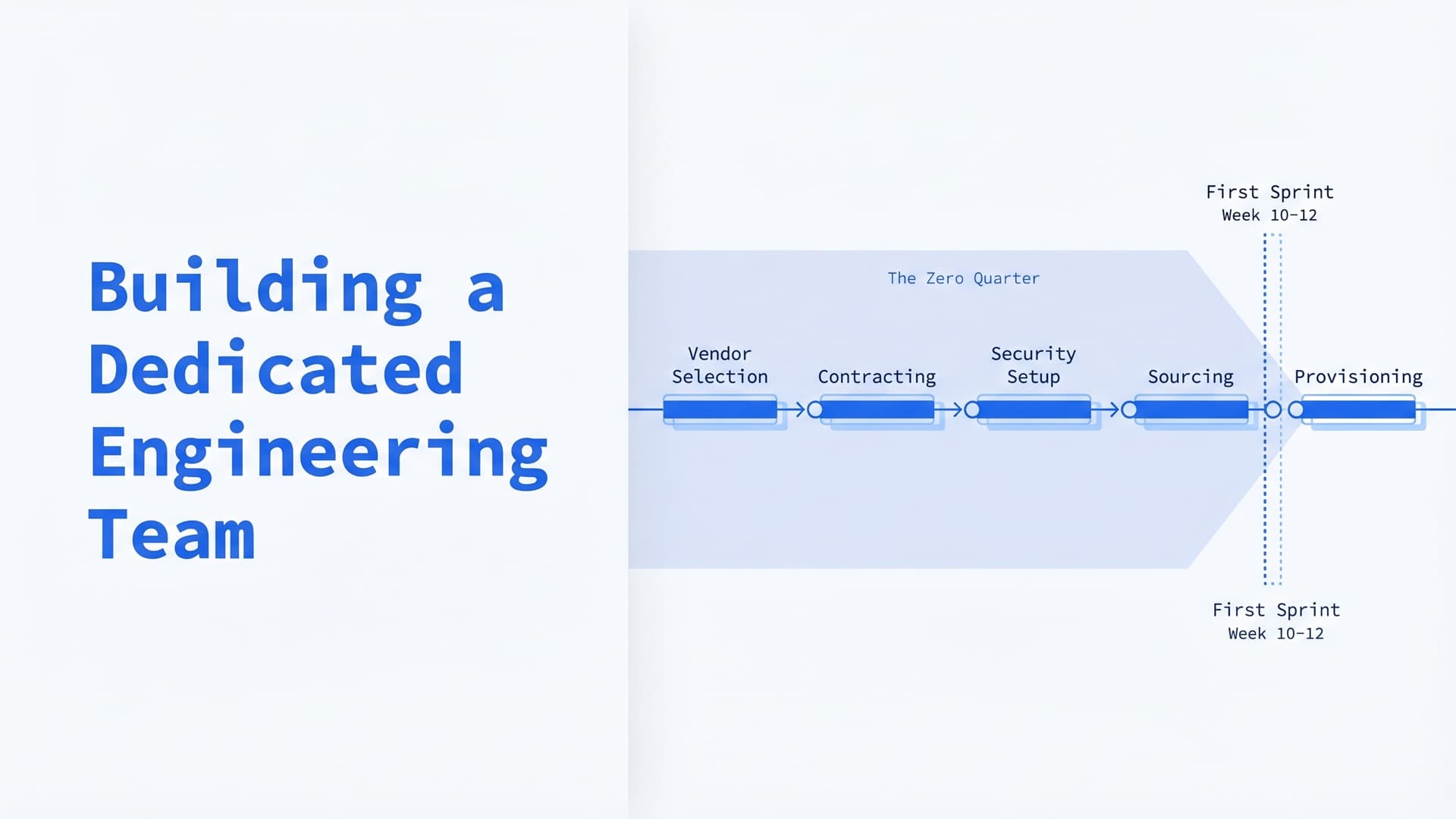
Building a Dedicated Engineering Team from Scratch: Timeline, Cost, and Mistakes
Vendor decks show 2 weeks. The real timeline is 10-16 weeks. Call it The Zero Quarter — everything between decision and first sprint. Cost model, worked example, and the five setup mistakes that compound.
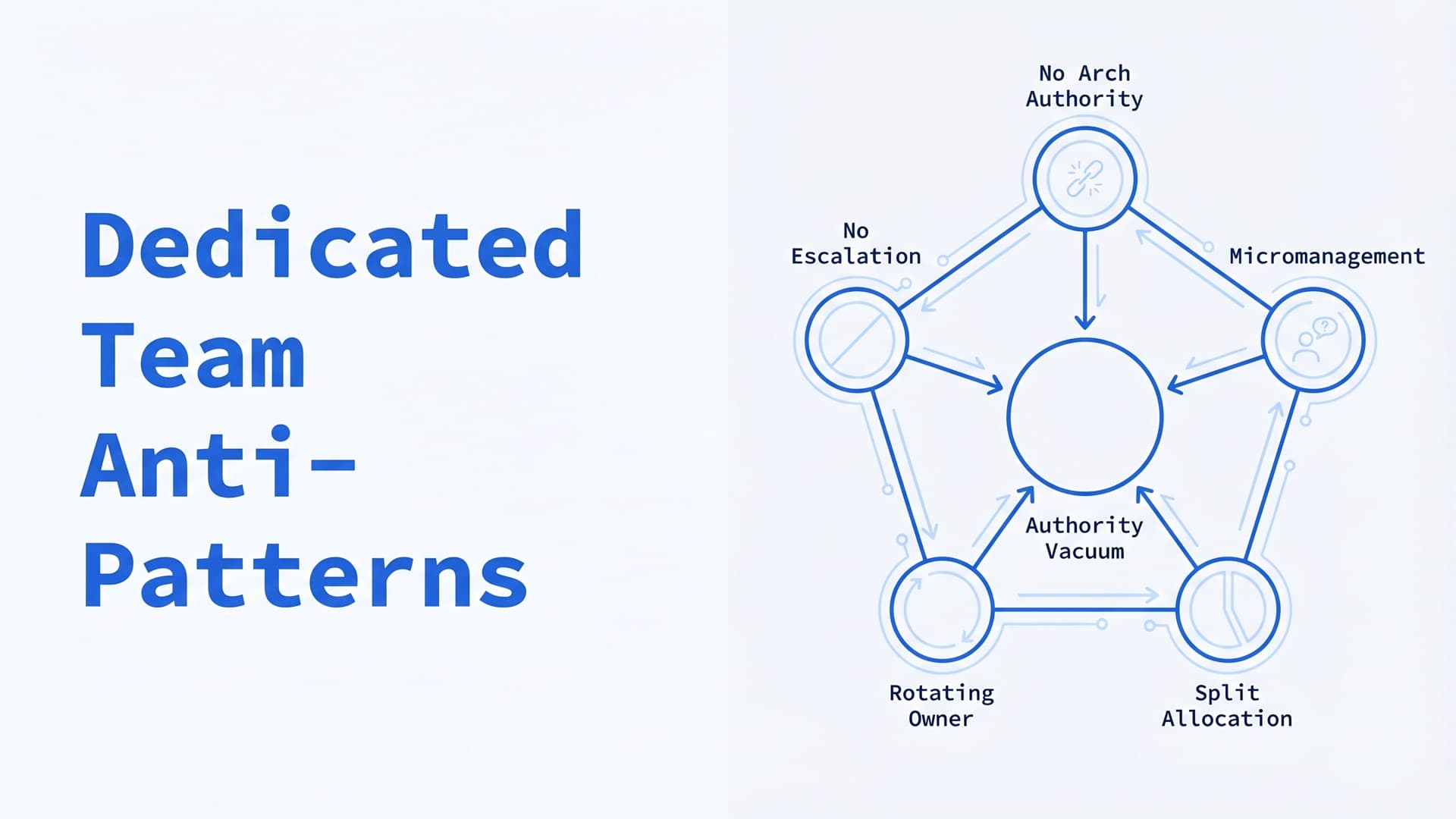
Dedicated Team Anti-Patterns: 5 Governance Failures That Kill Productivity
Five governance failures account for most dedicated team engagement failures — and none of them are about engineer quality. The Authority Vacuum, the five patterns it creates, and how to diagnose which one you have.
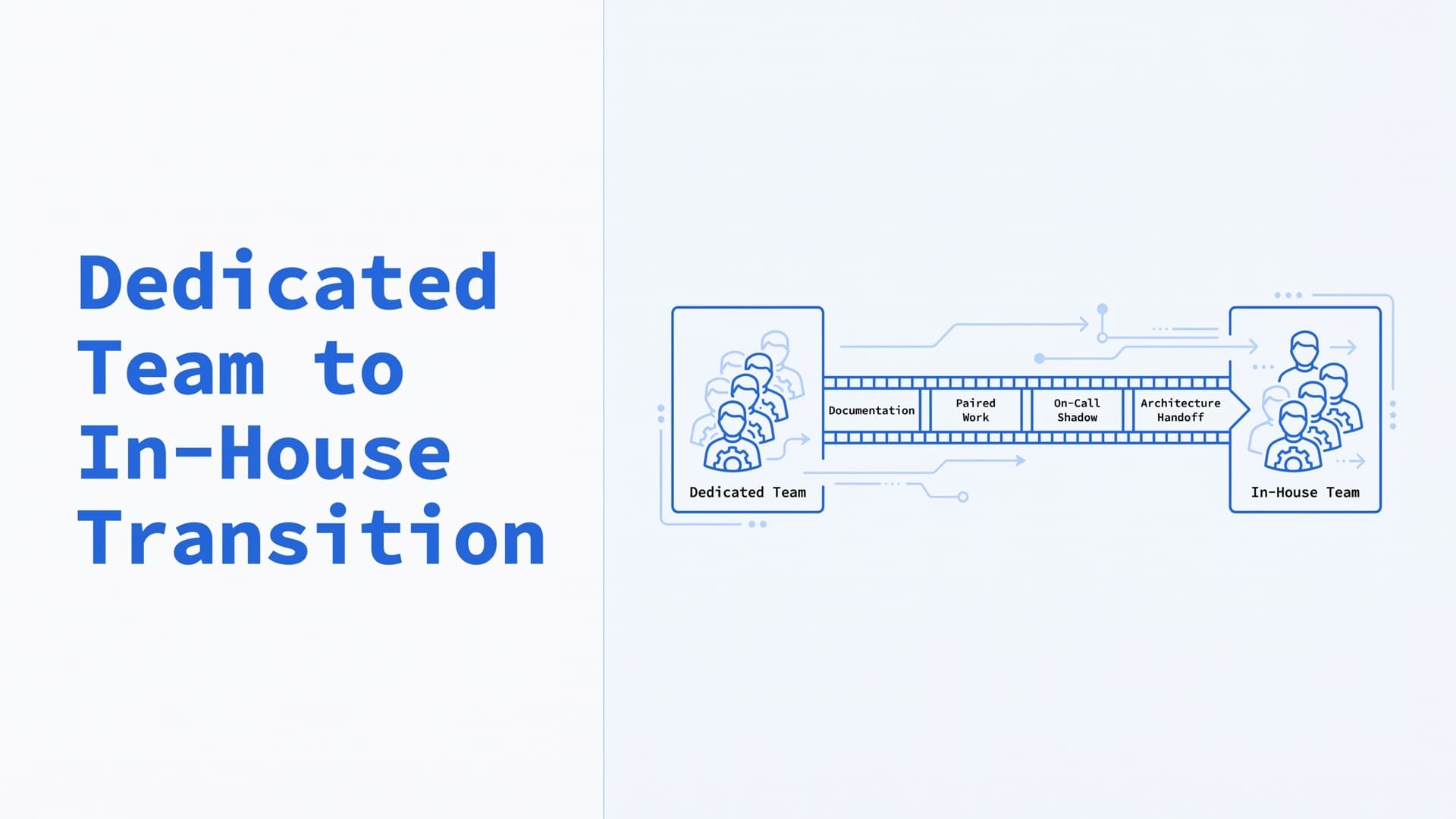
When to Bring a Dedicated Team In-House (And How to Do the Transition)
70% of executives have selectively insourced. The Knowledge Bridge is what separates successful transitions from expensive restarts. Signals, playbook, and the four failure modes that sabotage in-housing.