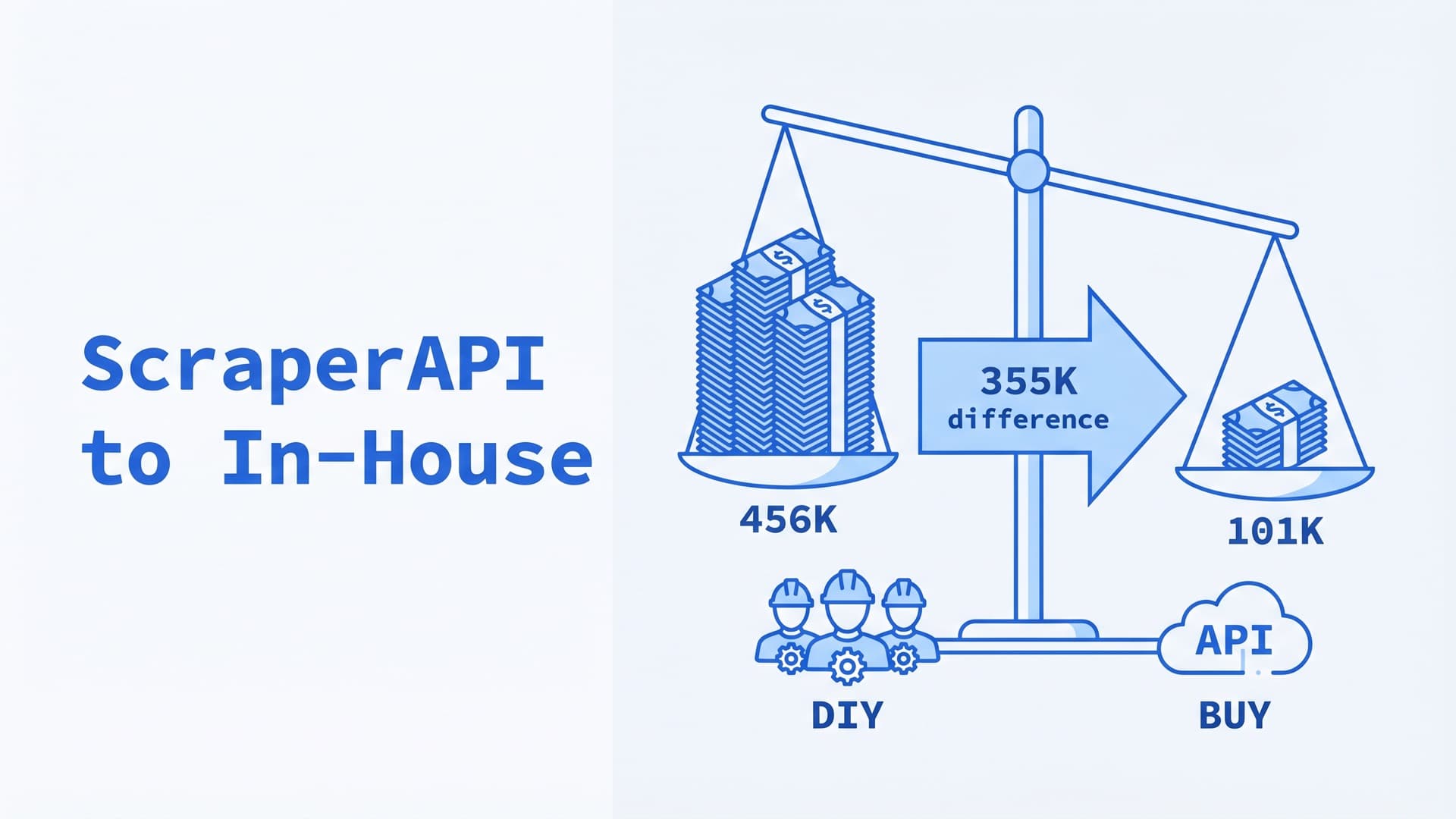
From ScraperAPI to In-House: When to Build Your Own Scraping Service
A startup builds in-house scraping infrastructure instead of paying ScraperAPI. Nine months later, the product roadmap has slipped five months, two senior engineers have spent the quarter debugging Cloudflare challenges instead of shipping features, and the team missed a fundraising round. The scraper works. The company is in trouble.
The case is documented as a cautionary example in SOAX's build-vs-buy analysis, and the pattern generalizes. Teams build because they can. Engineers prefer writing infrastructure to paying for it. Founders prefer CapEx (engineer salaries they control) to OpEx (a vendor bill that grows with volume). Both biases push toward in-house when the math doesn't.
SOAX's numbers for a year-one custom scraping platform: $456,000. That breaks down as 2–3 scraping engineers at $120K–$180K, a DevOps engineer at $130K–$200K, $60K–$180K in cloud compute, $36K–$120K in proxies, $24K–$72K in browser automation licenses, plus monitoring. Managed services at comparable volume: roughly $90K–$200K in total annual cost. Year-one gap: $250K–$350K, plus 9–18 months of roadmap opportunity cost while the team builds instead of ships.
The decision isn't build vs. buy. It's the Unique Data Test: is the data source unique enough — in volume, structure, or extraction logic — to justify three headcount-years of engineering?
The Cost Gap at Each Volume Tier
Volume drives the answer more than any other variable. The build-vs-buy math shifts hard at three tiers.
Under 50K pages/day, managed wins decisively. ScraperAPI's free tier covers 5K requests/month; paid plans start at $49/month for 100K credits. Bright Data Web Scraping API starts at $1.50 per 1,000 records. A scraper pulling 30K e-commerce pages/day from well-known targets (Amazon, Walmart, Shopify stores) runs $300–$1,500/month on ScraperAPI or ScrapFly. Fully-loaded annual cost tops out around $18K — less than a month of a single engineer's salary. Don't build at this volume.
The 50K–500K tier is the middle zone. Managed APIs are still simpler to operate, but the bill starts scaling linearly. At 200K pages/day, Bright Data's volume pricing lands around $5K–$15K/month — $60K–$180K annually. A self-hosted Playwright cluster on Kubernetes (detailed in our K8s scraping cluster post) runs $500–$2,400/month in infrastructure plus 0.25–0.5 FTE ($60K–$120K). Totals land close. Engineering ownership cost is where the in-house option starts bleeding time.
Above 500K pages/day — managed pricing gets punitive. Bright Data at 1M pages/day runs $15K–$50K/month depending on target complexity. That's $180K–$600K annually, eclipsing the salary of one or two dedicated scraping engineers. Self-hosted at this volume runs $6K–$30K/month infrastructure plus 0.5–1 FTE engineer.
The crossover moves with the target. Building becomes economical somewhere between 300K and 800K pages/day — Cloudflare Enterprise targets push it higher, strong Playwright/K8s experience on staff pushes it lower.
The naive version of this decision: "we'll save money at scale." The accurate version has three conditions. Already at scale. Scraping targets managed providers charge the highest multipliers for. K8s experience on staff. Miss any one and the build is more expensive than it looks.
What Managed APIs Actually Cost
Vendor pricing pages describe a cost structure that doesn't survive contact with real scraping requirements. The trap: credit-based pricing with multipliers. ZenRows charges 25 credits per request when JavaScript rendering plus premium proxies are required — and for Cloudflare-protected targets, both are required. A plan advertised at 1,000,000 requests/month becomes 40,000 real requests when those multipliers apply.
Three costs that don't show up on the pricing page:
Multiplier inflation. ZenRows premium + JS rendering at 25 credits per request, Bright Data residential proxy surcharges, ScrapFly's asp=true cost cliff for anti-bot protection. Headline $49/month plans cover simple sites; real production workloads on Cloudflare Business and above burn credits 5–75x faster than the naive math suggests. Tendem.ai's pricing comparison documents this pattern across seven major vendors.
Failed request billing. Most managed APIs bill successful requests only but define "successful" as HTTP 2xx/3xx. A Cloudflare challenge page that returns 200 OK with a challenge body counts as successful — you paid for a page with no data. Bright Data's Web Unblocker is one of the few that bills only on true content delivery.
Bandwidth overage. Residential proxy services sold per-GB (SOAX, Bright Data residential) charge for response bandwidth, not request count. A single JavaScript-heavy SPA can pull 5 MB of content per request. At $8–$15/GB and 100K pages/day, that's $1,200–$4,500/month in bandwidth alone, not counting the proxy service fees.
Actual monthly cost at realistic volumes, pricing published as of April 2026:
| Volume | ScraperAPI | Bright Data Web Unblocker | ScrapFly | Self-hosted (K8s + proxies) | |--------|-----------|---------------------------|----------|-----------------------------| | 100K/month | $49 | $100–$300 | $49–$149 | $600–$1,200 | | 1M/month | $149–$299 | $500–$1,500 | $149–$499 | $1,500–$3,000 | | 10M/month | $999+ | $3,000–$10,000 | $999–$3,000 | $3,000–$8,000 | | 100M/month | Custom | $15,000–$50,000 | Custom | $10,000–$25,000 + 0.5 FTE |
Self-hosted numbers assume Hetzner or equivalent commodity cloud. AWS/GCP runs 2–3x higher; the K8s cluster architecture from our resource management post describes the pattern.
The Unique Data Test
"Can we build this?" is the wrong question. "Is this worth building?" is better. The test breaks down into three conditions you need to pass.
Target set justifies custom handling. Scraping publicly indexed e-commerce products from top-100 retailers doesn't justify a custom build — Bright Data and ScraperAPI already invested in detection evasion for those targets, and you inherit their investment by paying them. Custom builds win for proprietary data sources (specific industry portals, regulatory sites, niche forums), targets where managed providers don't maintain coverage, or sites where you need custom extraction logic that API services don't expose.
Volume exceeds the crossover. Below 300K pages/day, managed almost always wins on total cost including engineering ownership. Above 500K, building starts earning back the investment — but only if the team ships in under 6 months. That's the condition most teams miss.
Internal capability exists. Building a scraping cluster without senior Playwright and K8s experience in-house is the fastest way to recreate this post's opening case. Hiring is an option, but the timeline (3–6 months for a senior scraping specialist in 2026 markets) is part of the build cost. Training existing engineers into the role compounds the opportunity cost — you lose them from product work twice: once to learn, once to maintain.
Miss any one of the three, and the managed API is cheaper even when the per-page rate looks higher. The hidden cost of building is the engineering time not spent on the product that actually makes money.
The Hybrid Path That Usually Wins
Most production pipelines live between pure-build and pure-buy. The architecture that holds up at every scale: own the extraction and pipeline layers, delegate the browser and proxy infrastructure.
Architecture:
-
Browser + proxy layer (managed). Bright Data Scraping Browser, Browserless, or a similar managed CDP-compatible browser. The team writes Playwright scripts that connect to a remote WebSocket instead of spawning local Chromium. The managed service handles anti-bot evasion, CAPTCHA solving, and proxy rotation. Effectively rented infrastructure.
-
Extraction + validation layer (custom). The Pydantic schemas, the per-target extraction rules, the structured data parsing (covered in our extraction post), and the anomaly detection. This is the team's IP.
-
Orchestration + monitoring layer (custom). Queue management (BullMQ, Celery, SQS), retry logic, dead-letter queues, output validation, per-target health metrics. Not fungible with vendor features — every team's orchestration reflects their specific reliability requirements.
-
Storage + analytics layer (custom). Staging database, pipeline warehouse, downstream consumers. Completely owned.
This architecture defers the fully-loaded build cost by 12–24 months. The team doesn't have to hire scraping specialists — their existing backend engineers can handle extraction logic. The K8s cluster for browsers is outsourced; the K8s cluster for their own services stays small. When volume justifies it (typically above 500K pages/day on a stable target set), migrate the browser layer in-house — the extraction and monitoring code stays the same.
The reverse migration, from pure-custom to hybrid, is just as valid. A team that built their own scraper in 2023 before Stagehand and patchright existed is often running infrastructure that duplicates what managed providers now do better. Moving the browser/proxy layer to Bright Data Scraping Browser frees engineers from maintaining their own Playwright cluster. Keep the extraction logic they've already tuned.
What the Case Studies Don't Tell You
SOAX's $456K year-one estimate assumes you can hire and retain the engineers at the salaries listed. In 2026 markets, senior scraping engineers with Playwright + K8s + anti-bot experience aren't easy to find. A team budgeting $180K for a senior scraping engineer will often land at $220K–$260K fully loaded, or wait 6 months for the right hire. Both failure modes push the custom build further out of the money.
The other thing case studies miss: switching costs. A scraper on ScraperAPI is a small amount of code. A scraper on custom K8s infrastructure is a commitment to operating that infrastructure for years. Migrating back to managed, after your team has built opinions and process around the custom stack, is harder than migrating forward.
Need help with build-vs-buy? Talk to an engineer — we architect scraping stacks that use managed infrastructure where it wins and custom extraction where it matters.
What This Framework Cannot Tell You
Whether your target set will still be accessible via managed APIs in 12 months. Bright Data, Oxylabs, and ScrapFly all maintain coverage of the top-scraped sites, but when a large target like LinkedIn or Cloudflare Enterprise gets aggressive enough, some managed providers drop support to avoid legal exposure. Teams that depend on managed APIs for single-source access are exposed to the vendor's coverage decisions.
The reverse is also true. A target your team can scrape today with custom code and a patched Playwright may require residential proxies and vendor-level evasion next quarter. Managed providers absorb that maintenance; custom builds inherit it.
The right decision for most teams isn't build or buy. It's build the thin layer you actually need and rent the rest.
Frequently Asked Questions
When should I switch from ScraperAPI to building my own scraper?
Switch when three conditions are true: your target set includes sources managed APIs don't cover (proprietary portals, niche forums, specific industry sites), your volume exceeds roughly 300K pages/day on stable targets, and your team has senior Playwright and Kubernetes experience. Below any of those thresholds, managed APIs like ScraperAPI, ScrapFly, or Bright Data cost less than the fully-loaded engineering time required to build.
How much does it cost to build an in-house web scraping infrastructure?
Year-one cost runs roughly $456,000 per SOAX's build-vs-buy analysis — 2–3 scraping engineers plus DevOps, cloud compute, proxies, and browser automation licenses. Ongoing maintenance runs $15K–$30K/month after year one. Against managed services at $90K–$200K/year for comparable volume, the gap is $250K–$350K in year one alone, not counting 9–18 months of product roadmap opportunity cost.
Why are managed scraping APIs more expensive than advertised?
Credit-based pricing inflates real cost. Most managed APIs charge credit multipliers for JavaScript rendering (5x) plus premium proxies (5x), so Cloudflare-protected targets burn credits 25x faster than simple HTTP requests. Headline plans at $49/month rarely survive contact with production requirements. Bandwidth overage on residential proxies adds $1,200–$4,500/month at 100K pages/day.
What's the hybrid approach for scraping infrastructure?
Own the extraction, validation, orchestration, and storage layers; delegate browser and proxy infrastructure to managed services like Bright Data Scraping Browser or Browserless. The team writes Playwright scripts connecting to a remote CDP WebSocket. This architecture avoids hiring dedicated scraping specialists while keeping extraction logic and data pipeline as internal IP. Defers full build cost by 12–24 months.
At what scraping volume does building in-house become cheaper than managed services?
The crossover is typically 300K–500K pages/day on stable target sets, assuming the team has senior Playwright and Kubernetes experience in-house. Below 300K, managed wins on total cost. Between 300K and 500K, the totals are close and engineering ownership cost tips the decision. Above 500K with stable targets, custom builds begin saving money — but only if shipped in under 6 months.
Related posts
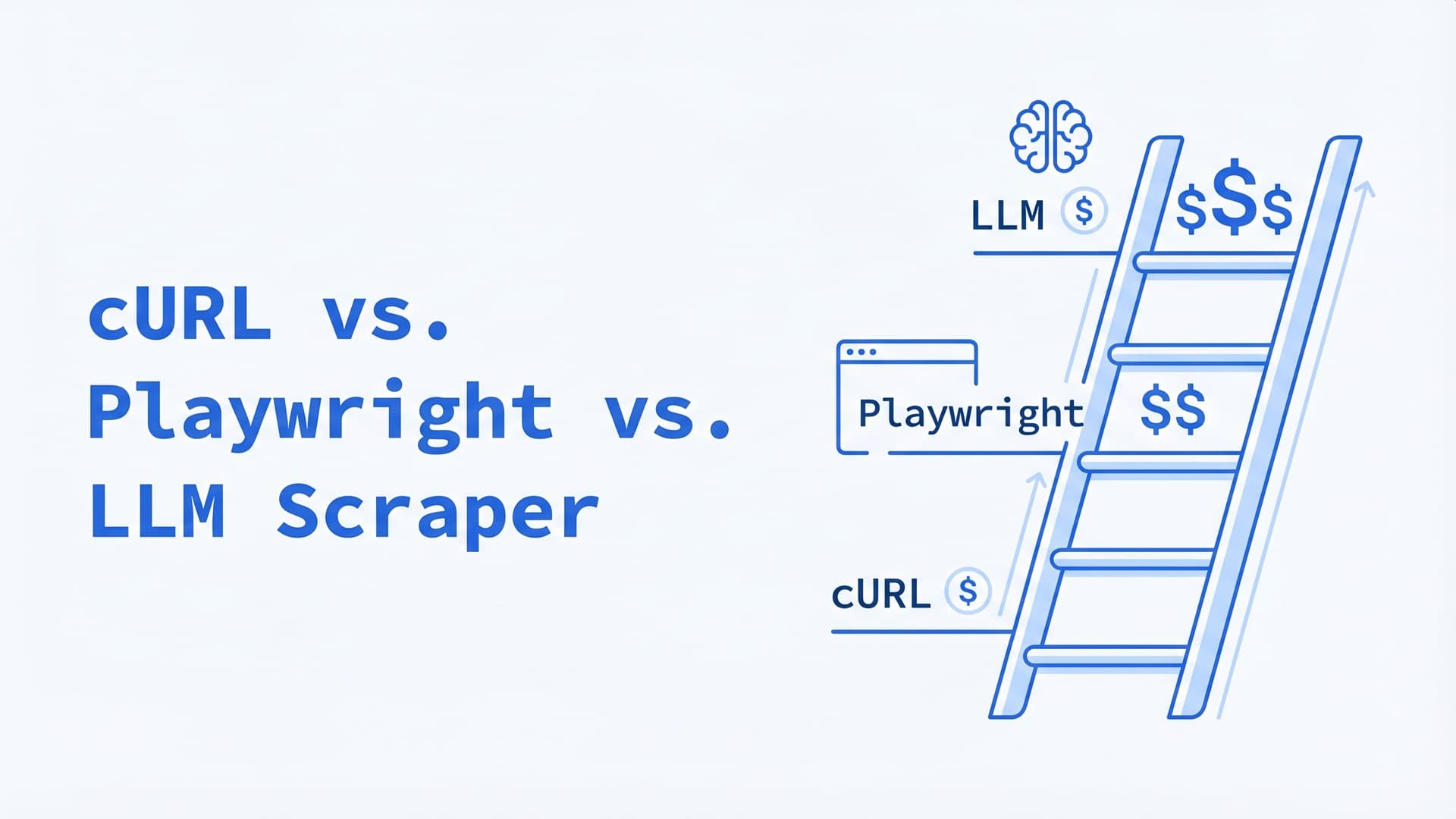
cURL vs. Playwright vs. LLM Scraper: A Decision Tree for 2026
Same scraping job costs $5, $150, or $6,000/month depending on the tool you pick. A 4-step decision tree for choosing between HTTP clients, headless browsers, and LLM-native scrapers in production.
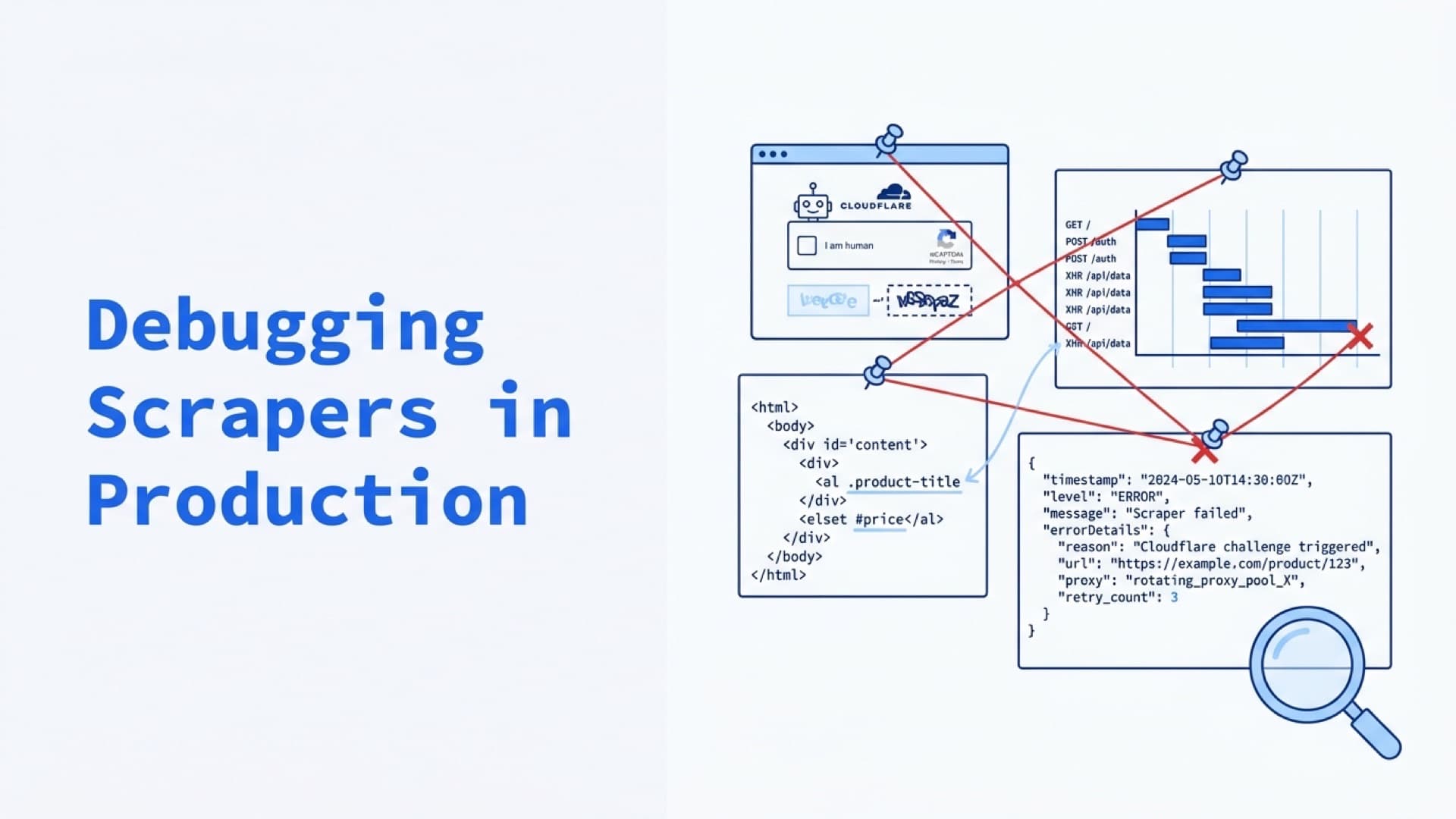
Debugging Scrapers in Production: Logs, Screenshots, Video Replay, and Failure Forensics
Status codes aren't evidence. Screenshots, DOM snapshots, Playwright traces, and structured logs are. The Evidence Bundle pattern for turning scraper failures from hours of investigation into dashboard queries.
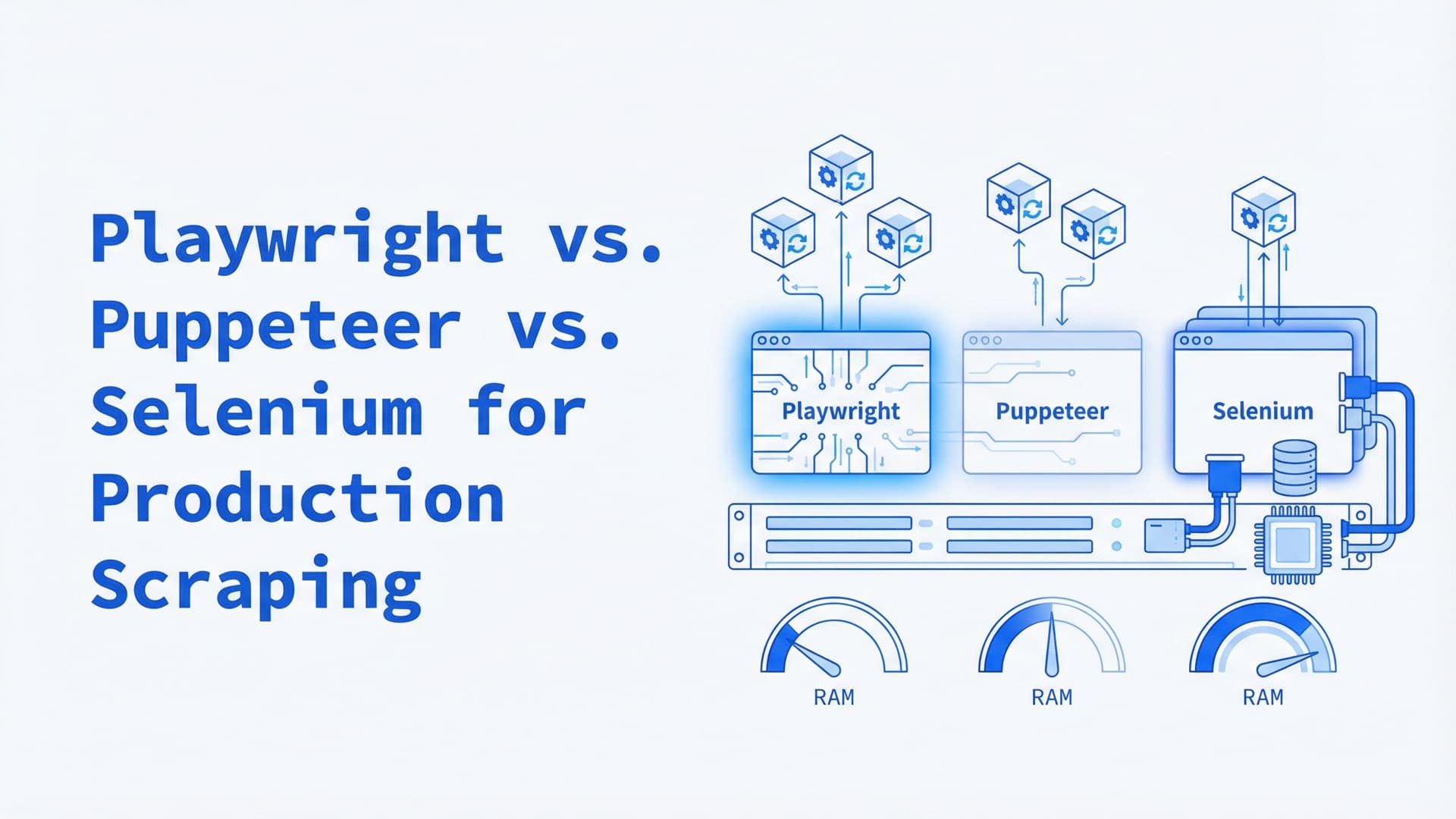
Playwright vs. Puppeteer vs. Selenium for Production Scraping: A 2026 Comparison
Most headless browser comparisons test on localhost. Production scraping at 100+ concurrent sessions reveals different winners — here's the data on memory, detection, and Kubernetes deployment.